5 Letter Words
Pick a letter, or put letters in the five boxes to fix their position. Common five-letter words come first.
Letter in a fixed position Put a letter in a box to fix its position (2nd letter, middle letter …). Leave the others empty.
4,290 five-letter words — 2,042 common
Showing the 150 most common of 4,290. Use the letters, the length and the boxes above to narrow the list, or turn on JavaScript to see every word.
Tap a word to see what it means. Word list: about 52,000 English words found in Wikipedia; common words are the ones seen most often. Meanings: WordNet 3.0 (Princeton University).
Popular 5-letter word searches
Contains ae ai al an ao ar are as ate au ave de ea ear ed ei ell en er es et ia ide ie ill in ine ing io iou la le lls oa oe oi on or os ove ra re rea res ri rit ro se st te ter ver
Starts with am ba bo ca ch co de ha lo ma mo pa re sh sp st ta th tr un
Ends with al ch de ds ed er es et ie ks le ls ly ns ps re se te ts us
Word List
Made with Crossword Print · crosswordprint.com/5-letter-words/
5 Letter Words is a free list of 4,290 five-letter English words that runs in your browser with no sign-up, so you can find 5 letter words by letter, position or vowels. You can choose a first letter, fix any position such as the second or middle letter, add letters you have, filter by vowels, and see the meaning of any word in the list. Common words appear first, and rarer words are shown in grey. Nothing you type is sent anywhere. Use it as a 5 letter word helper or searcher: finding five letter words containing the letters you have, a 5 letter word that begins with A, or words with a pair such as AE or EAR together.
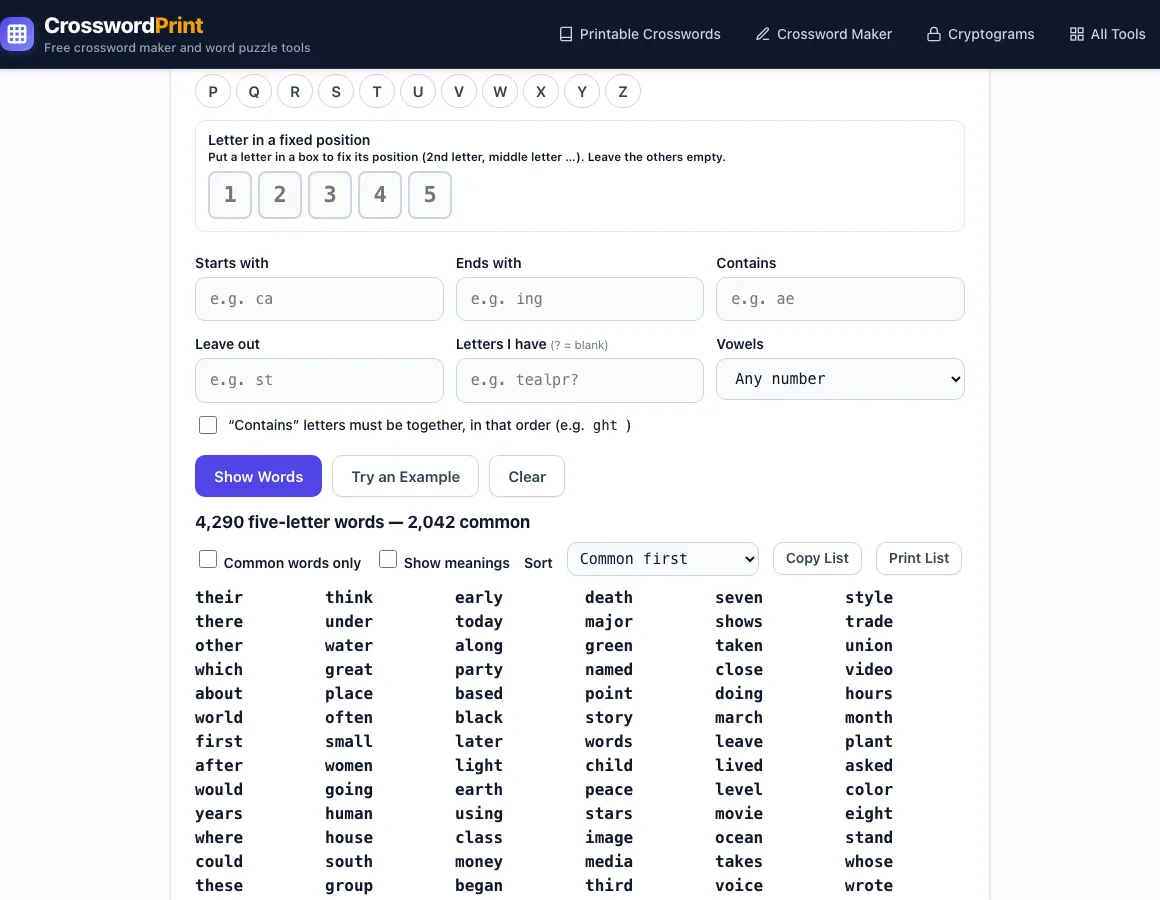
How to use the 5 letter word finder
- Click an A–Z chip to set the first letter, or leave the All chip selected to see every five-letter word.
- Type a letter into any of the 5 position boxes to fix that spot, such as the 2nd letter or the middle letter. Leave a box empty to allow any letter.
- Fill in Starts with, Ends with or Contains for letter patterns. Use Leave out for letters the word must not have.
- Enter the tiles you hold in Letters I have. Use ? for a blank tile.
- Open the vowels select and choose an option, such as None (Y allowed) or Exactly 2.
- Pick a sort order, such as Most vowels first, and tick Common words only if you want only everyday words.
- Click Show Words. The count appears first, then 300 words. Use Show more or Show all for the rest.
- Click any word to see its meaning, or tick Show meanings to show a definition under every word.
Try an Example loads a sample search, and Clear resets the form. Copy List copies the results one word per line. Print List makes a clean printable sheet of up to 1,500 words. The search is saved in the address bar, so a bookmarked or shared link opens the same list. Printed lists are free for commercial use too, for example in KDP books or Etsy printables.
How many 5 letter words are there in this list?
This list contains 4,290 five-letter words. The list is built from a public-domain word list filtered to words seen in Wikipedia, so very rare words may be missing and it is not a complete dictionary.
The counts are uneven. For example, 258 words start with A, 580 end in E, 336 end in Y, and 176 end in ER.
What are 5 letter words with no vowels?
Choose None (Y allowed) in the vowels select. This returns five-letter words with no A, E, I, O or U, and Y is still allowed. There are 19 of them, including psych, myths, lynch, crypt, flyby and lymph.
These are the 5 letter words without a vowel, or with no vowels except Y. Y counts as a vowel only some of the time in English, which is why these words can exist.
What are 5 letter words with the most vowels?
Choose 4 or more in the vowels select, or sort by Most vowels first to put 5 letter words with a lot of vowels at the top. The words with four or more vowels are audio, eerie, queue and adieu. The list also has a few rare ones, such as heiau, ousia and uraei.
No five-letter word is made only of vowels. The All letters are vowels option therefore returns no words.
How do I find a 5 letter word with a letter in a given position?
Type the letter into the box for that position. Put A in the second box to find words with A as the second letter, which gives 730 results. Put O in the third box to find words with O in the middle, which gives 338 results. E as the 4th letter gives 804.
You can combine boxes. A pattern with R in the second box and N in the fourth box gives 43 words, such as front, bring, wrong and grand. To find words ending in E, use Ends with, which gives 580 results. To find words beginning with QU or RE, use Starts with, which gives 27 and 57 results.
Five letter words with meaning: how do I see what a 5 letter word means?
Most of the words in the list have meanings. Tap a word to see its part of speech and up to two short definitions from WordNet 3.0. Tick Show meanings to print a short definition under every word on the page and on the printed sheet.
Some short function words have no definition on file.
What are the best 5 letter words to start Wordle?
This list does not give daily Wordle answers, and the page is not designed for them. Our Wordle Solver covers how to narrow down candidates from your results.
As a general idea, a good opening guess uses common letters such as E, A, R, S and T, so it tests several likely letters at once.
Can I print a list of 5 letter words?
Yes. Set your filters, click Show Words, then click Print List. The printable sheet has a title that reflects your filters, such as “5-Letter Words Starting with C, Ending in E”. It holds up to 1,500 words, and it includes definitions if you have ticked Show meanings.
Frequently asked questions
Is the 5-letter word finder free?
Yes. It is free, runs in your browser, and needs no sign-up.
Is what I type sent anywhere?
No. Nothing you type is sent anywhere.
What does “common” mean on this page?
A common word appears in our frequency data from everyday English text, which includes Tatoeba sentences and Simple English Wikipedia. Tick Common words only to hide all the other words.
Where are the hard, unique or cool 5 letter words?
The rare words are the hard and unique ones. They are shown in grey after the common words; untick Common words only and sort A–Z to browse them. Whether a word is fun or cool is up to you, but rare words make good spelling challenges.
Do the letters in Contains need to be in order?
Not unless you want them to be. Tick the checkbox beside Contains to keep the letters together in the order you typed them.
How many words can I see at once?
Results show 300 words at a time. Click Show more for the next batch or Show all to see the full list.
Can I share or bookmark my search?
Yes. The search is saved in the address bar, for example as ?start=qu&len=5, so a bookmarked or shared link opens the same list.
Can I use the printed word lists for commercial purposes, such as Amazon KDP or Etsy?
Yes. Word lists you make here are free to use for any purpose, including classroom packs, KDP puzzle and activity books, Etsy printables and print-on-demand products, royalty-free and with no attribution needed. The only limit is that you may not copy the tool itself to run a competing service.
Related tools
- Word Finder: Use it to search for words by pattern when your word is not five letters long.
- 6 Letter Words: Use it when you need six-letter words with the same kinds of filters.
- 7 Letter Words: Use it when you are looking for seven-letter words.
- Words That Start With: Use it when you know the opening letters but not the length.
- Words Ending In: Use it when you know how the word finishes.
- Wordle Solver: Use it to narrow down possible answers while you play Wordle.
- Crossword Solver: Use it when a crossword clue has a fixed number of letters.
- Word Unscrambler: Use it when you have a set of letters and need to rearrange them into a word.
- Words With Friends Cheat: Use it to find playable words from the letters on your rack.
About letter frequency in English
Letter frequency is the number of times letters of the alphabet appear on average in written language. Letter frequency analysis dates back to the Arab mathematician Al-Kindi (c. AD 801–873), who formally developed the method to break ciphers. Letter frequency analysis gained importance in Europe with the development of movable type in AD 1450, wherein one must estimate the amount of type required for each letterform. Linguists use letter frequency analysis as a rudimentary technique for language identification, where it is particularly effective as an indication of whether an unknown writing system is alphabetic, syllabic, or logographic.
The use of letter frequencies and frequency analysis plays a fundamental role in cryptograms and several word puzzle games, including hangman, Scrabble, Wordle and the television game show Wheel of Fortune. One of the earliest descriptions in classical literature of applying the knowledge of English letter frequency to solving a cryptogram is found in Edgar Allan Poe's famous story "The Gold-Bug", where the method is successfully applied to decipher a message giving the location of a treasure hidden by Captain Kidd.
Herbert S. Zim, in his classic introductory cryptography text Codes and Secret Writing, gives the English letter frequency sequence as "ETAON RISHD LFCMU GYPWB VKJXZQ", the most common letter pairs as "TH HE AN RE ER IN ON AT ND ST ES EN OF TE ED OR TI HI AS TO", and the most common doubled letters as "LL EE SS OO TT FF RR NN PP CC". Different ways of counting can produce somewhat different orders.
Letter frequencies also have a strong effect on the design of some keyboard layouts. The most frequent letters are placed on the home row of the Blickensderfer typewriter, the Dvorak keyboard layout, Colemak and other layouts optimized for common English typing, while the commonly used QWERTY layout was instead optimized for transcribing telegraphs.
Background
The frequency of letters in text has been studied for use in cryptanalysis, and frequency analysis in particular, dating back to the Arab mathematician al-Kindi (c. AD 801–873 ), who formally developed the method (the ciphers breakable by this technique go back at least to the Caesar cipher used by Julius Caesar, so this method could have been explored in classical times). Letter frequency analysis gained additional importance in Europe with the development of movable type in AD 1450, wherein one must estimate the amount of type required for each letterform, as evidenced by the variations in letter compartment size in typographer's type cases.
No exact letter frequency distribution underlies a given language, since all writers write slightly differently. However, most languages have a characteristic distribution which is strongly apparent in longer texts. Even language changes as extreme as from Old English to modern English (regarded as mutually unintelligible) show strong trends in related letter frequencies: over a small sample of Biblical passages, from most frequent to least frequent, of Old English compares to of modern English, with the most extreme differences concerning letterforms not shared.
Linotype machines for the English language assumed the letter order, from most to least common, to be based on the experience and custom of manual compositors. The equivalent for the French language was.
Arranging the alphabet in Morse into groups of letters that require equal amounts of time to transmit, and then sorting these groups in increasing order, yields. Letter frequency was used by other telegraph systems, such as the Murray Code.
Similar ideas are used in modern data-compression techniques such as Huffman coding.
Text adapted from the Wikipedia article “Letter frequency” (revision 1357626460, 2026-06-03), authors, licensed under CC BY-SA 4.0. Shortened: some sections and paragraphs were left out, and reference markers, images and templates were removed; wording is otherwise unchanged. This text remains available under the same licence.