Words Ending In E or Any Letter, 5 Letters or Any Length
Choose an ending letter or type the last letters of the word, then pick a length. Common words come first.
580 five-letter words end in E — 292 common
Showing the 150 most common of 580. Use the letters, the length and the boxes above to narrow the list, or turn on JavaScript to see every word.
Tap a word to see what it means. Word list: about 52,000 English words found in Wikipedia; common words are the ones seen most often. Meanings: WordNet 3.0 (Princeton University).
Popular word endings
B b
C c ic nic onic ric tic atic etic stic
D d ad ed ced ded nded ged hed ched shed ied fied ked cked led lled med ned ened ined oned ped pped red ered ured sed ised ssed ted ated cted ited nted sted zed ized id nd and rd ard
E e ce nce ance ence de ide ude ee ge age ie le ble able ible ile me ne ine line one re are ure ture se ise ose te ate cate iate late nate rate tate ite que ve ave ive sive tive ze ize
F f
G g ng ing cing ding ging hing king ling ming ning ping ring sing ting ving wing ying zing
J j
L l al cal ical ial rial nal onal ral tal el ll ell ill ful
M m am em om dom rm orm form sm ism lism um ium
N n an ian man en men in on ion sion tion son
Q q
R r ar lar ular er der nder her ier ker ler ner per ter ster ver air or tor ator
S s as cs ics tics ds nds ards es ces nces des ges ages hes ches shes ies ries ties les nes ines res ures ses sses uses tes ates ves ives gs ngs ings is sis ks cks ls als ms ns ans ins ons ions ps rs ers ders hers kers lers ners pers ters ors tors ss ess less ness ts cts ets nts ants ents sts ists us ous eous ious nous rous
T t at et ght ight it nt ant ent ment ot st est ist gist list nist
U u
V v
Y y ay cy gy ogy logy ology ly bly ably ely vely ngly lly ally sly usly tly ntly oy ry ary nary ery ory tory ty ity lity rity
Z z
Word List
Made with Crossword Print · crosswordprint.com/words-ending-in/
Words Ending In is a free tool that finds English words by the letters they finish with, from a 5 letter word ending in E to long words ending in -able or -ology. Type an ending such as er, ing or able, or pick a letter from the A–Z chips, and the tool lists matching words. It runs in your browser with no sign-up, and nothing you type is sent anywhere.
The word list holds about 54,000 English words. Common words appear first, and rarer words are shown in grey, so the most useful matches are easy to spot. Tap any word for a short meaning, and copy or print the list when you are done.
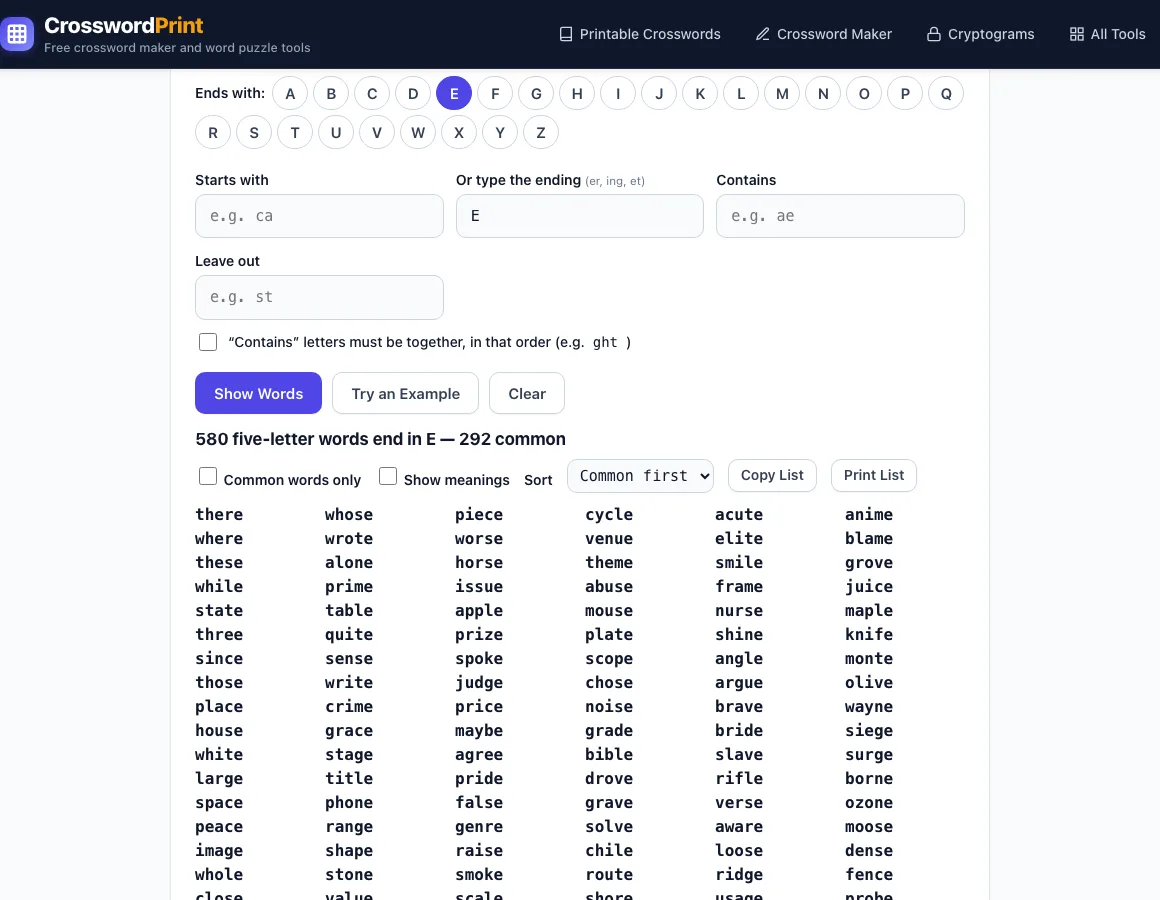
How to use the Words Ending In tool
- Open the tool. The default view shows 5-letter words ending in E.
- Pick a letter from the A–Z chips, or type the ending in the box marked “Or type the ending,” such as er, ing or able.
- Choose a length chip: Any, Short (4 letters or fewer), 2, 3, 4, 5, 6, 7, 8, or Long (9 or more).
- Optional: in the Contains box, enter letters the word must have. Tick the checkbox to keep them together in that order. In the Leave out box, enter letters the word must not have.
- Optional: tick “Common words only” to hide the rarer words.
- Choose a sort order: Common first, or A–Z.
- Click Show Words. The count line appears above the first 300 results. Use Show more or Show all to see the rest.
- Tap any word to see its part of speech and short definitions. To see a definition under every word, tick “Show meanings.”
Try an Example shows a sample search, and Clear resets the controls. Copy List gives you one word per line. Print List makes a clean sheet of up to 1,500 words, and it can include definitions if “Show meanings” is ticked. The search is saved in the address bar (for example, ?end=er&len=5), so a bookmarked or shared link opens the same list. The Popular endings table below the tool links to common endings. Printed lists are free for commercial use too, for example in KDP books or Etsy printables.
How do I find 5 letter words ending in e, er, or y?
Set the length chip to 5 and enter the ending in the box, or click E on the A–Z chips. A word ending in “er” does not end in “e,” so the three lists do not overlap.
In the list, 580 five-letter words end in E, and 292 of them are common. There are 176 five-letter words that end in ER, and 87 of those are common, such as other, after, never, under and water. There are 336 five-letter words that end in Y.
What is a suffix, and how is it different from the last letters?
A suffix is a meaningful ending added to the end of a root word, such as -ness in kindness or -able in readable. The last letters of a word are just letters. The tool matches letters only, so it does not know which endings are suffixes.
This matters for results. Typing “ing” also returns king, thing and sing, even though those words do not contain the -ing suffix. To find words built with a suffix, look through the results and check the meaning of each word.
How do I search for words ending in -able, -ible, -ance, -ence, -ion, or -ology?
Type the suffix in the ending box, or click the matching link in the Popular endings table. The table includes able, ance, ence, ible, ion, tion and ology.
Many words ending in -able and -ible describe something that can be done or that has a certain quality. Words ending in -ology are names of fields of study, such as biology and geology. Words ending in -ion and -tion are often nouns made from verbs. Use the Common words only checkbox to keep the list manageable.
How many words end in ing in this list?
Across all lengths, 4,003 words end in ING, and 1,324 of them are common. The full list holds about 54,000 words, so these are a small share of the total.
Many of these matches are verbs in the -ing form, such as running. Others are nouns or unrelated words, such as king. Use a length chip or the Contains box to narrow the list. For example, set the length to 6 to see only six-letter words ending in ing. For four letter words ending in A, pick 4 and A: there are 81, such as area, data and idea.
How can I combine an ending with other letters?
Use the Contains and Leave out boxes together with the ending. Contains requires letters in the word, and Leave out removes words that have the letters you list. If you tick the checkbox next to Contains, the letters must appear together and in the order you typed them. Both boxes accept up to 12 letters for Contains and up to 26 for Leave out.
Frequently asked questions
What is the difference between words ending in e and words ending in er?
Words ending in E finish with the single letter E, such as stare. Words ending in ER finish with the two letters E and R, such as water. A word cannot end in both, so the two searches return different lists.
Why does the ing search return words like king?
The tool matches letters, not word parts. King ends in the same three letters as ing, so it appears in the results. Check each word’s meaning to see whether it has the -ing suffix.
Can I search for words ending in tion or tch?
Yes. Type tion or tch in the “Or type the ending” box and click Show Words. The Popular endings table also has links for tch, tion and ion.
Are the results sorted alphabetically?
Not by default. The default sort is Common first, which puts common words at the top. Choose A–Z in the Sort control to sort alphabetically.
Do I need an account to save a search?
No account is needed. The search is saved in the address bar, so you can bookmark the page or share the link to open the same list.
Can I print or copy the results?
Yes. Copy List gives you one word per line. Print List makes a clean printable sheet of up to 1,500 words, and it can include short definitions if “Show meanings” is ticked.
Does the tool show definitions for every word?
Most words have a definition from WordNet 3.0. Some short function words have no definition on file, so the tool may not show one for them.
Can I use the printed word lists for commercial purposes, such as Amazon KDP or Etsy?
Yes. Word lists you make here are free to use for any purpose, including classroom packs, KDP puzzle and activity books, Etsy printables and print-on-demand products, royalty-free and with no attribution needed. The only limit is that you may not copy the tool itself to run a competing service.
Related tools
- Words With X: Use it when the letters can be anywhere in the word.
- Word Finder: Use it to search by letters, length and patterns when you have partial letters.
- 5 Letter Words: Use it to browse five-letter words when the length is the main constraint.
- 6 Letter Words: Use it to browse six-letter words for longer puzzles or word lists.
- 7 Letter Words: Use it to find seven-letter words for longer puzzles.
- Words That Start With: Use it when you know the opening letters rather than the ending.
- Wordle Solver: Use it to narrow down possible answers based on the letters you have found.
- Crossword Solver: Use it to fill a crossword gap when you know the length and some letters.
- Word Unscrambler: Use it when you have a set of letters and need to rearrange them into a word.
- Words With Friends Cheat: Use it to find playable words for a Words With Friends game.
About suffixes and word endings
In linguistics, a suffix is an affix which is placed after the stem and the prefix of a word. Common examples are case endings, which indicate the grammatical case of nouns and adjectives, and verb endings, which form the conjugation of verbs.
Suffixes can carry grammatical information (inflectional endings) or lexical information (derivational/lexical suffixes). Inflection changes the grammatical properties of a word within its syntactic category. Derivational suffixes fall into two categories: class-changing derivation and class-maintaining derivation.
Particularly in the study of Semitic languages, suffixes are called affirmatives, as they can alter the form of the words. In Indo-European studies, a distinction is made between suffixes and endings (see Proto-Indo-European root).
A word-final segment that is somewhere between a free morpheme and a bound morpheme is known as a suffixoid or a semi-suffix (e.g., English -like or German -freundlich "friendly").
Examples
Britania—where the suffix ia means Land of the
Girls—where the suffix -s marks the plurality.
He makes—where suffix -s marks the third person singular present tense.
It closed—where the suffix -ed marks the past tense.
It's brighter—where the suffix -er marks the comparative.
Derivation
Derivational suffixes can be divided into two categories: class-changing derivation and class-maintaining derivation. In English, they include
-ly (usually changes adjectives into adverbs, but also some nouns into adjectives)
-al /-ual (usually changes nouns into adjectives)
-ic /-ical (usually changes nouns into adjectives)
-ish (usually changes nouns into adjectives/class-maintaining, with the word class remaining an adjective)
Text adapted from the Wikipedia article “Suffix” (revision 1361173023, 2026-06-26), authors, licensed under CC BY-SA 4.0. Shortened: some sections and paragraphs were left out, and reference markers, images and templates were removed; wording is otherwise unchanged. This text remains available under the same licence.