Positive and Action Verbs That Start With Any Letter
Choose a first letter and see the verbs that start with it, common words first. Narrow the list to positive verbs, a category such as movement, or a length.
170 verbs start with A — 117 common. Showing the 117 most common.
Made with Crossword Print · crosswordprint.com/verbs-that-start-with/
Verbs That Start With is a free tool that lists verbs that start with the letter or letters you choose, such as A, E, N, or “th.” Tick one box to see only positive verbs that start with your letter, or pick a type of action verb; it runs in your browser with no sign-up required. Verbs beginning with B, D or any other letter are one tap away.
A verb names an action or a state, like jump, think, or be. People use this page when they need a verb for a sentence, a resume bullet, a poem line, or a word game. Each list comes from WordNet 3.0, a lexical database that labels each word’s part of speech, and is checked against our 54,000-word English list. Results show verbs in their base form, so you get run, not running.
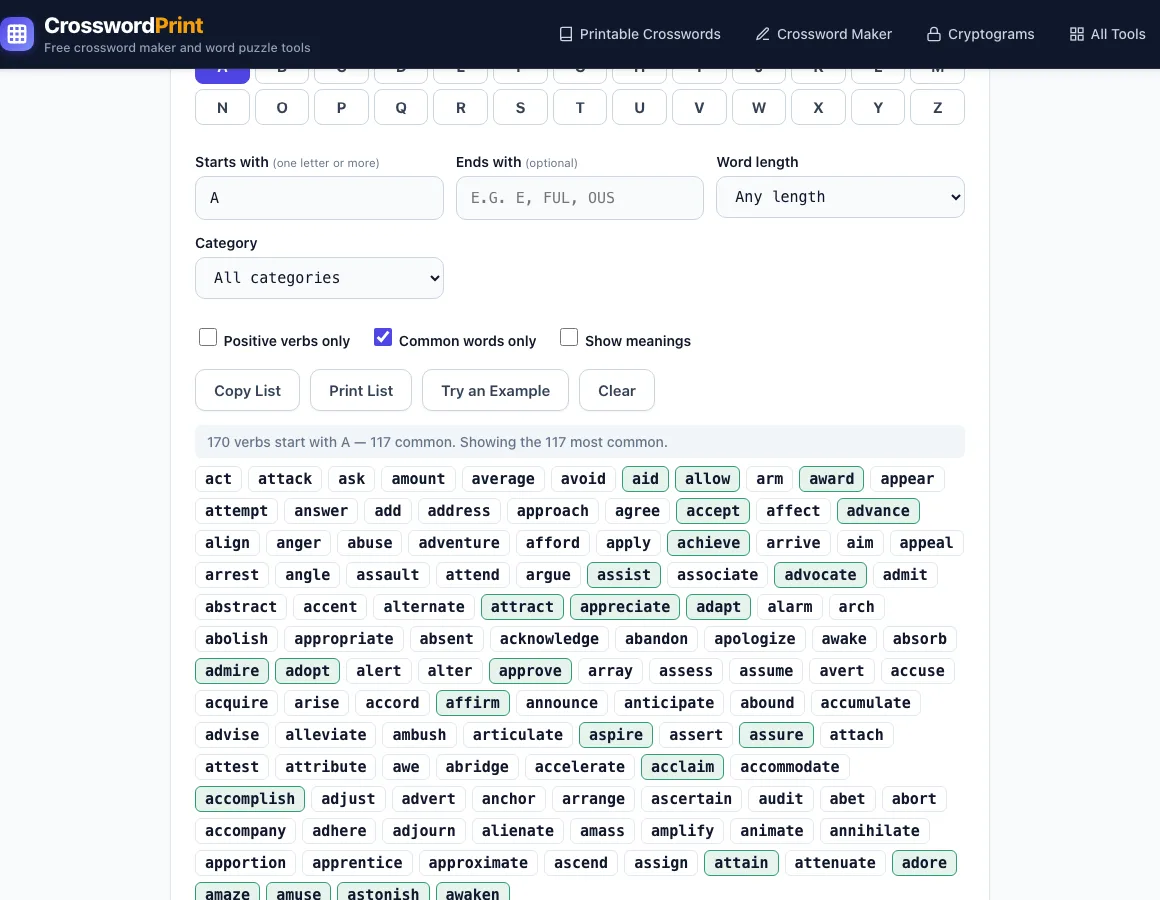
How to use the Verbs That Start With tool
- Open the page. It already shows the most common verbs starting with A.
- To change the letter, tap a chip in the A–Z row.
- For a longer start, type up to 6 letters into the ‘Starts with’ box, such as ’th’ or ‘un’.
- To match an ending, type up to 6 letters into the ‘Ends with’ box.
- Open the ‘Word length’ select and choose Any length, 3 to 11 letters, or 12 or more.
- Turn on ‘Positive verbs only’ to see the 261 hand-picked positive verbs, or pick a ‘Category’ such as movement or feelings.
- Keep ‘Common words only’ on to hide rare words, or turn it off to see every match.
- Turn on ‘Show meanings’ for a short definition under each word. You can also tap any word to see its part of speech and up to two senses.
The count line tells you how many matches there are, with common words listed first. The list shows 400 words at a time, so press ‘Show all’ to see the rest. Copy List gives you one word per line. Print List makes a titled sheet in four columns, or two columns when meanings are shown. Try an Example fills in a sample search, and Clear resets everything. Your search is saved in the address bar, so a bookmarked link reopens the same list. Printed lists are free for commercial use too, for example in KDP books or Etsy printables.
What is a verb (action word)?
A verb is the part of speech that tells what a subject does or is. Action verbs such as run, write, and build name things people or objects do. State verbs such as be, seem, and know describe a condition instead of a movement.
Every complete sentence needs a verb, which is why verb lists are so useful for writing. Choosing a strong verb often changes a sentence more than adding extra adjectives does.
Positive verbs that start with a, e, or n?
Positive verbs describe encouragement, achievement, pleasure, or support. Our hand-picked positive list includes 25 verbs starting with A, such as aid, achieve, admire, and adore. It includes 29 starting with E, such as enjoy, encourage, empower, and enrich. It includes 9 starting with N: network, nurse, nurture, nourish, nestle, and nuzzle, among others.
“Positive” is a judgment call. A verb like navigate or nominate is neutral in most sentences, so check whether it fits your context before you use it.
Action verbs by type: movement, talking, and feelings?
WordNet groups verbs into families based on what they describe. The Category filter uses these groups: movement, talking & writing, thinking & knowing, feelings, making & creating, touching & hitting, changing & growing, eating & drinking, and giving, getting & owning.
Movement verbs describe motion, such as run or jump. Talking & writing verbs describe communication, such as negotiate or explain. Feelings verbs describe emotion, such as admire or enjoy. Choosing a category helps you match the verb to the kind of action you are describing.
Which verbs work for a resume or a poem?
Resumes need clear action verbs that show what you did. Good examples from our A list include achieve, accomplish, advance, and assist. Other common examples are lead and organize. Write bullets in the past tense for past jobs, and begin each bullet with the verb.
Poems often benefit from vivid verbs that create a picture or sound. Words such as awaken, nestle, and nuzzle show gentle movement and closeness. Feelings and movement categories are good places to look for images that suit a poem.
Frequently asked questions
Why don’t I see jumped, running, or other forms of a verb?
The list shows verbs in their base form, such as jump and run. A word only appears under the letter it starts with in that base form. Search for the base form instead of the past or -ing form.
Why is a verb I know missing from the list?
The word list only includes verbs that WordNet mainly treats as verbs, and only if the word is also in our 54,000-word English list. Turn off ‘Common words only’ to see rarer matches.
How many verbs start with each letter?
The tool includes 3,219 verbs in total, with 2,247 of them common. Starting with A, there are 170 verbs (117 common). Starting with T, there are 133 (99 common). Starting with N, there are 39 (29 common). Starting with K, there are 14 (11 common).
How many verbs are in the positive verbs list?
The ‘Positive verbs only’ filter uses our own hand-picked list of 261 positive verbs. Positive verbs appear tinted green in the full list.
Can I search for verbs that end with a certain pattern?
Yes. Type up to 6 letters in the ‘Ends with’ box, and combine it with the ‘Starts with’ box to narrow the results. You can also set a word length to refine them further.
Why does a meaning look different from what I expected?
The meanings come from WordNet, which lists each word’s senses. A word can have more than one meaning, and the tool shows up to two senses when you tap a word. Choose the sense that fits your sentence.
Can I use the printed verb lists for commercial purposes, such as Amazon KDP or Etsy?
Yes. Lists you make here are free to use for any purpose, including classroom packs, KDP activity books, Etsy printables and print-on-demand products, royalty-free and with no attribution needed. The only limit is that you may not copy the tool itself to run a competing service.
Related tools
- Adjectives That Start With: use this when you need a describing word for a noun.
- Nouns That Start With: use this when you are looking for a person, place, or thing.
- Words That Start With: use this when you want every word type with a certain starting pattern.
- Acrostic Poem Generator: use this to build a poem where each line starts with a letter of a word.
- Random Word Generator: use this when you want a surprise word for a game or writing prompt.
- Word Finder: use this when you know some letters or a pattern and need matching words.
- Syllable Counter: use this to check the rhythm of a line or a word.
- 5 Letter Words: use this for word puzzles that need exactly five letters.
About verbs
A verb is a word that generally conveys an action (bring, read, walk, run, learn), an occurrence (happen, become), or a state of being (be, exist, stand). In the usual description of English, the basic form, with or without the particle to, is the infinitive. In many languages, verbs are inflected (modified in form) to encode tense, aspect, mood, and voice. A verb may also agree with the person, gender or number of some of its arguments, such as its subject, or object. In English, three tenses exist: present, to indicate that an action is being carried out; past, to indicate that an action has been done; and future, to indicate that an action will be done, expressed with the auxiliary verb will or shall.
Mike Trout became the American League (AL) Most Valuable Player (MVP) in 2014. (occurrence, past)
the Universe is expanding. (state of being, present)
Every language discovered so far makes some form of noun-verb distinction, possibly because of the graph-like nature of communicated meaning by humans, i.e. nouns being the "entities" and verbs being the "links" between them. The word verb comes and shares the same Indo-European root as word.
Types
Verbs vary by type, and each type is determined by the kinds of words that accompany it and the relationship those words have with the verb itself. Classified by the number of their valency arguments, usually four basic types are distinguished: intransitives, transitives, ditransitives and double transitive verbs. Some verbs have special grammatical uses and hence complements, such as copular verbs (i.e., be); the verb do used for do-support in questioning and negation; and tense or aspect auxiliaries (i.e., be, have or can). In addition, verbs can be non-finite (not inflected for person, number, tense, etc.), such special forms as infinitives, participles or gerunds.
An intransitive verb is one that does not have a direct object. Intransitive verbs may be followed by an adverb (a word that addresses how, where, when, and how often) or end a sentence. For example: "The woman spoke softly." "The athlete ran faster than the official." "The boy wept."
A transitive verb is followed by a noun or noun phrase. These noun phrases are not called predicate nouns, but are instead called direct objects because they refer to the object that is being acted upon. For example: "My friend read the newspaper." "The teenager earned a speeding ticket."
A way to identify a transitive verb is to invert the sentence, making it passive. For example: "The newspaper was read by my friend." "A speeding ticket was earned by the teenager."
Ditransitive verbs (sometimes called Vg verbs after the verb give) precede either two noun phrases or a noun phrase and then a prepositional phrase often led by to or for. For example: "The players gave their teammates high fives." "The players gave high fives to their teammates."
Text adapted from the Wikipedia article “Verb” (revision 1353749895, 2026-05-12), authors, licensed under CC BY-SA 4.0. Shortened: some sections and paragraphs were left out, and reference markers, images and templates were removed; wording is otherwise unchanged. This text remains available under the same licence.