Sentence Syllable Counter
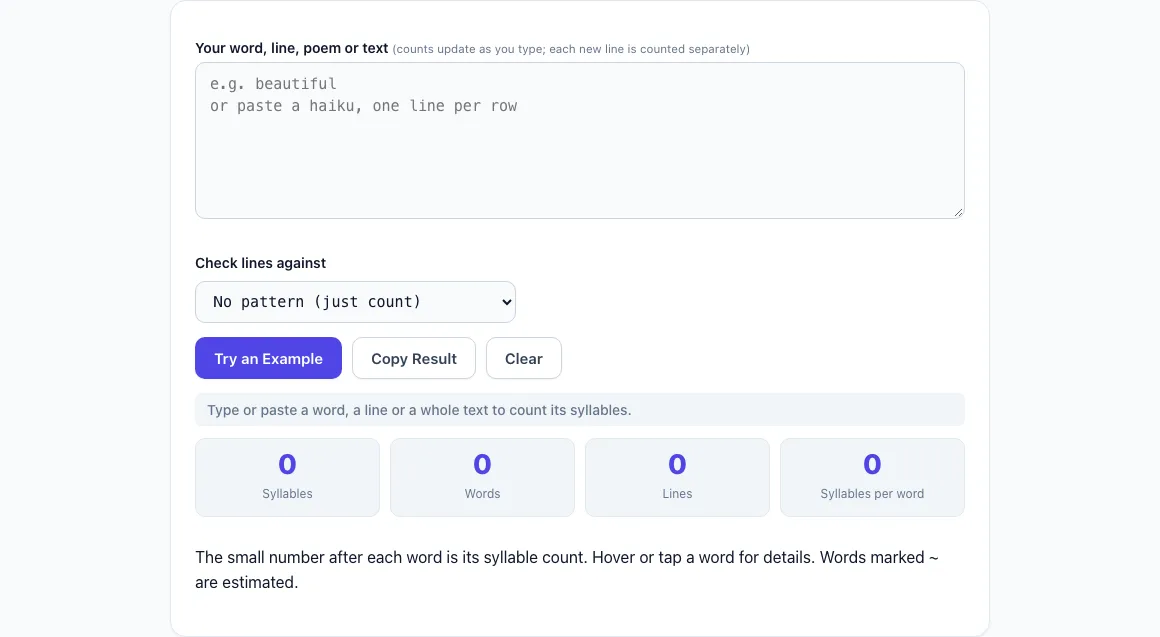
Type or paste a word, a line or a whole poem. Syllables are counted per word and per line as you type, and a pattern check marks lines that are long or short.
The small number after each word is its syllable count. Hover or tap a word for details. Words marked ~ are estimated.
The Sentence Syllable Counter is a free online tool that counts the syllables in any word, sentence, line or poem you type. It runs in your browser and the count updates as you type.
Each line is counted separately. You can check a haiku, a tanka, a sonnet or your own line pattern, and the tool marks each line as matching, having too many syllables or having too few. It also shows totals for syllables, words, lines and syllables per word.
It works as a syllable checker and syllable calculator: use it as a haiku syllable counter to check the 5-7-5 structure of a haiku, to count syllables in words for a poem or song, or to see how many syllables a line has before you revise it. Counts come from an English pronunciation dictionary, with spelling rules for missing words.
How to use the Syllable Counter
- Type or paste your text into the box labelled “Your word, line, poem or text”, with each line on its own line. Blank lines are ignored.
- Watch the four totals update: Syllables, Words, Lines and Syllables per word.
- Read the count badge at the start of each line. Under it, each word shows a small number for its syllables.
- Hover over a word, or tap it on a phone, to see its details. If a word has a second common pronunciation, the tooltip says it “can also be said with” another count.
- Open the “Check lines against” menu and pick a pattern: No pattern (the default), Haiku (5-7-5), Tanka (5-7-5-7-7), 10 syllables per line (sonnet), or Custom pattern.
- If you chose Custom pattern, type your numbers in the “Syllables per line” box. Separate them with commas, spaces or hyphens, for example 4,6,4. One number, such as 10, applies to every line. Each line can have 1 to 99 syllables, and you can use up to 30 lines.
- Read the mark on each line: OK, too many (n over), too few (n short) or extra line. The summary tells you whether the whole text matches the pattern.
- To see a finished example, click “Try an Example”. It loads a haiku and selects Haiku as the pattern.
- Click “Copy Result” to copy your text. Each line is followed by its count in square brackets, then a total. Click “Clear” to empty the box and start again.
What is a syllable?
A syllable is a unit of speech built around one vowel sound. When you count syllables, count the vowel sounds you hear, not the vowel letters you see. “Cake” has one syllable even though it has two vowel letters, because only one vowel sound is spoken.
How to count syllables in a word?
Two hand methods work well. The first is to clap once for each beat as you say the word slowly. The second is the chin method: put your hand under your chin, say the word, and count how many times your jaw drops. Each drop is one syllable. “Beautiful” gives three beats, so it counts as 3.
How many syllables in a haiku (5-7-5)?
A traditional English haiku has 17 syllables in three lines of 5, 7 and 5. The pattern is checked line by line, so each line must hit its own number, not just the total.
Here is a worked example. The lines “Morning light spills out / over the quiet river / and the geese wake up” give 5, 7 and 5 syllables. The text has 17 syllables across 13 words, and the haiku check passes. Choose Haiku (5-7-5) to run the same check on your own poem, or press Try an Example to load this one.
What is a tanka (5-7-5-7-7)?
A tanka is a short form with five lines of 5, 7, 5, 7 and 7 syllables, which makes 31 syllables in total. Choose Tanka (5-7-5-7-7) from the menu to check each line against that pattern. The first three lines follow the haiku shape, and the last two add two lines of 7.
How many syllables in a line of a sonnet?
A Shakespearean sonnet has 14 lines of about 10 syllables each. The lines are written in iambic pentameter, which means five pairs of an unstressed beat followed by a stressed beat. Choose “10 syllables per line (sonnet)” to check every line for a count of 10.
The tool counts syllables only. It does not check whether the stressed beats fall in the right places, so use it for the count and your ear for the rhythm.
Why do some words have two syllable counts?
Many words can be said in more than one way. “Different” counts 3 in the tool, and the tooltip notes that it can also be said with 2. Words such as “fire”, “flower” and “poem” may count as 1 or 2 depending on accent.
The tool uses the first common pronunciation it finds. This is sometimes the shorter form, so “chocolate” counts 2, even though some speakers say it with 3. When a word has two forms, the tooltip tells you the other count, so you can choose the one that fits how you say it.
Frequently asked questions
Is the Syllable Counter free, and is my text uploaded?
It is free and needs no sign-up. The counting happens in your browser, and nothing you type is sent to a server.
Why does a word have a ~ and a dashed underline?
That word is not in the pronunciation dictionary, so its count is estimated from spelling rules for vowel groups, silent e, -le, -ed and -es. Hover over the word for details. On held-out dictionary words, these rules were 92.5% exactly right and 99.75% within one syllable.
How are numbers counted?
Numbers are counted as they are spoken. “21” counts 3 as twenty-one, “1,250” counts 8, “3.5” counts 3 and “2nd” counts 2. Years are read as cardinal numbers, so 2024 counts 6 as two thousand twenty-four.
How are hyphenated words and contractions counted?
The tool checks the whole hyphenated word first. If it is not found, it adds up the parts, so “well-known” counts 2. Contractions count as spoken: “doesn’t” counts 2 and “don’t” counts 1.
What does “extra line” mean?
Your text has more lines than the pattern you chose. A haiku pattern has three lines, so a fourth line is marked as an extra line and does not count toward a match.
Can I check my own line pattern?
Yes. Choose Custom pattern and type the numbers, such as 8,6,8,6 for a ballad stanza, or one number such as 8 for every line.
Related tools
- Rhyming Dictionary: Use it to find rhymes for the end of a line.
- Acrostic Poem Generator: Use it to build a poem where the first letters of each line spell a word.
- Random Word Generator: Use it to find new words to fit a syllable pattern you have in mind.
- Word Finder: Use it to search for words that match letters or patterns when you need a replacement word.
- Number to Words Converter: Use it to see how a number is written out in words before you count its syllables.
- Name Anagram Generator: Use it to rearrange the letters of a name into new words for a playful poem or puzzle.
- Anagram Solver: Use it to find words hidden in a set of letters.
- Crossword Maker: Use it to build a crossword puzzle from your own word list.
- Word Ladder Generator: Use it to create a chain of words where each word changes by one letter.
About the syllable
A syllable is a basic unit of organization within a sequence of speech sounds, such as within a word. In phonology and studies of languages, syllables are often considered the "building blocks" of words. A syllable usually consists of a nucleus (most often a vowel), which may be preceded by an onset and followed by a coda (collectively margins, which are most often consonants). Syllables may bear properties such as stress and tone and be subject to operations such as reduplication. Speech can usually be divided up into a whole number of syllables: for example, the word ignite is made of two syllables: ig and nite. Most languages of the world use relatively simple syllable structures that often alternate between vowels and consonants.
Despite being present in virtually all human languages, syllables still have no precise definition that is valid for all known languages. A common criterion for finding syllable boundaries is native-speaker intuition, but individuals sometimes disagree on them.
The earliest attested instances of syllabic writing are on tablets written around 2800 BC in the Sumerian city of Ur, which predate the earliest instances of alphabetic writing by several centuries. The shift from pictographic writing to syllabic writing has been called "the most important advance in the history of writing".
A word that consists of a single syllable (like English dog) is called a monosyllable (and is said to be monosyllabic). Similar terms include disyllable (and disyllabic; also bisyllable and bisyllabic) for a word of two syllables; trisyllable (and trisyllabic) for a word of three syllables; and polysyllable (and polysyllabic), which may refer to any word of more than one syllable.
Etymology
Syllable is an Anglo-Norman variation of Old French sillabe, from Latin syllaba, from Koine Greek συλλαβή syllabḗ. συλλαβή means "the taken together", referring to letters that are taken together to make a single sound.
συλλαβή is a verbal noun from the verb συλλαμβάνω syllambánō, a compound of the preposition σύν sýn "with" and the verb λαμβάνω lambánō "take". The noun uses the root λαβ-, which appears in the aorist tense; the present tense stem λαμβάν- is formed by adding a nasal infix before the β b and a suffix -αν -an at the end.
Text adapted from the Wikipedia article “Syllable” (revision 1361088621, 2026-06-25), authors, licensed under CC BY-SA 4.0. Shortened: some sections and paragraphs were left out, and reference markers, images and templates were removed; wording is otherwise unchanged. This text remains available under the same licence.