Musical instrument Crossword Puzzle
Free printable educational crossword puzzle. Every clue is a sentence sourced directly from the Wikipedia article on Musical instrument with the key terms blanked out.
Musical instrument Crossword
Name: ____________________ Date: ______________
| 10Z | 1G | |||||||||||||||||||||
| I | R | |||||||||||||||||||||
| 6L | U | T | H | I | E | R | ||||||||||||||||
| 2B | H | E | ||||||||||||||||||||
| A | E | C | ||||||||||||||||||||
| 9O | R | C | H | E | 8S | T | R | A | E | |||||||||||||
| Y | U | 13P | ||||||||||||||||||||
| T | M | I | 11C | |||||||||||||||||||
| O | 5M | E | S | O | P | O | T | A | M | I | A | |||||||||||
| 12P | O | L | Y | P | H | O | N | I | C | R | N | R | ||||||||||
| 3K | I | N | N | O | R | N | ||||||||||||||||
| Y | ||||||||||||||||||||||
| 4B | U | L | L | R | 7O | A | R | E | R | X | ||||||||||||
| R | ||||||||||||||||||||||
| G | ||||||||||||||||||||||
| 14H | A | N | D | E | D | N | E | S | S | |||||||||||||
| N | ||||||||||||||||||||||
| O | ||||||||||||||||||||||
| L | ||||||||||||||||||||||
| O | ||||||||||||||||||||||
| G | ||||||||||||||||||||||
| Y |
Across
- 3. The Hebrew texts mention two prominent instruments associated with Jubal: the ugab (pipes) and _____ (lyre). (6 letters)
- 4. Such instrument pairs also included _____, slit drums, shell trumpets, and skin drums. (10 letters)
- 5. Despite this development, very few musical instruments have been recovered in _____. (11 letters)
- 6. Most makers of musical instruments specialize in one genre of instruments; for example, a _____ makes only stringed instruments. (7 letters)
- 9. New instruments such as the clarinet, saxophone, and tuba became fixtures in _____. (9 letters)
- 12. The _____ style dominated popular music, and the instrument makers responded accordingly. (10 letters)
- 14. Many musical instruments are able to be played with either right of left _____. (10 letters)
Down
- 1. Despite the influences of _____ and Rome, most musical instruments in Europe during the Middles Ages came from Asia. (6 letters)
- 2. Bowed instruments such as the violin, viola, _____, and various lutes dominated popular music. (7 letters)
- 7. The academic study of musical instruments is called _____. (10 letters)
- 8. Sachs notes that Egypt did not possess any instruments that the _____ culture did not also possess. (5 letters)
- 10. Musical instruments such as _____ appeared in Chinese writings around 12th century BC and earlier. (6 letters)
- 11. An instrument that can be attested to the Iron Age Celts is the _____, which is dated to 300 BC. (6 letters)
- 13. Some make only one type of instrument such as a _____. (5 letters)
Clues are sentences from the Wikipedia article “Musical instrument” (revision 1361920585, CC BY-SA 4.0). crosswordprint.com/printable-crosswords/music/musical-instrument/
Musical instrument Word Search
Name: ____________________ Date: ______________
Words to Find
crosswordprint.com/printable-crosswords/music/musical-instrument/
Pick the word that completes each sentence from the Wikipedia article.
Is the sentence correct? Some sentences have one word altered.
Click a clue, then click the word it belongs to.
Unscramble each word. The clue is the sentence it was taken from.
How to Solve & Use the Answer Key
This is a fill-in crossword. Each clue is a sentence from the Wikipedia article on Musical instrument, with the key term blanked out. The number in parentheses shows the letter count. Solve interactively on screen or check Show answers to view the answer key. To print a clean student worksheet, press Print Puzzle.
Musical instrument Crossword Answer Key & Definitions
Show Complete Answers & Word Definitions
- 3 Across: KINNOR — Kinnor ( kīnnōr) is an ancient Israelite musical instrument in the yoke lutes family, the first one to be mentioned in the Hebrew Bible. Wikipedia: Kinnor
- 4 Across: BULLROARER — The bullroarer, rhombus, or turndun is an ancient ritual musical instrument and a device historically used for communicating over great distances. Wikipedia: Bullroarer
- 5 Across: MESOPOTAMIA — Mesopotamia is a historical region of West Asia situated within the Tigris–Euphrates river system, in the northern part of the Fertile Crescent. Wikipedia: Mesopotamia
- 6 Across: LUTHIER — A luthier is a craftsperson who builds or repairs string instruments. Wikipedia: Luthier
- 9 Across: ORCHESTRA — An orchestra is a large instrumental ensemble typical of classical music or jazz, which combines instruments from different families. Wikipedia: Orchestra
- 12 Across: POLYPHONIC — Polyphony is a type of musical texture consisting of two or more simultaneous lines of independent melody, as opposed to a musical texture with just one voice (monophony) or a texture with one dominant melodic voice accompanied by chords (homophony). Wikipedia: Polyphony
- 14 Across: HANDEDNESS — In human biology, handedness is an individual's preferential use of one hand, known as the dominant hand, due to and causing it to be stronger, faster or more dextrous. Wikipedia: Handedness
- 1 Down: GREECE — Greece, officially the Hellenic Republic, is a country of 10 million people on the southern tip of the Balkan peninsula in Southeast Europe. Wikipedia: Greece
- 2 Down: BARYTON — The baryton is a bowed string instrument similar to the viol, but distinguished by an extra set of sympathetic but also pluckable strings. Wikipedia: Baryton
- 7 Down: ORGANOLOGY — Organology is the science of musical instruments and their classifications. Wikipedia: Organology
- 8 Down: SUMER — Sumer is the earliest known civilization, located in the historical region of southern Mesopotamia (now south-central Iraq), emerging during the Chalcolithic and early Bronze Ages between the 5th and 4th millennium BC. Wikipedia: Sumer
- 10 Down: ZITHER — Zither (, from the Greek κιθάρα, cithara) is a class of stringed instruments, and the term also refers to a specific subset of instruments of the zither class, most usually the concert or Alpine zithers. Wikipedia: Zither
- 11 Down: CARNYX — The carnyx (carnyces) is a wind instrument that was common in Celtic cultures during the Iron Age, between c. Wikipedia: Carnyx
- 13 Down: PIANO — A piano is a keyboard instrument that produces sound when its keys are pressed, activating an action mechanism where hammers strike strings. Wikipedia: Piano
Definitions adapted from Wikipedia articles (week 2026-W41), CC BY-SA 4.0.
Read about Musical instrument
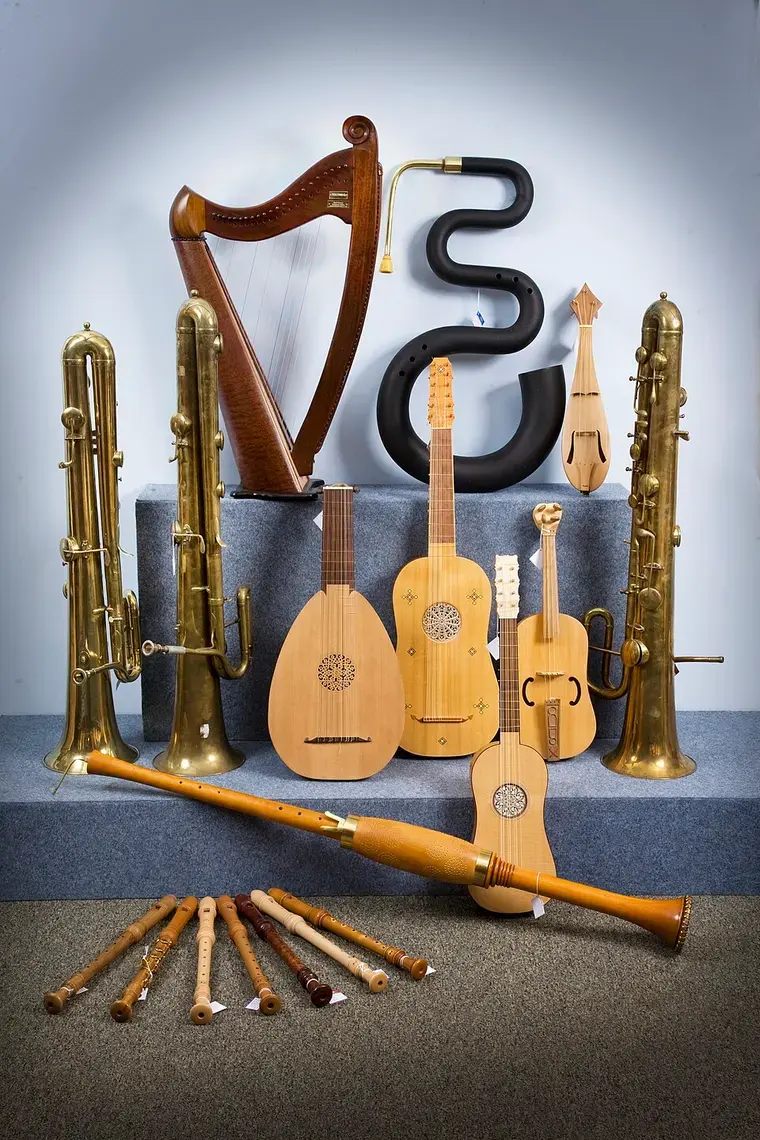
A musical instrument is a device created or adapted to make musical sounds. In principle, any object that produces sound can be considered a musical instrument—it is through purpose that the object becomes a musical instrument. A person who plays a musical instrument is known as an instrumentalist.
The history of musical instruments dates to the beginnings of human culture. Early musical instruments may have been used for rituals, such as a horn to signal success on the hunt, or a drum in a religious ceremony. Cultures eventually developed composition and performance of melodies for entertainment. Musical instruments evolved in step with changing applications and technologies.
The exact date and specific origin of the first device considered a musical instrument, is widely disputed. The oldest object identified by scholars as a musical instrument, is a simple flute, dated back 50,000–60,000 years. Many scholars date early flutes to about 40,000 years ago. Many historians believe that determining the specific date of musical instrument invention is impossible, as the majority of early musical instruments were constructed of animal skins, bone, wood, and other non-durable, bio-degradable materials. Additionally, some have proposed that lithophones, or stones used to make musical sounds—like those found at Sankarjang in India—are examples of prehistoric musical instruments.
Musical instruments developed independently in many populated regions of the world. However, contact among civilizations caused rapid spread and adaptation of most instruments in places far from their origin. By the post-classical era, instruments from Mesopotamia were in maritime Southeast Asia, and Europeans played instruments originating from North Africa. Development in the Americas occurred at a slower pace, but cultures of North, Central, and South America shared musical instruments.
By 1400, musical instrument development slowed in many areas and was dominated by the Occident. During the Classical and Romantic periods of music, lasting from roughly 1750 to 1900, many new musical instruments were developed. While the evolution of traditional musical instruments slowed beginning in the 20th century, the proliferation of electricity led to the invention of new electric and electronic instruments, such as electric guitars, synthesizers, and the theremin.
Definition and basic operation
A musical instrument is used to make musical sounds. Once humans moved from making sounds with their bodies — for example, by clapping—to using objects to create music from sounds, musical instruments were born.
Primitive instruments were probably designed to emulate natural sounds, and their purpose was ritual rather than entertainment. The concept of melody and the artistic pursuit of musical composition were probably unknown to early players of musical instruments. A person sounding a bone flute to signal the start of a hunt does so without thought of the modern notion of "making music". Musical instruments are constructed in a broad array of styles and shapes, using many different materials. Early musical instruments were made from "found objects" such as shells and plant parts. As instruments evolved, so did the selection and quality of materials. Virtually every material in nature has been used by at least one culture to make musical instruments.
One plays a musical instrument by interacting with it in some way — for example, by plucking the strings on a string instrument, striking the surface of a drum, or blowing into an animal horn.
Archaeology
Researchers have discovered archaeological evidence of musical instruments in many parts of the world. One disputed artifact (the Divje Babe flute) has been dated to 67,000 years old, but consensus solidifies around artifacts dated back to around 37,000 years old and later. Artifacts made from durable materials or constructed using durable methods, have been found to survive. As such, the specimens found cannot be irrefutably placed as the earliest musical instruments.
Recent studies indicate early hominins produced their percussive instruments from perishable materials like wood and animal hide, which the passing of time likely destroyed the artifacts beyond recovery.
The Divje Babe Flute is a perforated bone discovered in 1995, in the northwest region of Slovenia by archaeologist Ivan Turk. Its origin is disputed, with many arguing that it is most likely the product of carnivores chewing the bone, but Turk and others argue that it is a Neanderthal-made flute. With its age estimated between 43,400 and 67,000 years old, it would be the oldest known musical instrument and the only Neanderthal musical instrument.
Mammoth bone and swan bone flutes have been found dating back to 30,000 to 37,000 years old in the Swabian Alps of Germany. The flutes were made in the Upper Paleolithic age, and are more commonly accepted as being the oldest known musical instruments. The British music archaeologist Graeme Lawson, using a replica of a complete specimen, contends that rather than flutes, they produce the first five notes of the diatonic series in a clear, strident tone when played as an end-blown lip reed instrument, similar to a cornett. He argues that this method of playing is supported by microscopic wear patterns, the absence of a fipple or blowhole, and the well-rounded end aperture.
Archaeological evidence of musical instruments was discovered in excavations at the Royal Cemetery in the Sumerian city of Ur. These instruments, one of the first ensembles of instruments yet discovered, include nine lyres (the Lyres of Ur), two harps, a silver double flute, a sistrum, and cymbals. A set of reed-sounded silver pipes discovered in Ur was the likely predecessor of modern bagpipes. The cylindrical pipes feature three side holes that allowed players to produce a whole-tone scale. These excavations, carried out by Leonard Woolley in the 1920s, uncovered non-degradable fragments of instruments and the voids left by the degraded segments that, together, have been used to reconstruct them. The graves these instruments were buried in have been carbon dated to between 2600 and 2500 BC, providing evidence that these instruments were used in Sumeria by this time.
History
Scholars agree that there are no completely reliable methods of determining the exact chronology of musical instruments across cultures. Comparing and organizing instruments based on their complexity is misleading, since advancements in musical instruments have sometimes reduced complexity. For example, the construction of early slit drums involved felling and hollowing out large trees; later slit drums were made by opening bamboo stalks, a much simpler task.
German musicologist Curt Sachs, one of the most prominent musicologists and musical ethnologists in modern times, argues that it is misleading to arrange the development of musical instruments by workmanship, since cultures advance at different rates and have access to different raw materials.
For example, contemporary anthropologists comparing musical instruments from two cultures that existed at the same time but differed in organization, culture, and handicraft cannot determine which instruments are more "primitive".
Ordering instruments by geography is also not reliable, as it cannot always be determined when and how cultures contacted one another and shared knowledge. Sachs proposed that a geographical chronology until approximately 1400 is preferable, however, due to its limited subjectivity. Beyond 1400, one can follow the overall development of musical instruments over time.
The science of marking the order of musical instrument development relies on archaeological artifacts, artistic depictions, and literary references. Since data in one research path can be inconclusive, all three paths provide a better historical picture.
Classification
There are many different methods of classifying musical instruments. Various methods examine aspects such as the physical properties of the instrument (material, color, shape, etc.), the use for the instrument, the means by which music is produced with the instrument, the range of the instrument, and the instrument's place in an orchestra or other ensemble. Most methods are specific to a geographic area or cultural group, developed to serve their unique classification requirements. These specialized classification schemes tend to break down once they are applied outside of their original area, for example a system based on instrument use would fail if a culture invented a new use for the same instrument. Scholars recognize Hornbostel–Sachs as the only system that applies irrespective of culture and provides only one possible classification for any given instrument.
An ancient Hindu system named the Natya Shastra, written by the sage Bharata Muni and dating from between 200 BC and 200 AD, divides instruments into four main classification groups: instruments where the sound is produced by vibrating strings; percussion instruments with skin heads; instruments where the sound is produced by vibrating columns of air; and "solid", or non-skin, percussion instruments. This system was similar to some degree in 12th-century Europe by Johannes de Muris, who used the terms tensibilia (stringed instruments), inflatibilia (wind instruments), and percussibilia (all percussion instruments). In 1880, Victor-Charles Mahillon adapted the Natya Shastra and assigned Greek labels to the four classifications: chordophones (stringed instruments), membranophones (skin-head percussion instruments), aerophones (wind instruments), and autophones (non-skin percussion instruments).
Erich von Hornbostel and Curt Sachs adopted Mahillon's scheme and published an extensive new scheme for classification in Zeitschrift für Ethnologie in 1914. Hornbostel and Sachs used most of Mahillon's system, but replaced the term autophone with idiophone.
The original Hornbostel–Sachs system classified instruments into four main groups:
Idiophones, which produce sound by vibrating the primary body of the instrument itself; they are sorted into concussion, percussion, shaken, scraped, split, and plucked idiophones, such as claves, xylophone, guiro, slit drum, mbira, and rattle.
Construction
The materials used in making musical instruments vary greatly by culture and application. Many of the materials have special significance owing to their source or rarity. Some cultures worked substances from the human body into their instruments. In ancient Mexico, for example, the material drums were made from might contain actual human body parts obtained from sacrificial offerings. In New Guinea, drum makers would mix human blood into the adhesive used to attach the membrane. Mulberry trees are held in high regard in China owing to their mythological significance—instrument makers would hence use them to make zithers. The Yakuts believe that making drums from trees struck by lightning gives them a special connection to nature.
Musical instrument construction is a specialized trade that requires years of training, practice, and sometimes an apprenticeship. Most makers of musical instruments specialize in one genre of instruments; for example, a luthier makes only stringed instruments. Some make only one type of instrument such as a piano. Whatever the instrument constructed, the instrument maker must consider materials, construction technique, and decoration, creating a balanced instrument that is both functional and aesthetically pleasing. Some builders focus on a more artistic approach and develop experimental musical instruments, like Harry Partch, who created many instruments to play his own music based on unequal intervals in just intonation.
User interfaces
Regardless of how the sound is produced, many musical instruments have a keyboard as the user interface. Keyboard instruments are any instruments that are played with a musical keyboard, which is a row of small keys that can be pressed. Every key generates one or more sounds; most keyboard instruments have extra means (pedals for a piano, stops and a pedal keyboard for an organ) to manipulate these sounds. They may produce sound by wind being fanned (organ) or pumped (accordion), vibrating strings either hammered (piano) or plucked (harpsichord), by electronic means (synthesizer), or in some other way. Sometimes, instruments that do not usually have a keyboard, such as the glockenspiel, are fitted with one. Though keyboard percussion instruments have the same physical arrangement as a musical keyboard, they are composed of bars instead of keys.
The theremin, an electrophone, is played without physical contact by the player. The theremin senses the proximity of each the player's hands to an antennae, which control pitch and amplitude respectively. More recently, the invention of the MIDI technical standard has given rise to a variety of MIDI controllers that can change the sound parameters of electronic musical instruments, like synthesizers. These controllers include MIDI keyboards, as well as a wide range of more specialised designs.
Many musical instruments are able to be played with either right of left handedness. However, some instruments can be made for the less frequent (≈10%) left handedness, such as guitars. Well known left handed players include Jimi Hendrix and Paul McCartney.
Instrumentalist
A person who plays a musical instrument is known as an instrumentalist or instrumental musician. Many instrumentalists are known for playing specific musical instruments such as guitarist (guitar), pianist (piano), bassist (bass), and drummer (drum). These different types of instrumentalists can perform together in a music group. A person who is able to play a number of instruments is called a multi-instrumentalist. According to David Baskerville in the book Music Business Handbook and Career Guide, the working hours of a full-time instrumentalist may average only three hours a day, but most musicians spent at least forty hours a week.
Text adapted from the Wikipedia article “Musical instrument” (revision 1361920585, 2026-06-30), authors, licensed under CC BY-SA 4.0.