Human body Crossword Puzzle
Free printable educational crossword puzzle. Every clue is a sentence sourced directly from the Wikipedia article on Human body with the key terms blanked out.
Human body Crossword
Name: ____________________ Date: ______________
| 6E | ||||||||||||||||||||
| M | ||||||||||||||||||||
| B | ||||||||||||||||||||
| R | ||||||||||||||||||||
| Y | ||||||||||||||||||||
| 11I | N | F | O | R | M | A | T | I | O | N | 9M | |||||||||
| L | 8P | H | O | S | 5P | H | O | R | U | S | ||||||||||
| O | R | L | ||||||||||||||||||
| 3G | A | L | L | S | T | O | N | E | ||||||||||||
| 12O | Y | T | C | |||||||||||||||||
| 4V | E | I | 7N | V | 14B | 2U | E | U | ||||||||||||
| E | A | I | 10T | E | S | T | I | C | L | E | ||||||||||
| 1E | L | E | C | T | R | O | L | Y | T | E | N | E | ||||||||
| K | Y | E | R | |||||||||||||||||
| 13M | U | S | C | L | E | |||||||||||||||
| S |
Across
- 1. The main _____ in body water outside cells are sodium and chloride, whereas within cells it is potassium and other phosphates. (11 letters)
- 3. Having _____ is a risk factor for gallbladder cancer, which, although quite uncommon, is rapidly fatal if not diagnosed early. (9 letters)
- 4. Venules and _____ collect blood low in oxygen from tissues throughout the body. (4 letters)
- 8. The human body is composed of elements including hydrogen, oxygen, carbon, calcium and _____. (10 letters)
- 10. Male puberty sees the further development of the human penis and _____. (8 letters)
- 11. The eyes, ears, tongue, and nose gather _____ about the body's environment. (11 letters)
- 13. Body shape is influenced by the distribution of bones, _____ and fat tissue. (6 letters)
Down
- 2. The egg then lodges in the _____, where an embryo and later fetus develop until birth. (6 letters)
- 5. The RNA is then used to create _____, which form the basis for cells, their activity, and their products. (7 letters)
- 6. The study of the human body includes anatomy, physiology, histology, and _____. (10 letters)
- 7. The human body has four limbs (two arms and two legs), a head and a _____, which connect to the torso. (4 letters)
- 9. It converts food into small, nutritional, non-toxic _____ for distribution and absorption into the body. (8 letters)
- 12. The process begins with fertilisation, where an egg released from the _____ of a female is penetrated by sperm. (5 letters)
- 14. It stores _____ before it is released into the small intestine via the common _____ duct to help with digestion of fats. (4 letters)
Clues are sentences from the Wikipedia article “Human body” (revision 1362374171, CC BY-SA 4.0). crosswordprint.com/printable-crosswords/human-body/human-body/
Human body Word Search
Name: ____________________ Date: ______________
Words to Find
crosswordprint.com/printable-crosswords/human-body/human-body/
Pick the word that completes each sentence from the Wikipedia article.
Is the sentence correct? Some sentences have one word altered.
Click a clue, then click the word it belongs to.
Unscramble each word. The clue is the sentence it was taken from.
How to Solve & Use the Answer Key
This is a fill-in crossword. Each clue is a sentence from the Wikipedia article on Human body, with the key term blanked out. The number in parentheses shows the letter count. Solve interactively on screen or check Show answers to view the answer key. To print a clean student worksheet, press Print Puzzle.
Human body Crossword Answer Key & Definitions
Show Complete Answers & Word Definitions
- 1 Across: ELECTROLYTE — An electrolyte is a substance that conducts electricity through the movement of ions, but not through the movement of electrons. Wikipedia: Electrolyte
- 3 Across: GALLSTONE — A gallstone is a stone formed within the gallbladder from precipitated bile components. Wikipedia: Gallstone
- 4 Across: VEIN — A vein is a blood vessel in the circulatory system of humans and most other animals that carries blood towards the heart. Wikipedia: Vein
- 8 Across: PHOSPHORUS — Phosphorus is a chemical element; it has symbol P and atomic number 15. Wikipedia: Phosphorus
- 10 Across: TESTICLE — A testicle, also called testis ( testes) is the male gonad in all gonochoric animals, including humans, and is homologous to the ovary, which is the female gonad. Wikipedia: Testicle
- 11 Across: INFORMATION — Information is an abstract concept that refers to something which has the power to inform. Wikipedia: Information
- 13 Across: MUSCLE — Muscle is a specialised soft tissue, one of the four basic types of animal tissues. Wikipedia: Muscle
- 2 Down: UTERUS — The uterus (from Latin uterus,: uteri or uteruses) or womb is the organ in the reproductive system of most female mammals, including humans, that accommodates the embryonic and fetal development of one or more fertilized eggs until birth. Wikipedia: Uterus
- 5 Down: PROTEIN — Proteins are large biomolecules and macromolecules that comprise one or more long chains of amino acid residues. Wikipedia: Protein
- 6 Down: EMBRYOLOGY — Embryology is the branch of zoology that studies the prenatal development of gametes (sex cells), fertilization and development of embryos and fetuses. Wikipedia: Embryology
- 7 Down: NECK — The neck is the part of the body in many vertebrates that connects the head to the torso. Wikipedia: Neck
- 9 Down: MOLECULE — A molecule is a group of two or more atoms that are held together by attractive forces known as chemical bonds; depending on context, the term may or may not include ions that satisfy this criterion. Wikipedia: Molecule
- 12 Down: OVARY — The ovary is a gonad in the female reproductive system that produces ova; when released, an ovum travels through the oviduct into the uterus. Wikipedia: Ovary
- 14 Down: BILE — Bile (from Latin bilis), also known as gall, is a yellow-green fluid produced by the liver of most vertebrates that aids the digestion of lipids in the small intestine. Wikipedia: Bile
Definitions adapted from Wikipedia articles (week 2026-W41), CC BY-SA 4.0.
Read about Human body
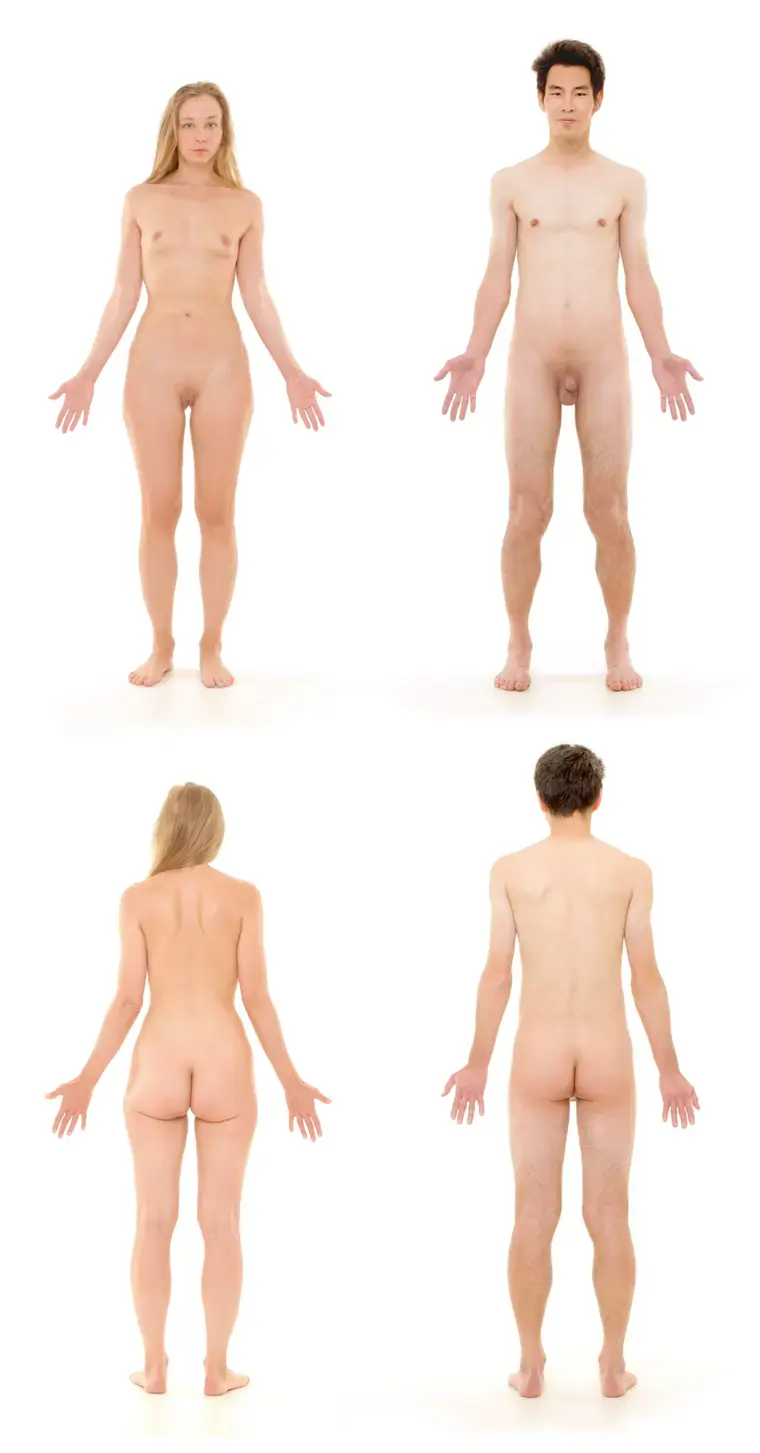
The human body is the entire structure of a human being. It is composed of many different types of cells that together create tissues and subsequently organs and then organ systems.
The external human body consists of a head, hair, neck, torso (which includes the thorax and abdomen), genitals, arms, hands, legs, and feet. The internal human body includes organs, teeth, bones, muscles, tendons, ligaments, blood vessels and blood, lymphatic vessels and lymph.
The study of the human body includes anatomy, physiology, histology, and embryology. The body varies anatomically in known ways. Physiology focuses on the systems and organs of the human body and their functions. Many systems and mechanisms interact in order to maintain homeostasis, with safe levels of substances such as sugar, iron, and oxygen in the blood.
The human body is studied by health professionals, physiologists, anatomists, and artists to assist them in their work.
Composition
The human body is composed of elements including hydrogen, oxygen, carbon, calcium and phosphorus. These elements reside in trillions of cells and non-cellular components of the body.
The adult male body is about 60% total body water content of some 42 litre. This is made up of about 19 litres of extracellular fluid including about 3.2 litre of blood plasma and about 8.4 litre of interstitial fluid, and about 23 litre of fluid inside cells. The content, acidity and composition of the water inside and outside cells is carefully maintained. The main electrolytes in body water outside cells are sodium and chloride, whereas within cells it is potassium and other phosphates.
The body contains trillions of cells, the fundamental unit of life. At maturity, there are roughly 30 trillion cells, and 38 trillion bacteria in the body, an estimate arrived at by totaling the cell numbers of all the organs of the body and cell types. The skin of the body is also host to billions of commensal organisms as well as immune cells. Not all parts of the body are made from cells. Cells sit in an extracellular matrix that consists of proteins such as collagen, surrounded by extracellular fluids.
Each of the cells of the human body experiences, on average, tens of thousands of DNA damages per day. These damages can block genome replication or genome transcription, and if they are not repaired or are repaired incorrectly, they may lead to mutations, or other genome alterations that threaten cell viability.
Cells in the body function because of DNA. DNA sits within the nucleus of a cell. Here, parts of DNA are copied and sent to the body of the cell via RNA. The RNA is then used to create proteins, which form the basis for cells, their activity, and their products. Proteins dictate cell function and gene expression, a cell is able to self-regulate by the amount of proteins produced. However, not all cells have DNA; some cells such as mature red blood cells lose their nucleus as they mature.
Anatomy
Human anatomy is the study of the shape and form of the human body. The human body has four limbs (two arms and two legs), a head and a neck, which connect to the torso. The body's shape is determined by a strong skeleton made of bone and cartilage, surrounded by fat (adipose tissue), muscle, connective tissue, organs, and other structures. The spine at the back of the skeleton contains the flexible vertebral column, which surrounds the spinal cord, which is a collection of nerve fibres connecting the brain to the rest of the body. Nerves connect the spinal cord and brain to the rest of the body. All major bones, muscles, and nerves in the body are named, with the exception of anatomical variations such as sesamoid bones and accessory muscles.
Blood vessels carry blood throughout the body, which moves because of the beating of the heart. Venules and veins collect blood low in oxygen from tissues throughout the body. These collect in progressively larger veins until they reach the body's two largest veins, the superior and inferior vena cava, which drain blood into the right side of the heart. From here, the blood is pumped into the lungs where it receives oxygen and drains back into the left side of the heart. From here, it is pumped into the body's largest artery, the aorta, and then progressively smaller arteries and arterioles until it reaches tissue. Here, blood passes from small arteries into capillaries, then small veins and the process begins again. Blood carries oxygen, waste products, and hormones from one place in the body to another. Blood is filtered at the kidneys and liver.
The body consists of a number of body cavities, separated areas which house different organ systems. The brain and central nervous system reside in an area protected from the rest of the body by the blood brain barrier. The lungs sit in the pleural cavity. The intestines, liver, and spleen sit in the abdominal cavity.
Height, weight, shape and other body proportions vary individually and with age and sex. Body shape is influenced by the distribution of bones, muscle and fat tissue.
Physiology
Human physiology is the study of how the human body functions. This includes the mechanical, physical, bioelectrical, and biochemical functions of humans in good health, from organs to the cells of which they are composed. The human body consists of many interacting systems of organs. These interact to maintain homeostasis, keeping the body in a stable state with safe levels of substances such as sugar and oxygen in the blood.
Each system contributes to homeostasis, of itself, other systems, and the entire body. Some combined systems are referred to by joint names. For example, the nervous system and the endocrine system operate together as the neuroendocrine system. The nervous system receives information from the body, and transmits this to the brain via nerve impulses and neurotransmitters. At the same time, the endocrine system releases hormones, such as to help regulate blood pressure and volume. Together, these systems regulate the internal environment of the body, maintaining blood flow, posture, energy supply, temperature, and acid balance (pH).
Development
Development of the human body is the process of growth to maturity. The process begins with fertilisation, where an egg released from the ovary of a female is penetrated by sperm. The egg then lodges in the uterus, where an embryo and later fetus develop until birth. Growth and development occur after birth, and include both physical and psychological development, influenced by genetic, hormonal, environmental and other factors. Development and growth continue throughout life, through childhood, adolescence, and through adulthood to old age, and are referred to as the process of aging.
Society and culture
Health professionals learn about the human body from illustrations, models, and demonstrations. Medical and dental students in addition gain practical experience, for example by dissection of cadavers. Human anatomy, physiology, and biochemistry are basic medical sciences, generally taught to medical students in their first year at medical school.
In Western societies, the contexts for depictions of the human body include information, art and pornography. Information includes both science and education, such as anatomical drawings. Any ambiguous image not easily fitting into one of these categories may be misinterpreted, leading to disputes. The most contentious disputes are between fine art and erotic images, which define the legal distinction of which images are permitted or prohibited.
In Ancient Greece, the Hippocratic Corpus described the anatomy of the skeleton and muscles. The 2nd century physician Galen of Pergamum compiled classical knowledge of anatomy into a text that was used throughout the Middle Ages. In the Renaissance, Andreas Vesalius (1514–1564) pioneered the modern study of human anatomy by dissection, writing the influential book De humani corporis fabrica. Anatomy advanced further with the invention of the microscope and the study of the cellular structure of tissues and organs. Modern anatomy uses techniques such as magnetic resonance imaging, computed tomography, fluoroscopy and ultrasound imaging to study the body in unprecedented detail.
The study of human physiology began with Hippocrates in Ancient Greece, around 420 BCE, and with Aristotle (384–322 BCE) who applied critical thinking and emphasis on the relationship between structure and function. Galen (c. 129) was the first to use experiments to probe the body's functions. The term physiology was introduced by the French physician Jean Fernel (1497–1558). In the 17th century, William Harvey (1578–1657) described the circulatory system, pioneering the combination of close observation with careful experiment. In the 19th century, physiological knowledge began to accumulate at a rapid rate with the cell theory of Matthias Schleiden and Theodor Schwann in 1838, that organisms are made up of cells. Claude Bernard (1813–1878) created the concept of the milieu interieur (internal environment), which Walter Cannon (1871–1945) later said was regulated to a steady state in homeostasis. In the 20th century, the physiologists Knut Schmidt-Nielsen and George Bartholomew extended their studies to comparative physiology and ecophysiology. Most recently, evolutionary physiology has become a distinct subdiscipline.
Text adapted from the Wikipedia article “Human body” (revision 1362374171, 2026-07-03), authors, licensed under CC BY-SA 4.0.