Halloween Crossword Puzzle
Free printable educational crossword puzzle. Every clue is a sentence sourced directly from the Wikipedia article on Halloween with the key terms blanked out.
Halloween Crossword
Name: ____________________ Date: ______________
| 2M | U | M | M | I | N | G | |||||||||
| O | |||||||||||||||
| 9S | 1C | O | T | L | A | N | D | 6C | O | I | N | ||||
| A | S | 5L | E | ||||||||||||
| N | T | E | L | 8P | |||||||||||
| D | 7S | U | P | E | R | N | A | T | U | R | A | L | |||
| Y | R | T | S | A | |||||||||||
| N | |||||||||||||||
| 12L | I | P | 10H | O | O | K | |||||||||
| A | |||||||||||||||
| 3C | H | R | I | S | T | I | A | N | |||||||
| V | |||||||||||||||
| 4P | A | R | E | N | T | A | L | I | A | ||||||
| S | |||||||||||||||
| 11C | A | T | H | O | L | I | C |
Across
- 2. The practice is said to have roots in the medieval practice of _____, which is closely related to souling. (7 letters)
- 3. Some _____ observe this custom at Halloween today. (9 letters)
- 4. Some folklorists also suggest the ancient Roman festival of _____ (including Feralia) influenced All Saints' and All Souls' days. (10 letters)
- 6. A similar game involved hanging an apple from a string with a _____ embedded; the _____ had to be removed without using hands. (4 letters)
- 7. In popular culture, Halloween has become a celebration of horror and is associated with the macabre and the _____. (12 letters)
- 9. Dressing up in costumes and going "guising" was prevalent in _____ and Ireland at Halloween by the late 19th century. (8 letters)
- 11. If it is just a game, there is no harm in that." The _____ Archdiocese of Boston has organized a "Saint Fest" on Halloween. (8 letters)
- 12. The first recorded purpose-built haunted attraction was the Orton and Spooner Ghost House, which opened in 1915 in _____, England. (7 letters)
Down
- 1. Others order Halloween-themed Scripture _____ to pass out to children on this day. (5 letters)
- 2. Halloween imagery includes themes of death, evil, and mythical _____. (7 letters)
- 5. As with the _____ tradition of hot cross buns, soul cakes were often marked with a cross, indicating that they were baked as alms. (4 letters)
- 6. For the _____, the day ended and began at sunset; thus the festival begins the evening before 1 November by modern reckoning. (5 letters)
- 8. Wearing costumes and playing _____ at Halloween did not spread to England until the 20th century. (5 letters)
- 10. Samhain marked the end of the _____ season in autumn and beginning of winter or the 'darker half' of the year. (7 letters)
Clues are sentences from the Wikipedia article “Halloween” (revision 1361029353, CC BY-SA 4.0). crosswordprint.com/printable-crosswords/holidays/halloween/
Halloween Word Search
Name: ____________________ Date: ______________
Words to Find
crosswordprint.com/printable-crosswords/holidays/halloween/
Pick the word that completes each sentence from the Wikipedia article.
Is the sentence correct? Some sentences have one word altered.
Click a clue, then click the word it belongs to.
Unscramble each word. The clue is the sentence it was taken from.
How to Solve & Use the Answer Key
This is a fill-in crossword. Each clue is a sentence from the Wikipedia article on Halloween, with the key term blanked out. The number in parentheses shows the letter count. Solve interactively on screen or check Show answers to view the answer key. To print a clean student worksheet, press Print Puzzle.
Halloween Crossword Answer Key & Definitions
Show Complete Answers & Word Definitions
- 2 Across: MUMMING — Mummers were bands of men and women from the medieval to early modern era who (during public festivities) dressed in fantastic clothes and costumes and serenaded people outside their houses, or joined the party inside. Wikipedia: Mummers
- 3 Across: CHRISTIAN — A Christian is a person who follows or adheres to Christianity, a monotheistic Abrahamic religion based on the life and teachings of Jesus Christ. Wikipedia: Christians
- 4 Across: PARENTALIA — In ancient Rome, the Parentalia or dies parentales ("ancestral days") was a nine-day festival held in honour of family ancestors, beginning on 13 February. Wikipedia: Parentalia
- 6 Across: COIN — A coin is a small object, usually round and flat, used primarily as a medium of exchange or legal tender. Wikipedia: Coin
- 7 Across: SUPERNATURAL — Supernatural phenomena or entities are those beyond the laws of nature. Wikipedia: Supernatural
- 9 Across: SCOTLAND — Scotland is a country that is part of the United Kingdom, consisting of the northern part of the island of Great Britain and adjacent islands, principally in the archipelagos of the Hebrides and the Northern Isles. Wikipedia: Scotland
- 11 Across: CATHOLIC — The Catholic Church (Ecclesia Catholica), also called the Roman Catholic Church, is the largest Christian church, with an estimated 1.28 to 1.41 billion baptized members worldwide as of 2026. Wikipedia: Catholic Church
- 12 Across: LIPHOOK — Liphook is a village in the East Hampshire district of Hampshire, England. Wikipedia: Liphook
- 1 Down: CANDY — Candy, also known as sweets, is a confection that features sugar as a principal ingredient. Wikipedia: Candy
- 2 Down: MONSTER — A monster is a type of imaginary or fictional creature found in literature, folklore, mythology, horror, fantasy, fiction and religion. Wikipedia: Monster
- 5 Down: LENT — Lent (Quadragesima, 'Fortieth') is the solemn Christian religious observance in the liturgical year in preparation for Easter. Wikipedia: Lent
- 6 Down: CELTS — The Celts (see pronunciation for different usages) or Celtic peoples were a collection of Indo-European peoples in Europe and Anatolia, identified by their use of Celtic languages and other cultural similarities. Wikipedia: Celts
- 8 Down: PRANK — A practical joke, also known as a prank or trolling, is a trick played on people, generally causing the victim to experience embarrassment, perplexity, confusion, discomfort, or irritation. Wikipedia: Practical joke
- 10 Down: HARVEST — Harvesting is the process of collecting plants, animals, or fish (as well as fungi) as food, especially the process of gathering mature crops, and "the harvest" also refers to the collected crops. Wikipedia: Harvest
Definitions adapted from Wikipedia articles (week 2026-W41), CC BY-SA 4.0.
Read about Halloween
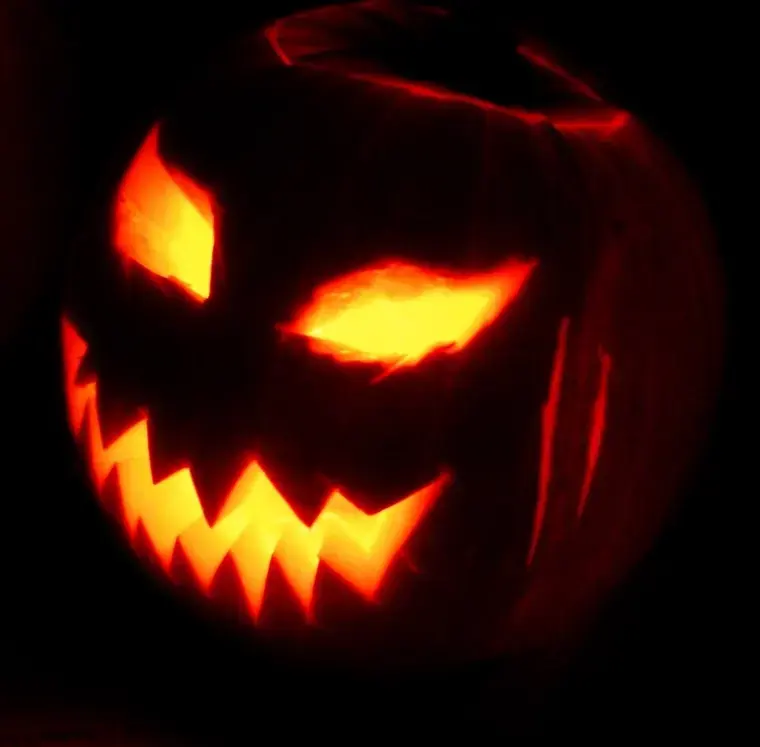
Halloween, also known as All Hallows' Eve, or All Saints' Eve, is a celebration observed in many countries on 31 October, the eve of the Western Christian feast of All Hallows' Day. It is at the beginning of the observance of Allhallowtide, the time in the Christian liturgical year dedicated to remembering the dead, including saints (hallows), martyrs, and all the faithful departed. In popular culture, Halloween has become a celebration of horror and is associated with the macabre and the supernatural.
One theory holds that many Halloween traditions were influenced by Celtic harvest festivals, particularly the Gaelic festival Samhain, which are believed to have pagan roots. Some theories go further and suggest that Samhain may have been Christianized as All Hallows' Day, along with its eve, by the Church. Other academics say Halloween began independently as a Christian holiday, being the vigil of All Hallows' Day. Celebrated in Ireland and Scotland for centuries, Irish and Scottish immigrants brought many Halloween customs to North America in the 19th century, and then through American influence various Halloween customs spread to other countries by the late 20th and early 21st centuries.
Popular activities during Halloween include trick-or-treating (or the related guising and souling), attending Halloween costume parties, carving pumpkins or turnips into jack-o'-lanterns, lighting bonfires, apple bobbing, divination games, playing pranks, visiting haunted attractions, telling frightening stories, and watching horror or Halloween-themed films. Some Christians practice the observances of All Hallows' Eve, including attending church services and lighting candles on the graves of the dead, although it is a secular celebration for others. Historically, some Christians abstained from meat on All Hallows' Eve, a tradition reflected in the eating of certain vegetarian foods on this day, including apples, potato pancakes, and soul cakes.
Etymology
Hallow derives from Middle English halowen, from Old English hālig meaning holy and has been used synonymously with the word saint. The word Halloween or Hallowe'en comes from the Lowland Scots form of All Hallows' Eve (the evening before All Hallows' Day): even is the Scots term for 'eve' or 'evening', and is contracted to e'en or een; so (All) Hallow(s) E(v)en became Halloween. A term equivalent to 'All Hallows Eve' as attested in Old English. Thus, the name has an origin in Christianity, and means 'Saints' eve(ning)'.
History
Halloween is influenced by Christian beliefs and practices surrounding All Hallows' Day (All Saints' Day). The English word 'Halloween' comes from "All Hallows' Eve", being the evening before the Christian holy days of All Hallows' Day (All Saints' Day) on 1 November and All Souls' Day on 2 November. Since the time of the early Church, major feasts in Christianity (such as Christmas, Easter and Pentecost) had vigils that began the night before, as did the feast of All Hallows. These three days are included in the liturgical period of Allhallowtide, a time when Western Christians honour all Christian martyrs and saints, as well as pray for departed souls.
After the persecution of Christians in the Roman Empire, "there were more martyrs than there were days in the year, and so one day was set apart in honor of them all, and called All Saints' Day." Commemorations of all saints and martyrs were held by several churches on various dates, mostly in springtime. In 4th-century Roman Edessa it was held on 13 May, and on that date in 609, Pope Boniface IV re-dedicated the Pantheon in Rome to "St Mary and all martyrs". This was the date of Lemuria, an ancient Roman festival of the dead, when it was believed that restless and vengeful souls wandered. Some folklorists also suggest the ancient Roman festival of Parentalia (including Feralia) influenced All Saints' and All Souls' days. Parentalia involved a commemorative meal at the graves of relatives, during which food and drink were offered to the dead, and Christian Romans continued this custom, extending it to the saints and martyrs.
There is evidence that by 800, churches in Ireland and Northumbria were holding a feast commemorating all saints on 1 November. In 835, the Frankish Empire officially adopted 1 November as the date of All Saints' Day. This may have been promoted by Alcuin of Northumbria, who was a member of Charlemagne's court, or by the Irish clerics and scholars who were also members of the Frankish court. Some suggest the date was due to Celtic influence; others, that it was a Germanic idea, although it is said that both Germanic- and Celtic-speaking peoples commemorated the dead at the beginning of winter. They may have seen it as the most fitting time to do so, as it is a time of "dying" in nature. It is also suggested the change was made on the "practical grounds that Rome in summer could not accommodate the great number of pilgrims who flocked to it", and perhaps because of public health concerns over Roman Fever, which claimed a number of lives during Rome's sultry summers.
All Souls' Day, a feast commemorating all deceased Christians, became widespread in the 12th century. Its date was fixed on 2 November, the day after All Saints' Day. By the end of the 12th century, they had become holy days of obligation requiring church attendance in Western Christianity and involved such traditions as ringing church bells for souls in Purgatory. It was also "customary for criers dressed in black to parade the streets, ringing a bell of mournful sound and calling on all good Christians to remember the poor souls".
The Allhallowtide custom of baking and sharing soul cakes for all christened souls has been suggested as the origin of trick-or-treating. The custom dates back at least as far as the 15th century and was found in parts of England, Wales, Flanders, Bavaria and Austria. Groups of poor people, often children, would go door to door during Allhallowtide, collecting soul cakes in exchange for praying for the dead, especially the souls of the givers' friends and relatives. This was called "souling". Soul cakes were also offered for the souls themselves to eat, being laid on graves, or the "soulers" would act as their representatives. As with the Lenten tradition of hot cross buns, soul cakes were often marked with a cross, indicating that they were baked as alms. Shakespeare mentions souling in his comedy The Two Gentlemen of Verona (1593). While souling, Christians would carry "lanterns made of hollowed-out turnips", which could have originally represented souls of the dead; later jack-o'-lanterns were used to ward off evil spirits.
Symbols
Development of artifacts and symbols associated with Halloween formed over time. Jack-o'-lanterns are traditionally carried by guisers on All Hallows' Eve in order to frighten evil spirits. There is a popular Irish Christian folktale associated with the jack-o'-lantern, which in folklore is said to represent a "soul who has been denied entry into both heaven and hell":
In Ireland, Scotland, and Northern England the turnip has traditionally been carved during Halloween, but immigrants to North America used the native pumpkin, which is both much softer and much larger, making it easier to carve than a turnip. The American tradition of carving pumpkins is recorded in 1837 and was originally associated with harvest time in general, not becoming specifically associated with Halloween until the mid-to-late 19th century.
The modern imagery of Halloween comes from many sources, including Christian eschatology, national customs, works of Gothic and horror literature (such as the novels Frankenstein; or, The Modern Prometheus and Dracula) and classic horror films such as Frankenstein (1931) and Night of the Living Dead (1968). Imagery of the skull, a reference to Golgotha in the Christian tradition, serves as "a reminder of death and the transitory quality of human life" and is consequently found in memento mori and vanitas compositions; skulls have therefore been commonplace in Halloween, which touches on this theme. Traditionally, the back walls of churches are "decorated with a depiction of the Last Judgment, complete with graves opening and the dead rising, with a heaven filled with angels and a hell filled with devils", a motif that has permeated the observance of this triduum. One of the earliest works on the subject of Halloween is from Scottish poet John Mayne, who, in 1780, made note of pranks at Halloween—"What fearfu' pranks ensue!", as well as the supernatural associated with the night, "bogles" (ghosts)—influencing Robert Burns' "Halloween" (1785). Elements of the autumn season, such as pumpkins, corn husks, autumn leaves, and scarecrows, are also prevalent. Homes are often decorated with these types of symbols around Halloween. Halloween imagery includes themes of death, evil, and mythical monsters. Black cats, which have been long associated with witches, are also a common symbol of Halloween. Black, orange, and sometimes purple are Halloween's traditional colors.
Trick-or-treating and guising
Trick-or-treating is a customary celebration for children on Halloween. Children go in costume from house to house, asking for treats such as candy and other confections, or sometimes money, with the question, "Trick or treat?" The word "treat" is asking for a sweet treat while the word "trick" implies a "threat" to perform mischief on the homeowners or their property if no treat is given. The practice is said to have roots in the medieval practice of mumming, which is closely related to souling. John Pymm wrote that "many of the feast days associated with the presentation of mumming plays were celebrated by the Christian Church." These feast days included All Hallows' Eve, Christmas, Twelfth Night and Shrove Tuesday. Mumming practiced in Germany, Scandinavia and other parts of Europe, involved masked persons in fancy dress who "paraded the streets and entered houses to dance or play dice in silence".
In England, from the medieval period, up until the 1930s, people practiced the Christian custom of souling on Halloween, which involved groups of soulers, both Protestant and Catholic, going from parish to parish, begging the rich for soul cakes, in exchange for praying for the souls of the givers and their friends. In the Philippines, the practice of souling is called Pangangaluluwa and is practiced on All Hallows' Eve among children in rural areas. People drape themselves in white cloths to represent souls and then visit houses, where they sing in return for prayers and sweets.
In Scotland and Ireland, guising—children disguised in costume going from door to door for food or coins—is a secular Halloween custom. It is recorded in Scotland at Halloween in 1895 where masqueraders in disguise carrying lanterns made out of scooped out turnips, visit homes to be rewarded with cakes, fruit, and money. In Ireland, the most popular phrase for kids to shout (until the 2000s) was "Help the Halloween Party". Author Nicholas Rogers cites an early example of guising in North America in 1911, where a newspaper in Kingston, Ontario, Canada, reported children going "guising" around the neighborhood.
American historian and author Ruth Edna Kelley of Massachusetts wrote the first book-length history of Halloween in the US: The Book of Hallowe'en (1919), and references souling in the chapter "Hallowe'en in America". In her book, Kelley touches on customs that arrived from across the Atlantic; "Americans have fostered them, and are making this an occasion something like what it must have been in its best days overseas. All Halloween customs in the United States are borrowed directly or adapted from those of other countries".
While the first reference to "guising" in North America occurs in 1911, another reference to ritual begging on Halloween appears, place unknown, in 1915, with a third reference in Chicago in 1920. The earliest known use in print of the term "trick or treat" appears in 1917, in The Sault Daily Star, of Sault Ste. Marie, Ontario, Canada.
Costumes
Halloween costumes were traditionally modeled after figures such as vampires, ghosts, skeletons, scary looking witches, and scarecrows. Over time, the costume selection extended to include popular characters from fiction, celebrities, and generic archetypes including ninjas and princesses.
Dressing up in costumes and going "guising" was prevalent in Scotland and Ireland at Halloween by the late 19th century. A Scottish term, the tradition is called "guising" because of the disguises or costumes worn by the children. In Ireland and Scotland, the masks are known as 'false faces', a term recorded in Ayr, Scotland in 1890 by a Scot describing guisers: "I had mind it was Halloween... the wee callans (boys) were at it already, rinning aboot wi' their fause-faces (false faces) on and their bits o' turnip lanthrons (lanterns) in their haun (hand)". Costuming became popular for Halloween parties in the US in the early 20th century, as often for adults as for children, and when trick-or-treating was becoming popular in Canada and the US in the 1920s and 1930s.
Eddie J. Smith, in his book Halloween, Hallowed is Thy Name, offers a religious perspective to the wearing of costumes on All Hallows' Eve, suggesting that by dressing up as creatures "who at one time caused us to fear and tremble", people are able to poke fun at Satan "whose kingdom has been plundered by our Saviour". Images of skeletons and the dead are traditional decorations used as memento mori.
"Trick-or-Treat for UNICEF" is a fundraising program to support UNICEF, a United Nations Programme that provides humanitarian aid to children in developing countries. Started as a local event in a Northeast Philadelphia neighborhood in 1950 and expanded nationally in 1952, the program involves the distribution of small boxes by schools (or in modern times, corporate sponsors like Hallmark, at their licensed stores) to trick-or-treaters, in which they can solicit small-change donations from the houses they visit. It is estimated that children have collected more than $118 million for UNICEF since its inception. In Canada, in 2006, UNICEF decided to discontinue their Halloween collection boxes, citing safety and administrative concerns; after consultation with schools, they instead redesigned the program.
The yearly New York's Village Halloween Parade was begun in 1974, with its roots in New York's queer culture; it is the world's largest Halloween parade and America's only major nighttime parade, attracting more than 60,000 costumed participants, two million spectators, and a worldwide television audience.
Games and other activities
There are several games traditionally associated with Halloween. Some of these games originated as divination rituals or ways of foretelling one's future, especially regarding death, marriage and children. During the Middle Ages, these rituals were done by a "rare few" in rural communities as they were considered to be "deadly serious" practices. In recent centuries, these divination games have been "a common feature of the household festivities" in Ireland and Britain. They often involve apples and hazelnuts. In Celtic mythology, apples were strongly associated with the Otherworld and immortality, while hazelnuts were associated with divine wisdom. Tamanna Nangia also suggests that they derive from Roman practices in celebration of Pomona.
The following activities were a common feature of Halloween in Ireland and Britain during the 17th–20th centuries. Some have become more widespread and continue to be popular today.
One common game is apple bobbing or dunking (which may be called "dooking" in Scotland) in which apples float in a tub or a large basin of water and the participants must use only their teeth to remove an apple from the basin. Variants of dunking involve kneeling on a chair, holding a fork between the teeth and trying to drive the fork into an apple, or embedding a coin in the apple which participants had to remove with their teeth. Another common game involves hanging up treacle or syrup-coated scones by strings; these must be eaten without using hands while they remain attached to the string, an activity that inevitably leads to a sticky face. A similar game involved hanging an apple from a string with a coin embedded; the coin had to be removed without using hands. Another once-popular game involves hanging a small wooden rod from the ceiling at head height, with a lit candle on one end and an apple hanging from the other. The rod is spun round, and everyone takes turns to try to catch the apple with their teeth.
Several of the traditional activities from Ireland and Britain involve foretelling one's future partner or spouse. An apple would be peeled in one long strip, then the peel tossed over the shoulder. The peel is believed to land in the shape of the first letter of the future spouse's name. Two hazelnuts would be roasted near a fire; one named for the person roasting them and the other for the person they desire. If the nuts jump away from the heat, it is a bad sign, but if the nuts roast quietly it foretells a good match. A salty oatmeal bannock would be baked; the person would eat it in three bites and then go to bed in silence without anything to drink. This is said to result in a dream in which their future spouse offers them a drink to quench their thirst. Unmarried women were told that if they sat in a darkened room and gazed into a mirror on Halloween night, the face of their future husband would appear in the mirror. The custom was widespread enough to be commemorated on greeting cards from the late 19th century and early 20th century.
Another popular Irish game was known as púicíní ("blindfolds"); a person would be blindfolded and then would choose between several saucers. The item in the saucer would provide a hint as to their future: a ring would mean that they would marry soon; clay, that they would die soon, perhaps within the year; water, that they would emigrate; rosary beads, that they would take Holy Orders (become a nun, priest, monk, etc.); a coin, that they would become rich; a bean, that they would be poor. The game features prominently in the James Joyce short story "Clay" (1914).
Haunted attractions
Haunted attractions are entertainment venues designed to thrill and scare patrons. Most attractions are seasonal Halloween businesses that may include haunted houses, corn mazes, and hayrides, and the level of sophistication of the effects has risen as the industry has grown.
The first recorded purpose-built haunted attraction was the Orton and Spooner Ghost House, which opened in 1915 in Liphook, England. This attraction actually most closely resembles a carnival fun house, powered by steam. The House still exists, in the Hollycombe Steam Collection.
It was during the 1930s, about the same time as trick-or-treating, that Halloween-themed haunted houses first began to appear in America. It was in the late 1950s that haunted houses as a major attraction began to appear, focusing first on California. Sponsored by the Children's Health Home Junior Auxiliary, the San Mateo Haunted House opened in 1957. The San Bernardino Assistance League Haunted House opened in 1958. Home haunts began appearing across the country during 1962 and 1963. In 1964, the San Manteo Haunted House opened, as well as the Children's Museum Haunted House in Indianapolis.
The haunted house as an American cultural icon can be attributed to the opening of The Haunted Mansion in Disneyland on 12 August 1969. Knott's Berry Farm began hosting its own Halloween night attraction, Knott's Scary Farm, which opened in 1973. Evangelical Christians adopted a form of these attractions by opening one of the first "hell houses" in 1972.
The first Halloween haunted house run by a nonprofit organization was produced in 1970 by the Sycamore-Deer Park Jaycees in Clifton, Ohio. It was cosponsored by WSAI, an AM radio station broadcasting out of Cincinnati, Ohio. It was last produced in 1982. Other Jaycees followed suit with their own versions after the success of the Ohio house. The March of Dimes copyrighted a "Mini haunted house for the March of Dimes" in 1976 and began fundraising through their local chapters by conducting haunted houses soon after. Although they apparently quit supporting this type of event nationally sometime in the 1980s, some March of Dimes haunted houses have persisted until today.
Text adapted from the Wikipedia article “Halloween” (revision 1361029353, 2026-06-25), authors, licensed under CC BY-SA 4.0.