Easter Crossword Puzzle
Free printable educational crossword puzzle. Every clue is a sentence sourced directly from the Wikipedia article on Easter with the key terms blanked out.
Easter Crossword
Name: ____________________ Date: ______________
| 7H | ||||||||||||||||||||||||||
| O | 6C | 13P | ||||||||||||||||||||||||
| L | A | 2L | E | |||||||||||||||||||||||
| 11T | R | I | N | I | T | Y | 4F | A | S | T | I | N | G | |||||||||||||
| D | A | 1J | 9C | T | T | |||||||||||||||||||||
| A | 8L | E | A | V | E | T | A | K | I | N | G | E | ||||||||||||||
| Y | O | S | K | N | 5C | H | R | I | S | T | I | A | N | S | ||||||||||||
| N | U | E | O | |||||||||||||||||||||||
| 3M | A | G | I | R | I | T | S | 14A | 12P | A | S | S | O | V | E | R | ||||||||||
| A | F | T | ||||||||||||||||||||||||
| T | ||||||||||||||||||||||||||
| E | ||||||||||||||||||||||||||
| 10C | A | P | I | R | O | T | A | D | A | |||||||||||||||||
| F | ||||||||||||||||||||||||||
| E | ||||||||||||||||||||||||||
| A | ||||||||||||||||||||||||||
| S | ||||||||||||||||||||||||||
| T |
Across
- 3. Greek foods of the Easter tradition are Flaouna, Lazarakia, Koulourakia, _____ and Tsoureki. (9 letters)
- 4. The service continues early into Sunday morning, with a feast to end the _____. (7 letters)
- 5. Early _____ in Britain and Ireland also used an 84-year cycle. (10 letters)
- 8. However, in Eastern Christianity, the _____ of the feast occurs on the 39th day, the eve of the Feast of the Ascension. (11 letters)
- 10. Despite originally being consumed before Lent, _____ is now consumed during Lent, especially during Holy Week and on Good Friday. (10 letters)
- 11. Others believe the pyramid is a symbol of the _____, the Church, or the Tomb of Christ. (7 letters)
- 12. Lamb is eaten in many countries, mirroring the Jewish _____ meal. (8 letters)
Down
- 1. In Christianity it became associated with _____'s crucifixion and resurrection. (5 letters)
- 2. In most languages, the feast is known by names derived from the Greek and _____. (5 letters)
- 6. The 1783 edition of the dictionary of the Royal Spanish Academy has the following definition: "_____, Valencia and Murcia. (9 letters)
- 7. Easter in Italy is one of that country's major _____. (7 letters)
- 9. The Greeks in the 6th century AD may have marked _____ with a cross. (4 letters)
- 13. Eastertide, or Paschaltide, the season of Easter, begins on Easter Sunday and lasts until the day of _____, seven weeks later. (9 letters)
- 14. The _____ of Easter lasts 39 days, with its Apodosis (leave-taking) on the day before the Feast of the Ascension. (10 letters)
Clues are sentences from the Wikipedia article “Easter” (revision 1359884442, CC BY-SA 4.0). crosswordprint.com/printable-crosswords/holidays/easter/
Easter Word Search
Name: ____________________ Date: ______________
Words to Find
crosswordprint.com/printable-crosswords/holidays/easter/
Pick the word that completes each sentence from the Wikipedia article.
Is the sentence correct? Some sentences have one word altered.
Click a clue, then click the word it belongs to.
Unscramble each word. The clue is the sentence it was taken from.
How to Solve & Use the Answer Key
This is a fill-in crossword. Each clue is a sentence from the Wikipedia article on Easter, with the key term blanked out. The number in parentheses shows the letter count. Solve interactively on screen or check Show answers to view the answer key. To print a clean student worksheet, press Print Puzzle.
Easter Crossword Answer Key & Definitions
Show Complete Answers & Word Definitions
- 3 Across: MAGIRITSA — Magiritsa (μαγειρίτσα ) is a Greek soup made from lamb offal, associated with the Easter (Pascha) tradition of the Greek Orthodox Church. Wikipedia: Magiritsa
- 4 Across: FASTING — Fasting is the act of refraining from eating, and sometimes drinking. Wikipedia: Fasting
- 5 Across: CHRISTIANS — A Christian is a person who follows or adheres to Christianity, a monotheistic Abrahamic religion based on the life and teachings of Jesus Christ. Wikipedia: Christians
- 8 Across: LEAVETAKING — An Afterfeast, or Postfeast, is a period of celebration attached to one of the Great Feasts celebrated by the Eastern Orthodox Christian and Eastern Catholic Churches (somewhat analogous to what in Western Christianity would be called an Octave). Wikipedia: Afterfeast
- 10 Across: CAPIROTADA — Capirotada or Capilotade, also known as Capirotada de vigilia, is a traditional Mexican food similar to a bread pudding that is usually eaten during the Lenten period. Wikipedia: Capirotada
- 11 Across: TRINITY
- 12 Across: PASSOVER — Passover, also called Pasch or Pesach (Pilgrimage of the Passing Over), or Peysekh in Yiddish, is a major Jewish holiday and one of the Three Pilgrimage Festivals. Wikipedia: Passover
- 1 Down: JESUS — Jesus (c. 6 to 4 BCAD 30 or 33), also referred to as Jesus Christ, Jesus of Nazareth, and by various other names and titles, was a 1st-century Jewish preacher and religious leader in the Roman province of Judaea. Wikipedia: Jesus
- 2 Down: LATIN — Latin (lingua Latina or Latinum) is a classical language belonging to the Italic branch of the Indo-European languages. Wikipedia: Latin
- 6 Down: CATALONIA — Catalonia is an autonomous community of Spain, designated as a nationality by its Statute of Autonomy. Wikipedia: Catalonia
- 7 Down: HOLIDAY — A holiday is a day or other period of time set aside for festivals or recreation. Wikipedia: Holiday
- 9 Down: CAKE — Cake is a baker's confectionery made by combining flour with a liquid, a fat or both, and usually with a leavening agent. Wikipedia: Cake
- 13 Down: PENTECOST — Pentecost (also called Whit Sunday, Whitsunday or Whitsun) is a Christian holiday that takes place on the 49th day (50th day when inclusive counting is used) after Easter. Wikipedia: Pentecost
- 14 Down: AFTERFEAST — An Afterfeast, or Postfeast, is a period of celebration attached to one of the Great Feasts celebrated by the Eastern Orthodox Christian and Eastern Catholic Churches (somewhat analogous to what in Western Christianity would be called an Octave). Wikipedia: Afterfeast
Definitions adapted from Wikipedia articles (week 2026-W41), CC BY-SA 4.0.
Read about Easter
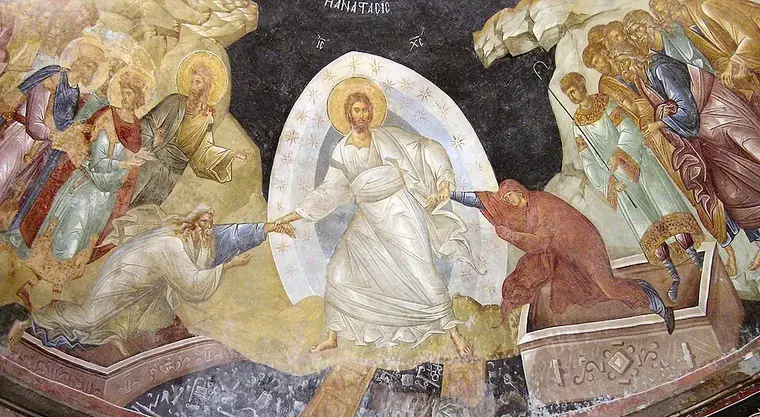
Easter, also called Pasch, Pascha, Pascua, or Resurrection Sunday, is a Christian festival and cultural holiday commemorating the resurrection of Jesus from the dead, described in the Bible's New Testament as having occurred on the third day of his burial following his crucifixion by the Romans at Calvary c. 30 AD. It is the culmination of the Passion of Jesus, preceded by Lent (or Great Lent), a 40-day period of fasting, prayer, and penance.
Easter-observing Christians commonly refer to the last week of Lent, before Easter, as Holy Week, which in Western Christianity begins on Palm Sunday (marking the entrance of Jesus in Jerusalem), includes Spy Wednesday (on which the betrayal of Jesus is mourned), and contains the days of the Easter Triduum including Maundy Thursday, commemorating the Maundy and Last Supper, as well as Good Friday, commemorating the crucifixion and death of Jesus. In Eastern Christianity, the same events are commemorated with the names of days all starting with "Holy" or "Holy and Great", and Easter itself might be called Great and Holy Pascha. In both Western and Eastern Christianity, Eastertide—also known as the Easter or Paschal season—begins on Easter Sunday and continues for seven weeks, concluding on the 50th day, Pentecost Sunday. However, in Eastern Christianity, the leavetaking of the feast occurs on the 39th day, the eve of the Feast of the Ascension.
Easter and its related holidays are moveable feasts, not falling on a fixed date; its date is computed based on a lunisolar calendar (solar year plus Moon phase) similar to the Hebrew calendar, generating a number of controversies. The First Council of Nicaea (325) established common Paschal observance by all Christians on the first Sunday after the first full moon on or after the vernal equinox. Even if calculated on the basis of the Gregorian calendar, the date of that full moon sometimes differs from that of the astronomical first full moon after the March equinox.
Easter is linked to the Jewish Passover by its name (פֶּסַח,; pascha; whence the term Pascha), by its origin (according to the synoptic Gospels, both the crucifixion and the resurrection took place during the week of Passover) and by much of its symbolism, as well as by its position in the calendar. In most European languages, both the Christian Easter and the Jewish Passover are called by the same name; and in the older English translations of the Bible, as well, the term Easter was used to translate Passover. The English term may derive from the Anglo-Saxon goddess name Ēostre.
Easter traditions vary across the Christian world, and include sunrise services or late-night vigils, exclamations and exchanges of Paschal greetings, flowering the cross, the wearing of Easter bonnets by women, clipping the church, and the decoration and the communal breaking of Easter eggs (a symbol of the empty tomb). The Easter lily, a symbol of the resurrection in Western Christianity, traditionally decorates the chancel area of churches on this day and for the rest of Eastertide. In addition to the viewing of Passion Plays during Lent and Easter, many television channels air films related to the resurrection, such as The Passion of the Christ, The Greatest Story Ever Told and The Jesus Film. Additional customs that have become associated with Easter and are observed by both Christians and some non-Christians include Easter parades, communal dancing (Eastern Europe), the Easter Bunny and egg hunting. There are also traditional Easter foods that vary by region and culture.
Etymology
The modern English term Easter, cognate with German Ostern, developed from an Old English word that usually appears in the form Ēastrun, Ēastron, or Ēastran; but also as Ēastru, Ēastro; and Ēastre or Ēostre. In the 8th century AD, Anglo-Saxon monk and scholar Bede recorded in his The Reckoning of Time that Ēosturmōnaþ (Old English for 'Month of Ēostre', translated in Bede's time as "Paschal month") was an English month, corresponding to April, which he says "was once called after a goddess of theirs named Ēostre, in whose honour feasts were celebrated in that month".
In Latin and Greek, the Christian celebration was, and still is, called (Greek: Πάσχα), a word derived from Aramaic פסחא, cognate to the Hebrew פֶּסַח. The word originally denoted the Jewish festival known in English as Passover, commemorating the Jewish Exodus from slavery in Egypt. As early as 50 AD, Paul the Apostle, writing from Ephesus to the Christians in Corinth, applied the term to Christ. It is unlikely that the Ephesian and Corinthian Christians were the first to hear Exodus 12 interpreted as speaking about the death of Jesus, not just about the Jewish Passover ritual. In most languages, the feast is known by names derived from the Greek and Latin. Pascha is also a name by which Jesus himself is remembered in the Orthodox Church, especially in connection with his resurrection and with the season of its celebration. Others call the holiday "Resurrection Sunday" or "Resurrection Day", after the Greek Ἀνάστασις.
Theological significance
Easter celebrates Jesus' supernatural resurrection from the dead, which is one of the chief tenets of the Christian faith. Paul writes that, for those who trust in Jesus's death and resurrection, "death is swallowed up in victory". The First Epistle of Peter declares that God has given believers "a new birth into a living hope through the resurrection of Jesus Christ from the dead". Christian theology holds that, through faith in the working of God, those who follow Jesus are spiritually resurrected with him so that they may walk in a new way of life and receive eternal salvation, and can hope to be physically resurrected to dwell with him in the Kingdom of Heaven.
Easter is linked to Passover and the Exodus from Egypt recorded in the Old Testament through the Last Supper, sufferings, and crucifixion of Jesus that preceded the resurrection. According to the three Synoptic Gospels, Jesus gave the Passover meal a new meaning, as in the upper room during the Last Supper he prepared himself and his disciples for his death. He identified the bread and cup of wine as his body, soon to be sacrificed, and his blood, soon to be shed. The Apostle Paul states in his First Epistle to the Corinthians: "Get rid of the old yeast that you may be a new batch without yeast—as you really are. For Christ, our Passover lamb, has been sacrificed." This refers to the requirement in Jewish law that Jews eliminate all, or leavening, from their homes in advance of Passover, and to the allegory of Jesus as the Passover lamb.
Early Christianity
As the Gospels assert that both the crucifixion and resurrection of Jesus occurred during the week of Passover, the first Christians timed the observance of the annual celebration of the resurrection in relation to Passover. Direct evidence for a more fully formed Christian festival of Pascha (Easter) begins to appear in the mid-2nd century. Perhaps the earliest extant primary source referring to Easter is a mid-2nd-century Paschal homily attributed to Melito of Sardis, which characterizes the celebration as a well-established one. Evidence for another kind of annually recurring Christian festival, those commemorating the martyrs, began to appear at about the same time as the above homily.
While martyrs' days (usually the individual dates of martyrdom) were celebrated on fixed dates in the local solar calendar, the date of Easter was fixed by means of the local Jewish lunisolar calendar. This is consistent with the celebration of Easter having entered Christianity during its earliest, Jewish period.
Date
Easter and holidays related to it are moveable feasts, in that they do not fall on a fixed date in the Gregorian or Julian calendars (both of which follow the cycle of the sun and the seasons). Instead, the date for Easter is determined on a lunisolar calendar similar to the Hebrew calendar.
The precise date of Easter has at times been a matter of contention. By the later 2nd century, it was widely accepted that the celebration of the holiday was a practice of the disciples and an undisputed tradition. The Quartodeciman controversy, the first of several Easter controversies, arose concerning the date on which the holiday should be celebrated.
The term "Quartodeciman" refers to the practice of ending the Lenten fast on Nisan 14 of the Hebrew calendar, "the 's passover". According to the church historian Eusebius, the Quartodeciman Polycarp (bishop of Smyrna, by tradition a disciple of John the Apostle) debated the question with Anicetus (bishop of Rome). The Roman province of Asia was Quartodeciman, while the Roman and Alexandrian churches continued the fast until the Sunday following (the Sunday of Unleavened Bread), wishing to associate Easter with Sunday. Neither Polycarp nor Anicetus persuaded the other, but they did not consider the matter schismatic either, parting in peace and leaving the question unsettled.
Controversy arose when Victor, bishop of Rome a generation after Anicetus, attempted to excommunicate Polycrates of Ephesus and all other bishops of Asia for their Quartodecimanism. According to Eusebius, a number of synods were convened to deal with the controversy, which he regarded as all ruling in support of Easter on Sunday. Polycrates (c. 190), however, wrote to Victor defending the antiquity of Asian Quartodecimanism. Victor's attempted excommunication was apparently rescinded, and the two sides reconciled upon the intervention of bishop Irenaeus and others, who reminded Victor of the tolerant precedent of Anicetus.
Quartodecimanism seems to have lingered into the 4th century, when Socrates of Constantinople recorded that some Quartodecimans were deprived of their churches by John Chrysostom and that some were harassed by Nestorius.
Position in the church year
In most branches of Western Christianity, Easter is preceded by Lent, a period of penitence that begins on Ash Wednesday, lasts 40 days (not counting Sundays), and is often marked with fasting. The week before Easter, known as Holy Week, is an important time for observers to commemorate the final week of Jesus' life on earth. The Sunday before Easter is Palm Sunday, with the Wednesday before Easter being known as Spy Wednesday (or Holy Wednesday). The last three days before Easter are Maundy Thursday, Good Friday and Holy Saturday (sometimes referred to as Silent Saturday).
Palm Sunday, Maundy Thursday and Good Friday respectively commemorate Jesus's entry in Jerusalem, the Last Supper and the crucifixion. Maundy Thursday, Good Friday, and Holy Saturday are sometimes referred to as the Easter Triduum (Latin for "Three Days"). Many churches begin celebrating Easter late in the evening of Holy Saturday at a service called the Easter Vigil.
The week beginning with Easter Sunday is called Easter Week or the Octave of Easter, and each day is prefaced with "Easter", e.g. Easter Monday (a public holiday in many countries), Easter Tuesday (a much less widespread public holiday), etc. Easter Saturday is therefore the Saturday after Easter Sunday. The day before Easter is properly called Holy Saturday. Eastertide, or Paschaltide, the season of Easter, begins on Easter Sunday and lasts until the day of Pentecost, seven weeks later.
In Eastern Christianity, the spiritual preparation for Easter/Pascha begins with Great Lent, which starts on Clean Monday and lasts for 40 continuous days (including Sundays). Great Lent ends on a Friday, and the next day is Lazarus Saturday. The Vespers which begins Lazarus Saturday officially brings Great Lent to a close, although the fast continues through the following week.
The Paschal Vigil begins with the Midnight Office, which is the last service of the Lenten Triodion and is timed so that it ends a little before midnight on Holy Saturday night. At the stroke of midnight the Paschal celebration itself begins, consisting of Paschal Matins, Paschal Hours, and Paschal Divine Liturgy.
Liturgical observance
The Easter festival is kept in many different ways among Western Christians. The traditional, liturgical observation of Easter, as practised among Roman Catholics, Lutherans, and some Anglicans begins on the night of Holy Saturday with the Easter Vigil which follows an ancient liturgy involving symbols of light, candles and water and numerous readings from the Old and New Testament.
Services continue on Easter Sunday and in a number of countries on Easter Monday. In parishes of the Moravian Church, as well as some other denominations such as the Methodist Churches, there is a tradition of Easter sunrise services, often starting in cemeteries in remembrance of the biblical narrative in the Gospels, or other places in the open where the sunrise is visible.
In some traditions, Easter services typically begin with the Paschal greeting: "Christ is risen!" The response is: "He is risen indeed. Alleluia!"
Eastern Orthodox, Eastern Catholics and Byzantine Rite Lutherans have a similar emphasis on Easter in their calendars, and many of their liturgical customs are very similar.
Preparation for Easter begins with the season of Great Lent, which begins on Clean Monday. While the end of Lent is Lazarus Saturday, fasting does not end until Easter Sunday. The Orthodox service begins late Saturday evening, observing the Jewish tradition that evening is the start of liturgical holy days.
Easter celebrations around the world
Easter is celebrated through various customs and practices across cultures and communities around the world. Eastertide is seen as a time of celebration and feasting, in contrast to the antecedent season of Lent, which is a time of penitence and fasting. Traditions include sunrise services or late-night vigils, exclamations and exchanges of Paschal greetings, flowering the cross, the wearing of Easter bonnets by women, and the custom of clipping the church. The Easter lily, a symbol of the resurrection in Christianity, traditionally decorates the chancel area of churches on this day and for the rest of Eastertide. There are also traditional Easter foods that vary by region and culture. The decoration and communal breaking of Easter eggs is a traditional practice, with the Easter egg symbolising the empty tomb. Related practices include egg rolling, egg tapping, and cascarones or confetti eggs. Egg hunting, originating in the idea of searching for the empty tomb, is an activity that remains popular among children. During the last century and a half, Easter has become increasingly commercialized, seeing wide sales of greeting cards and confectionery such as chocolate Easter eggs.
In countries where Christianity is a state religion, or those with large Christian populations, Easter is often a public holiday. As Easter always falls on a Sunday, many countries in the world also recognize Good Friday and Easter Monday as public holidays. Depending on the country, retail stores, shopping malls and restaurants may be closed on the Friday, Monday or Sunday.
In the Nordic countries, Good Friday, Easter Sunday, and Easter Monday are public holidays, and Good Friday and Easter Monday are bank holidays. In Denmark, Iceland and Norway, Maundy Thursday is also a public holiday; it is a holiday for most workers, except those operating some shopping malls which keep open for a half-day. Many businesses give their employees almost a week off, called Easter break. Schools are closed between Palm Sunday and Easter Monday. According to a 2014 poll, 6 of 10 Norwegians travel during Easter, often to a countryside cottage; 3 of 10 said their typical Easter included skiing.
Easter in Italy is one of that country's major holidays. Easter in Italy enters Holy Week with Palm Sunday, Maundy Thursday, Good Friday, and Holy Saturday, concluding with Easter Day and Easter Monday. Each day has a special significance. In Italy, both Easter Sunday and Easter Monday are national holidays, which results in a first and a second Easter Sunday, after which the week continues to a Tuesday. Also in the Netherlands, both Easter Sunday and Easter Monday are national holidays, and like first and second Christmas Day, they are both considered Sundays, resulting in a first and a second Easter Sunday, after which the week continues to a Tuesday.
Good Friday and Saturday as well as Easter Sunday and Monday are traditionally observed public holidays in Greece. It is customary for employees of the public sector to receive Easter bonuses as a gift from the state.
Text adapted from the Wikipedia article “Easter” (revision 1359884442, 2026-06-17), authors, licensed under CC BY-SA 4.0.