Christmas Crossword Puzzle
Free printable educational crossword puzzle. Every clue is a sentence sourced directly from the Wikipedia article on Christmas with the key terms blanked out. Kids version →
Christmas Crossword
Name: ____________________ Date: ______________
| 12G | ||||||||||||||||||||||||||
| A | ||||||||||||||||||||||||||
| 1H | E | I | R | L | O | O | M | 2M | ||||||||||||||||||
| L | I | |||||||||||||||||||||||||
| 5P | U | R | I | T | A | N | 8S | S | ||||||||||||||||||
| A | N | I | T | |||||||||||||||||||||||
| N | D | C | 4B | E | T | H | L | E | H | E | M | |||||||||||||||
| 9I | N | F | L | A | T | A | B | L | E | I | O | E | ||||||||||||||
| 10T | U | B | E | R | C | U | L | O | S | I | S | T | ||||||||||||||
| T | Y | T | O | |||||||||||||||||||||||
| O | 7W | O | E | |||||||||||||||||||||||
| N | 11M | 6U | K | R | A | I | N | E | ||||||||||||||||||
| E | E | E | ||||||||||||||||||||||||
| 3D | E | N | M | A | R | K | ||||||||||||||||||||
| I | T | |||||||||||||||||||||||||
| E | H | |||||||||||||||||||||||||
| V | ||||||||||||||||||||||||||
| A | ||||||||||||||||||||||||||
| L |
Across
- 1. Within some families, the pieces used to make the representation are considered a valuable family _____. (8 letters)
- 3. The first Christmas seal was issued in _____ in 1904, and since then other countries have issued their own Christmas seals. (7 letters)
- 4. In the Gospel of Matthew, by contrast, three magi follow a star to _____ to bring gifts to Jesus. (9 letters)
- 5. As in England, _____ in Colonial America staunchly opposed the observation of Christmas. (8 letters)
- 6. This followed the Orthodox Church of _____ formally adopting the Revised Julian calendar for fixed feasts and solemnities. (7 letters)
- 9. Many families have been decorating their houses with lights and in modern times, _____, to create a festive environment. (10 letters)
- 10. Christmas seals were first issued to raise funding to fight and bring awareness to _____. (12 letters)
Down
- 2. Other popular holiday plants include holly, _____, red amaryllis, and Christmas cactus. (9 letters)
- 4. Christmas observance was outlawed in _____ in 1659. (6 letters)
- 5. Slovenes prepare the traditional Christmas bread potica, bûche de Noël in France, _____ in Italy, and elaborate tarts and cakes. (9 letters)
- 7. The concentric assortment of leaves, usually from an evergreen, make up Christmas _____. (6 letters)
- 8. Some regions have special meals for Christmas Eve, such as _____, where 12 kinds of fish are served. (6 letters)
- 11. The Yule boar was a common feature of _____ Christmas feasts. (8 letters)
- 12. Along with a Christmas tree, the interior of a home may be decorated with these plants, along with _____ and evergreen foliage. (7 letters)
Clues are sentences from the Wikipedia article “Christmas” (revision 1361996453, CC BY-SA 4.0). crosswordprint.com/printable-crosswords/holidays/christmas/
Christmas Word Search
Name: ____________________ Date: ______________
Words to Find
crosswordprint.com/printable-crosswords/holidays/christmas/
Pick the word that completes each sentence from the Wikipedia article.
Is the sentence correct? Some sentences have one word altered.
Click a clue, then click the word it belongs to.
Unscramble each word. The clue is the sentence it was taken from.
How to Solve & Use the Answer Key
This is a fill-in crossword. Each clue is a sentence from the Wikipedia article on Christmas, with the key term blanked out. The number in parentheses shows the letter count. Solve interactively on screen or check Show answers to view the answer key. To print a clean student worksheet, press Print Puzzle.
Christmas Crossword Answer Key & Definitions
Show Complete Answers & Word Definitions
- 1 Across: HEIRLOOM — In popular usage, an heirloom is something that has been passed down for generations through family members. Wikipedia: Heirloom
- 3 Across: DENMARK — Denmark is a Nordic country in Northern Europe. Wikipedia: Denmark
- 4 Across: BETHLEHEM — Bethlehem is a city in the West Bank, Palestine, located about 10 km south of Jerusalem, and the capital of the Bethlehem Governorate. Wikipedia: Bethlehem
- 5 Across: PURITANS
- 6 Across: UKRAINE — Ukraine is a country in Eastern Europe. It is the second-largest country in Europe after Russia, which borders it to the east and northeast. Wikipedia: Ukraine
- 9 Across: INFLATABLE — An inflatable is an object that can be inflated with a gas, usually with air, but hydrogen, helium, and nitrogen are also used. Wikipedia: Inflatable
- 10 Across: TUBERCULOSIS — Tuberculosis, also known colloquially as the "white death", or historically as consumption, is a contagious disease usually caused by Mycobacterium tuberculosis (MTB) bacteria. Wikipedia: Tuberculosis
- 2 Down: MISTLETOE — Mistletoe is the common name for obligate hemiparasitic plants in the order Santalales. Wikipedia: Mistletoe
- 4 Down: BOSTON — Boston is the capital and most populous city of the U.S. Wikipedia: Boston
- 5 Down: PANETTONE — Panettone is an Italian sweet bread and fruitcake that is associated with the city of Milan. Wikipedia: Panettone
- 7 Down: WREATH — A wreath is an assortment of flowers, leaves, fruits, twigs, or various materials that is constructed to form a ring shape. Wikipedia: Wreath
- 8 Down: SICILY — Sicily (Italian and Sicilia), officially the Sicilian Region, is an island in the central Mediterranean Sea and one of the twenty regions of Italy, situated south of the Italian Peninsula in continental Europe. Wikipedia: Sicily
- 11 Down: MEDIEVAL — In the history of Europe, the Middle Ages or medieval period lasted approximately from the 5th to late 15th centuries, comparable with the post-classical period of global history. Wikipedia: Middle Ages
- 12 Down: GARLAND — A garland is a decorative braid, knot or wreath of flowers, leaves, or other material. Wikipedia: Garland
Definitions adapted from Wikipedia articles (week 2026-W41), CC BY-SA 4.0.
Read about Christmas
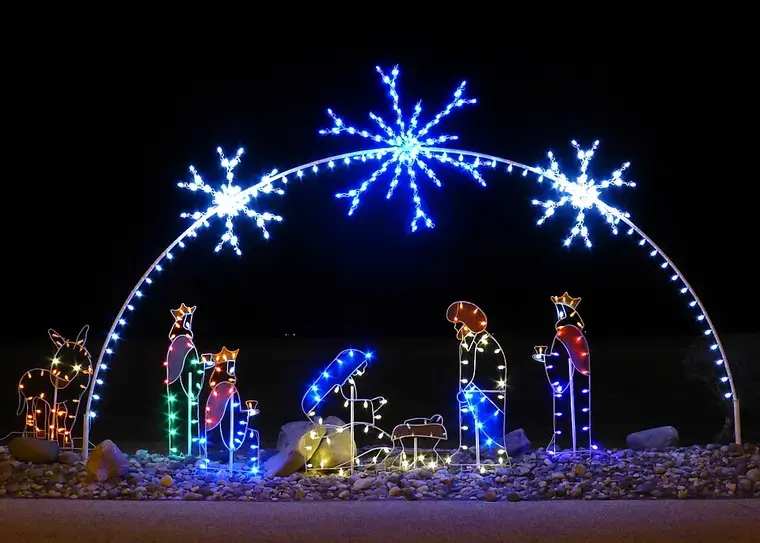
Christmas is an annual celebration commemorating the birth of Jesus Christ, observed primarily on December 25 as a religious and cultural celebration among billions of people around the world. A liturgical feast central to Christianity, Christmas preparation begins on the First Sunday of Advent. Advent is followed by Christmastide, which historically in the West lasts twelve days and culminates on Twelfth Night. Christmas Day is a public holiday in many countries and is observed by a majority of Christians; it is also celebrated culturally by many non-Christians and forms an integral part of the annual holiday season.
The traditional Christmas narrative recounted in the New Testament, known as the Nativity of Jesus, says that Jesus was born in Bethlehem, in accordance with messianic prophecies. When Joseph and Mary arrived in the city, the inn had no room, and so they were offered a stable where the Christ Child was soon born, with angels proclaiming this news to shepherds, who then spread the word.
There are different hypotheses regarding the date of the birth of Jesus. In the early fourth century, the church fixed the date as December 25, the date of the winter solstice in the Roman Empire. It is nine months after Annunciation on March 25, also the Roman date of the spring equinox. Most Christians celebrate on December 25 in the Gregorian calendar, which has been adopted almost universally in the civil calendars used in countries throughout the world. However, part of the Eastern Christian Churches celebrate Christmas on December 25 of the older Julian calendar, which currently corresponds to January 7 in the Gregorian calendar. For Christians, celebrating that God came into the world in the form of man to atone for the sins of humanity is more important than knowing Jesus Christ's exact birth date.
The customs associated with Christmas in various countries have a mix of pre-Christian, Christian, and secular themes and origins. Popular holiday traditions include gift-giving; completing an Advent calendar or Advent wreath; Christmas music and carolling; watching Christmas films; viewing a Nativity play; an exchange of Christmas cards; attending church services; a special meal; and displaying various Christmas decorations, including Christmas trees, Christmas lights, nativity scenes, poinsettias, garlands, wreaths, mistletoe, and holly. Additionally, several related and often interchangeable figures, known as Santa Claus, Father Christmas, Saint Nicholas, and Christkind, are associated with bringing gifts to children during the Christmas season and have their own body of traditions and lore. Because gift-giving and many other aspects of the Christmas festival involve heightened economic activity, Christmas has become a significant event and a key sales period for retailers and businesses. Over the past few centuries, Christmas has had a steadily growing economic effect in many regions of the world.
Etymology
The English word Christmas is a shortened form of 'Christ's Mass'. The word is recorded as Crīstesmæsse in 1038 and Cristes-messe in 1131. Crīst (genitive Crīstes) is from the Koine Greek Χριστός ('Christ'), a translation of the Hebrew ('Messiah'), meaning 'anointed'; and mæsse is from the Latin missa, the celebration of the Eucharist.
The form Christenmas was also used during some periods, but is now considered archaic. The term derives from Middle English Cristenmasse. Xmas is an abbreviation of Christmas, particularly in print, based on the initial letter chi (Χ) in the Greek Χριστός (Christ), although some style guides discourage its use. This abbreviation has a precedent in Middle English Χρ̄es masse (where Χρ̄ is another abbreviation of the Greek word).
The Anglo-Saxons referred to Christmas as midwinter. The period corresponding to December and January was called Gēola ('Yule'), and this term was eventually equated with Christmastide; Old English Ġeōhel-dæg ('Yule Day') was sometimes used as a name for Christmas Day. Yule or Yuil survived as the main name for Christmastide in Scotland until the modern era.
A rare name for Christmas in Old English was Nātiuiteð ('Nativity'), from the Latin nātīvitās meaning 'birth'. 'Noel' (also 'Nowel' or 'Nowell', as in "The First Nowell") entered English in the late 14th century and is from the Old French noël or naël, itself ultimately from the Latin nātālis (diēs) meaning 'birth (day)'.
Koleda is the traditional Slavic name for Christmas and the period from Christmas to Epiphany or, more generally, to Slavic Christmastide rituals, some dating to pre-Christian times.
Nativity
The gospels of Luke and Matthew describe Jesus as being born in Bethlehem of Judea to the Virgin Mary. In the Gospel of Luke, Joseph and Mary travel from Nazareth to Bethlehem in order to be counted for a census, and Jesus is born there and placed in a manger. Angels proclaim him a savior for all people, and three shepherds come to adore him. In the Gospel of Matthew, by contrast, three magi follow a star to Bethlehem to bring gifts to Jesus.
History
In the 2nd century, the "earliest church records" indicate that "Christians were remembering and celebrating the birth of the Lord", an "observance [that] sprang up organically from the authentic devotion of ordinary believers"; although "they did not agree upon a set date". Though Christmas did not appear on the lists of festivals given by the early Christian writers Irenaeus and Tertullian, the early Church Fathers John Chrysostom, Augustine of Hippo, and Jerome attested to December 25 as the date of Christmas toward the end of the fourth century.
The earliest document to place Jesus's birthday on December 25 is the Chronograph of 354 (also called the Calendar of Filocalus), which also names it as the birthday of the god Sol Invictus (the 'Invincible Sun'). Liturgical historians generally agree that this part of the text was written in Rome in AD 336. This is consistent with the assertion that the date was formally set by Pope Julius I, bishop of Rome from 337 to 352. December 25 was the traditional date of the winter solstice in the Roman Empire, where most Christians lived, and the Roman festival Dies Natalis Solis Invicti (birthday of Sol Invictus) had been held on this date since AD 274.
In the East, the birth of Jesus was celebrated in connection with the Epiphany on January 6. This holiday was not primarily about Christ's birth, but rather his baptism. Christmas was promoted in the East as part of the revival of Orthodox Christianity that followed the death of the pro-Arian Emperor Valens at the Battle of Adrianople in 378. The feast was introduced in Constantinople in 379, in Antioch by John Chrysostom towards the end of the fourth century, probably in 388, and in Alexandria in the following century. There is evidence that Christmas was celebrated in Jerusalem by the sixth century.
In the Early Middle Ages, Christmas Day was overshadowed by Epiphany, which in western Christianity focused on the visit of the magi. However, the medieval calendar was dominated by Christmas-related holidays. The forty days before Christmas became the "forty days of St. Martin" (which began on November 11, the feast of St. Martin of Tours), now known as Advent. In Italy, former Saturnalian traditions were attached to Advent. Around the 12th century, these traditions transferred again to the Twelve Days of Christmas (December 25 – January 5); a time that appears in the liturgical calendars as Christmastide or Twelve Holy Days.
In 567, the Council of Tours put in place the season of Christmastide, proclaiming "the twelve days from Christmas to Epiphany as a sacred and festive season, and established the duty of Advent fasting in preparation for the feast". This was done in order to solve the "administrative problem for the Roman Empire as it tried to coordinate the solar Julian calendar with the lunar calendars of its provinces in the east".
Observance and traditions
Christmas Day is celebrated as a major festival and public holiday in countries around the world, including many whose populations are mostly non-Christian. In some non-Christian areas, periods of former colonial rule introduced the celebration (e.g. Hong Kong); in others, Christian minorities or foreign cultural influences have led populations to observe the holiday. Countries such as Japan, where Christmas is popular despite there being only a small number of Christians, have adopted many of the cultural aspects of Christmas, such as gift-giving, decorations, and Christmas trees. A similar example is in Turkey, being Muslim-majority and with a small number of Christians, where Christmas trees and decorations tend to line public streets during the festival.
Many popular customs associated with Christmas developed independently of the commemoration of Jesus's birth, with some claiming that certain elements are Christianized and have origins in pre-Christian festivals that were celebrated by pagan populations who were later converted to Christianity; other scholars reject these claims and affirm that Christmas customs largely developed in a Christian context. The prevailing atmosphere of Christmas has also continually evolved since the holiday's inception, ranging from a sometimes raucous, drunken, carnival-like state in the Middle Ages, to a tamer family-oriented and children-centered theme introduced in a 19th-century transformation. The celebration of Christmas was banned on more than one occasion within certain groups, such as the Puritans and Jehovah's Witnesses (who do not celebrate birthdays in general), due to concerns that it was too unbiblical. Celtic winter herbs such as mistletoe and ivy, and the custom of kissing under a mistletoe, are common in modern Christmas celebrations in the English-speaking countries.
The pre-Christian Germanic peoples—including the Anglo-Saxons and the Norse—celebrated a winter festival called Yule, held in the late December to early January period, yielding modern English yule, today used as a synonym for Christmas. In Germanic language-speaking areas, numerous elements of modern Christmas folk custom and iconography may have originated from Yule, including the Yule log, Yule boar, and the Yule goat. Often leading a ghostly procession through the sky (the Wild Hunt), the long-bearded god Odin is referred to as "the Yule one" and "Yule father" in Old Norse texts, while other gods are referred to as "Yule beings". On the other hand, as there are no reliable existing references to a Christmas log prior to the 16th century, the burning of the Christmas block may have been an early modern invention by Christians unrelated to the pagan practice.
Among countries with a strong Christian tradition, a variety of Christmas celebrations have developed that incorporate regional and local cultures. For example, in eastern Europe Christmas celebrations incorporated pre-Christian traditions such as the Koleda, which shares parallels with the Christmas carol.
Christmas Day (inclusive of its vigil, Christmas Eve), is a Festival in the Lutheran Churches, a solemnity in the Roman Catholic Church, and a Principal Feast of the Anglican Communion. Other Christian denominations do not rank their feast days but nevertheless place importance on Christmas Eve/Christmas Day, as with other Christian feasts like Easter, Ascension Day, and Pentecost. As such, for Christians, attending a Christmas Eve or Christmas Day church service plays an important part in the recognition of the Christmas season. Christmas, along with Easter, is the period of the highest annual church attendance. A 2010 survey by LifeWay Christian Resources found that six in ten Americans attend church services during this time. In the United Kingdom, the Church of England reported an estimated attendance of 2.5million people at Christmas services in 2015.
Choice of date
There are several theories as to why December 25 was chosen as the date for Christmas. However, according to theology professor Susan Roll, liturgical historians agree that it was linked in some way with "the sun, the winter solstice and the popularity of solar worship in the later Roman Empire". In Roman tradition, December 25 was deemed to be the winter solstice and March 25 the spring equinox, dates that retained significance despite Julian calendar drift. Greco-Roman writers in the second and third centuries called December 25 the birth day of the Sun. The early Church linked Jesus to the Sun and referred to him as the 'true Sun' or 'Sun of Righteousness'. In the early fifth century, Augustine of Hippo and Maximus of Turin preached that it was fitting to celebrate Christ's birth at the winter solstice, because it marked the point when the hours of daylight begin to grow. The use of solar imagery for Christ is understood as part of broader cosmological symbolism in late antiquity, and may not have been direct cultic borrowing.
The 'history of religions' or 'substitution' theory proposes that the Church chose December 25 as Christ's birthday (dies Natalis Christi) to appropriate the Roman winter solstice festival dies Natalis Solis Invicti, the birthday of the god Sol Invictus (the 'Invincible Sun'). It had been held on this date since 274 AD; before the earliest evidence of Christmas on December 25. Professor Gary Forsythe says that the Natalis Solis Invicti followed "the seven-day period of the Saturnalia (December 17–23), Rome's most joyous holiday season since Republican times, characterized by parties, banquets, and exchanges of gifts". Roll says that "the specific nature of the relation" between Christmas and the Natalis Solis Invicti has not yet been "conclusively proven from extant texts".
The 'calculation theory' proposes that the date arose from Christian chronography rather than from an effort to supplant a pagan festival. It was first proposed by Louis Duchesne. Some early Christians marked Jesus's death on the day before Passover, the 14th of Nisan. Several third‑century sources correlate this with the spring equinox on March 25. Duchesne conjectured that early Christians believed Jesus was conceived and died on the same date, yielding a March 25 conception and December 25 birth nine months later. However, he admitted that this belief is not found in any early Christian text. The earliest attestation of a December 25 Nativity may be contemporaneous with or earlier than clear attestations of a December 25 Sol Invictus festival.
Some jurisdictions of the Eastern Orthodox Church, including those of Russia, Georgia, North Macedonia, Montenegro, Serbia, and Jerusalem, mark feasts using the older Julian calendar. Since Christmas 1899 until Christmas 2099 inclusive, there is a difference of 13 days between the Julian calendar and the modern Gregorian calendar. As a result, December 25 on the Julian calendar currently corresponds to January 7 on the calendar used by most governments and people in everyday life. Therefore, the aforementioned Orthodox Christians mark December 25 (and thus Christmas) on the day that is internationally considered to be January 7.
However, following the Council of Constantinople in 1923, other Orthodox Christians, such as those belonging to the jurisdictions of Constantinople, Bulgaria, Greece, Romania, Antioch, Alexandria, Albania, Cyprus, Finland, and the Orthodox Church in America, among others, began using the Revised Julian calendar, which at present corresponds exactly to the Gregorian calendar. Therefore, these Orthodox Christians mark December 25 (and thus Christmas) on the same day that is internationally considered to be December 25.
Economy
Christmas is typically a peak selling season for retailers in many nations around the world; sales increase dramatically during this time as people purchase gifts, decorations, and supplies to celebrate. In the United States, the "Christmas shopping season" starts as early as October. In Canada, merchants begin advertising campaigns before Halloween (October 31) and step up their marketing following Remembrance Day on November 11. In the UK and Ireland, the Christmas shopping season starts from mid-November, around the time when high street Christmas lights are turned on. A concept devised by retail entrepreneur David Lewis, the first Christmas grotto opened in Lewis's department store in Liverpool, England in 1879. In the United States, it has been calculated that a quarter of all personal spending takes place during the Christmas/holiday shopping season. Figures from the US Census Bureau reveal that expenditure in department stores nationwide rose from $20.8billion in November 2004 to $31.9billion in December 2004, an increase of 54 percent. In other sectors, the pre-Christmas increase in spending was even greater, there being a November–December buying surge of 100 percent in bookstores and 170 percent in jewelry stores. In the same year employment in American retail stores rose from 1.6million to 1.8million in the two months leading up to Christmas. Industries completely dependent on Christmas include Christmas cards, of which 1.9billion are sent in the United States each year, and live Christmas trees, of which 20.8million were cut in the US in 2002. In the UK in 2010, up to £8billion was expected to be spent online at Christmas, approximately a quarter of total retail festive sales.
In most Western nations, Christmas Day is the least active day of the year for business and commerce; almost all retail, commercial and institutional businesses are closed, and almost all industries cease activity (more than any other day of the year), whether laws require such or not. In England and Wales, the Christmas Day (Trading) Act 2004 prevents all large shops from trading on Christmas Day. Similar legislation was approved in Scotland in 2007. Film studios release many high-budget movies during the holiday season, including Christmas films, fantasy movies or high-tone dramas with high production values to hopes of maximizing the chance of nominations for the Academy Awards.
One economist's analysis calculates that despite increased overall spending, Christmas is a deadweight loss under orthodox microeconomic theory, because of the effect of gift-giving. This loss is calculated as the difference between what the gift giver spent on the item and what the gift receiver would have paid for the item. It is estimated that in 2001, Christmas resulted in a $4billion deadweight loss in the US alone. Because of complicating factors, this analysis is sometimes used to discuss possible flaws in current microeconomic theory. Other deadweight losses include the effects of Christmas on the environment and the fact that material gifts are often perceived as white elephants, imposing cost for upkeep and storage and contributing to clutter.
Prohibition
Christmas has been the subject of controversy and attacks from various sources, both Christian and non-Christian. Historically, it was prohibited by Puritans during their ascendency in the Commonwealth of England (1647–1660) and in Colonial New England where the Puritans outlawed the celebration of Christmas in 1659 on the grounds that Christmas was not mentioned in Scripture and therefore violated the regulative principle of worship. The Parliament of Scotland, which was dominated by Presbyterians, passed a series of acts outlawing the observance of Christmas between 1637 and 1690; Christmas Day did not become a public holiday in Scotland until 1871. Today, some conservative Reformed denominations such as the Free Presbyterian Church of Scotland and the Reformed Presbyterian Church of North America likewise reject the celebration of Christmas based on the regulative principle and what they see as its non-Scriptural origin. Celebrating Christmas is banned in the Jehovah's Witnesses, as the Governing Body believes that Christmas is originally pagan and without basis in Scripture. Christmas celebrations have also been prohibited by atheist states such as the Soviet Union and in 2015 by the majority Muslim states of Somalia, Tajikistan and Brunei.
As Christmas celebrations began to spread globally even outside traditional Christian cultures, several Muslim-majority countries began to ban the observance of Christmas, claiming it undermined Islam. In December 2018, the Iraqi Council of Ministers amended the national holidays law in order to designate Christmas Day (December 25) an official nationwide holiday which is to be celebrated by all Iraqis instead of only the country's Christian minority. In 2023, public Christmas celebrations were cancelled in Bethlehem, the city synonymous with the birth of Jesus. Palestinian leaders of various Christian denominations cited the ongoing Israel–Gaza war in their unanimous decision to cancel celebrations.
The government of the People's Republic of China officially espouses state atheism, and has conducted antireligious campaigns to this end. In December 2018, officials raided Christian churches prior to Christmastide and coerced them to close; Christmas trees and Santa Clauses were also forcibly removed.
Text adapted from the Wikipedia article “Christmas” (revision 1361996453, 2026-07-01), authors, licensed under CC BY-SA 4.0.