Volcano Crossword Puzzle
Free printable educational crossword puzzle. Every clue is a sentence sourced directly from the Wikipedia article on Volcano with the key terms blanked out.
Volcano Crossword
Name: ____________________ Date: ______________
| 12G | 10D | ||||||||||||||||||||
| 5C | A | 13R | B | O | N | A | |||||||||||||||
| 6M | I | D | 1S | C | |||||||||||||||||
| 7T | U | Y | A | L | 9S | E | I | S | M | I | C | ||||||||||
| R | L | L | T | ||||||||||||||||||
| 4T | R | O | P | O | S | 8P | H | E | R | E | I | 2V | E | S | U | V | I | U | S | ||
| U | I | C | |||||||||||||||||||
| F | N | 11A | N | T | A | R | C | T | I | C | A | ||||||||||
| F | 3V | U | L | C | A | N | O | T | |||||||||||||
| T | E | ||||||||||||||||||||
| U | |||||||||||||||||||||
| B | |||||||||||||||||||||
| O |
Across
- 2. They are named after Pliny the Younger, who chronicled the Plinian eruption of Mount _____ in 79 AD. (8 letters)
- 3. The study of volcanism and volcanoes is called volcanology [mid-19th century: from volcano + -logy], sometimes spelled _____. (7 letters)
- 4. Large eruptions can affect atmospheric temperature as ash and droplets of sulfuric acid obscure the Sun and cool Earth's _____. (11 letters)
- 5. Water vapour is typically the most abundant volcanic gas, followed by _____ dioxide and sulfur dioxide. (6 letters)
- 7. These volcanoes are also called table mountains, _____, or (in Iceland) mobergs. (4 letters)
- 9. However, dormant volcanoes are technically considered to be _____ "active". (7 letters)
- 11. Cinder Hill, a feature of Mount Bird on Ross Island, _____, is a prominent example of a dissected volcano. (10 letters)
Down
- 1. It is covered with volcanoes that erupt sulfur, sulfur dioxide and _____ rock, and as a result, Io is constantly being resurfaced. (8 letters)
- 4. The Romans often used _____, which is abundant in Italy, for construction. (4 letters)
- 6. There are several extinct volcanoes on _____, four of which are vast shield volcanoes far bigger than any on Earth. (4 letters)
- 8. One example of such a recent successful volcanic evacuation was the Mount _____ evacuation of 1991. (8 letters)
- 10. Felsic lavas (_____ or rhyolites) are highly viscous and are erupted as domes or short, stubby flows. (6 letters)
- 12. Many ancient accounts ascribe volcanic eruptions to supernatural causes, such as the actions of _____ or demigods. (4 letters)
- 13. However, the Moon does have many volcanic features such as maria (the darker patches seen on the Moon), _____ and domes. (5 letters)
Clues are sentences from the Wikipedia article “Volcano” (revision 1359260399, CC BY-SA 4.0). crosswordprint.com/printable-crosswords/earth-science/volcano/
Volcano Word Search
Name: ____________________ Date: ______________
Words to Find
crosswordprint.com/printable-crosswords/earth-science/volcano/
Pick the word that completes each sentence from the Wikipedia article.
Is the sentence correct? Some sentences have one word altered.
Click a clue, then click the word it belongs to.
Unscramble each word. The clue is the sentence it was taken from.
How to Solve & Use the Answer Key
This is a fill-in crossword. Each clue is a sentence from the Wikipedia article on Volcano, with the key term blanked out. The number in parentheses shows the letter count. Solve interactively on screen or check Show answers to view the answer key. To print a clean student worksheet, press Print Puzzle.
Volcano Crossword Answer Key & Definitions
Show Complete Answers & Word Definitions
- 2 Across: VESUVIUS — Mount Vesuvius is a somma–stratovolcano located on the Gulf of Naples in Campania, Italy, about 9 km east of Naples and a short distance from the shore. Wikipedia: Mount Vesuvius
- 3 Across: VULCANO — Vulcano (Vurcanu) or Vulcan is a small volcanic island belonging to Italy in the Tyrrhenian Sea, about 20 km north of Sicily and located at the southernmost end of the seven Aeolian Islands. Wikipedia: Vulcano
- 4 Across: TROPOSPHERE — The troposphere is the lowest layer of the atmosphere of Earth. Wikipedia: Troposphere
- 5 Across: CARBON — Carbon is a chemical element; it has symbol C and atomic number 6. Wikipedia: Carbon
- 7 Across: TUYA — A tuya is a flat-topped, steep-sided volcano formed when lava erupts through a thick glacier or ice sheet. Wikipedia: Tuya
- 9 Across: SEISMIC — Seismology (from Ancient Greek σεισμός (seismós), meaning 'earthquake', and -λογία (-logía), meaning 'study of') is the scientific study of earthquakes (or generally, quakes) and the generation and propagation of elastic waves through planetary bodies. Wikipedia: Seismology
- 11 Across: ANTARCTICA — Antarctica is Earth's southernmost and least-populated continent. Wikipedia: Antarctica
- 1 Down: SILICATE — A silicate is any member of a family of polyatomic anions consisting of silicon and oxygen, usually with the general formula, where 0 ≤ x < 2. Wikipedia: Silicate
- 4 Down: TUFF — Tuff is a type of rock made of volcanic ash ejected from a vent during a volcanic eruption. Wikipedia: Tuff
- 6 Down: MARS — Mars is the fourth planet from the Sun. It is also known as the "Red Planet", for its orange-red appearance. Wikipedia: Mars
- 8 Down: PINATUBO — Mount Pinatubo is an active stratovolcano in the Zambales Mountains in Luzon in the Philippines. Wikipedia: Mount Pinatubo
- 10 Down: DACITE — Dacite is a volcanic rock formed by rapid solidification of lava that is high in silica and low in alkali metal oxides. Wikipedia: Dacite
- 12 Down: GODS — A deity or god is a supernatural being considered to have authority over some aspect of the universe and/or life, with many also being considered as sacred and worthy of worship. Wikipedia: Deity
- 13 Down: RILLE — Rille (German for 'groove') is typically used to describe any of the long, narrow depressions in the surface of the Moon that resemble channels. Wikipedia: Rille
Definitions adapted from Wikipedia articles (week 2026-W41), CC BY-SA 4.0.
Read about Volcano
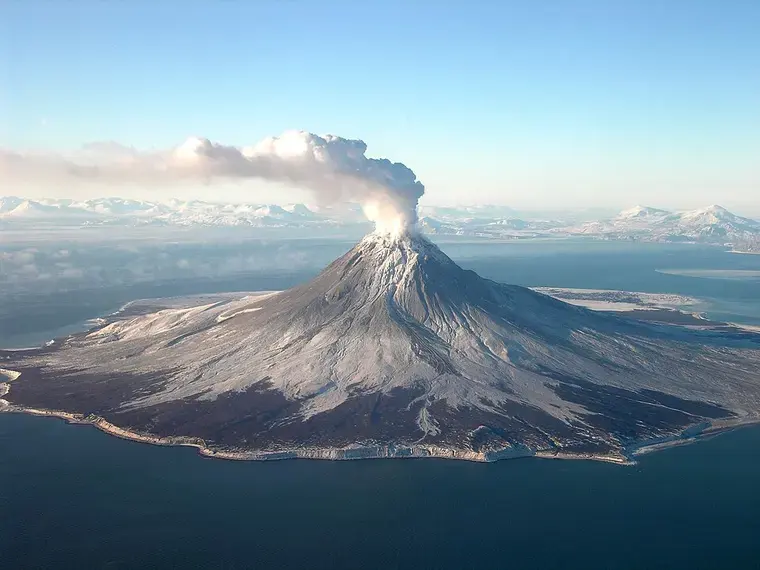
A volcano is a vent or fissure in the crust of a planetary-mass object that allows hot lava, volcanic ash, and gases to escape from a magma chamber below the surface. On Earth, volcanoes are most often found where tectonic plates are diverging or converging, and because most of Earth's plate boundaries are underwater, most volcanoes are found underwater. For example, a mid-ocean ridge, such as the Mid-Atlantic Ridge, has volcanoes caused by divergent tectonic plates whereas the Pacific Ring of Fire has volcanoes caused by convergent tectonic plates. Volcanoes resulting from divergent tectonic activity are usually non-explosive whereas those resulting from convergent tectonic activity cause violent eruptions. Volcanoes can also form where there is stretching and thinning of the crust's plates, such as in the East African Rift, the Wells Gray-Clearwater volcanic field, and the Rio Grande rift in North America. Volcanism away from plate boundaries most likely arises from upwelling diapirs from the core–mantle boundary called mantle plumes, 3000 km deep within Earth. This results in hotspot volcanism or intraplate volcanism, in which the plume may cause thinning of the crust and result in a volcanic island chain due to the continuous movement of the tectonic plate, of which the Hawaiian hotspot is an example. Volcanoes are usually not created at transform tectonic boundaries where two tectonic plates slide past one another.
Volcanoes, based on their frequency of eruption or volcanism, are referred to as either active, dormant, or extinct. Active volcanoes have a history of volcanism and are likely to erupt again, while extinct ones are not capable of eruption at all as they have no magma source. "Dormant" volcanoes have not erupted in a long time – generally accepted as since the start of the Holocene, about 12,000 years ago – but may erupt again. However, dormant volcanoes are technically considered to be seismically "active". These categories are not entirely uniform; they may overlap for certain examples. Large eruptions can affect atmospheric temperature as ash and droplets of sulfuric acid obscure the Sun and cool Earth's troposphere. Historically, large volcanic eruptions have been followed by volcanic winters which have caused catastrophic famines.
Other planets besides Earth have volcanoes. For example, volcanoes are very numerous on Venus. Mars has significant volcanoes. In 2009, a paper was published suggesting a new definition for the word 'volcano' that includes processes such as cryovolcanism. It suggested that a volcano be defined as 'an opening on a planet or moon's surface from which magma, as defined for that body, and/or magmatic gas is erupted.'
Etymology and terminology
The word volcano originates from the early 17th century, derived from the Italian name Vulcano, a volcanic island in the Aeolian Islands of Italy, which in turn comes from the Latin name or, referring to Vulcan, the god of fire in Roman mythology.
The set of processes and phenomena involved in volcanic activity is called volcanism [early 19th century: from volcano + -ism]. The study of volcanism and volcanoes is called volcanology [mid-19th century: from volcano + -logy], sometimes spelled vulcanology.
Plate tectonics
According to the theory of plate tectonics, Earth's lithosphere, its rigid outer shell, is broken into sixteen larger and several smaller plates. These move continuously at a slow pace, due to convection in the underlying ductile mantle, and most volcanic activity on Earth takes place along plate boundaries, where plates are converging (and lithosphere is being destroyed) or are diverging (and new lithosphere is being created).
During the development of geological theory, certain concepts that allowed the grouping of volcanoes in time, place, structure and composition have developed that ultimately have had to be explained in the theory of plate tectonics. For example, some volcanoes are polygenetic with more than one period of activity during their history; other volcanoes that become extinct after erupting exactly once are monogenetic (meaning "one life") and such volcanoes are often grouped together in a geographical region.
At the mid-ocean ridges, two tectonic plates diverge from one another as hot mantle rock creeps upwards beneath the thinned oceanic crust. The decrease of pressure in the rising mantle rock leads to adiabatic expansion and the partial melting of the rock, causing volcanism and creating new oceanic crust. Most divergent plate boundaries are at the bottom of the oceans, and so most volcanic activity on Earth is submarine, forming new seafloor. Black smokers (also known as deep sea vents) are evidence of this kind of volcanic activity. Where the mid-oceanic ridge is above sea level, volcanic islands are formed, such as Iceland.
Subduction zones are places where two plates, usually an oceanic plate and a continental plate, collide. The oceanic plate subducts (dives beneath the continental plate), forming a deep ocean trench just offshore. In a process called flux melting, water released from the subducting plate lowers the melting temperature of the overlying mantle wedge, thus creating magma. This magma tends to be extremely viscous because of its high silica content, so it often does not reach the surface but cools and solidifies at depth. When it does reach the surface, however, a volcano is formed. Thus subduction zones are bordered by chains of volcanoes called volcanic arcs. Typical examples are the volcanoes in the Pacific Ring of Fire, such as the Cascade Volcanoes or the Japanese archipelago, or the eastern islands of Indonesia.
Hotspots are volcanic areas thought to be formed by mantle plumes, which are hypothesized to be columns of hot material rising from the core-mantle boundary. As with mid-ocean ridges, the rising mantle rock experiences decompression melting which generates large volumes of magma. Because tectonic plates move across mantle plumes, each volcano becomes inactive as it drifts off the plume, and new volcanoes are created where the plate advances over the plume. The Hawaiian Islands are thought to have been formed in such a manner, as has the Snake River Plain, with the Yellowstone Caldera being part of the North American plate currently above the Yellowstone hotspot. However, the mantle plume hypothesis has been questioned.
Volcanic features
A volcano needs a reservoir of molten magma (e.g. a magma chamber), a conduit to allow magma to rise through the crust, and a vent to allow the magma to escape above the surface as lava. The erupted volcanic material (lava and tephra) that is deposited around the vent is known as a, typically a volcanic cone or mountain.
The most common perception of a volcano is of a conical mountain, spewing lava and poisonous gases from a crater at its summit; however, this describes just one of the many types of volcano. The features of volcanoes are varied. The structure and behaviour of volcanoes depend on several factors. Some volcanoes have rugged peaks formed by lava domes rather than a summit crater while others have landscape features such as massive plateaus. Vents that issue volcanic material (including lava and ash) and gases (mainly steam and magmatic gases) can develop anywhere on the landform and may give rise to smaller cones such as Puu Ōō on a flank of Kīlauea in Hawaii. Volcanic craters are not always at the top of a mountain or hill and may be filled with lakes such as with Lake Taupō in New Zealand. Some volcanoes can be low-relief landform features, with the potential to be hard to recognize as such and be obscured by geological processes.
Other types of volcano include mud volcanoes, which are structures often not associated with known magmatic activity; and cryovolcanoes (or ice volcanoes), particularly on some moons of Jupiter, Saturn, and Neptune. Active mud volcanoes tend to involve temperatures much lower than those of igneous volcanoes except when the mud volcano is actually a vent of an igneous volcano.
Volcanic fissure vents are generally found at diverging plate boundaries, they are flat, linear fractures through which basaltic lava emerges. These kinds of volcanoes are non-explosive and the basaltic lava tends to have a low viscosity and solidifies slowly leading to a gentle sloping basaltic lava plateau. They often relate or constitute shield volcanoes
Shield volcanoes, so named for their broad, shield-like profiles, are formed by the eruption of low-viscosity basaltic or andesitic lava that can flow a great distance from a vent. They generally do not explode catastrophically but are characterized by relatively gentle effusive eruptions. Since low-viscosity magma is typically low in silica, shield volcanoes are more common in oceanic than continental settings. The Hawaiian volcanic chain is a series of shield cones, and they are common in Iceland, as well. Olympus Mons, an extinct martian shield volcano is the largest known volcano in the Solar System.
Erupted material
The material that is expelled in a volcanic eruption can be classified into three types:
Volcanic gases, a mixture made mostly of steam, carbon dioxide, and a sulfur compound (either sulfur dioxide, SO2, or hydrogen sulfide, H2S, depending on the temperature)
Lava, the name of magma when it emerges and flows over the surface
Tephra, particles of solid material of all shapes and sizes ejected and thrown through the air
The concentrations of different volcanic gases can vary considerably from one volcano to the next. Water vapour is typically the most abundant volcanic gas, followed by carbon dioxide and sulfur dioxide. Other principal volcanic gases include hydrogen sulfide, hydrogen chloride, and hydrogen fluoride. A large number of minor and trace gases are also found in volcanic emissions, for example hydrogen, carbon monoxide, halocarbons, organic compounds, and volatile metal chlorides.
Volcanic eruptions
, the Smithsonian Institution's Global Volcanism Program database of volcanic eruptions in the Holocene Epoch (the last 11,700 years) lists 9,901 confirmed eruptions from 859 volcanoes. The database also lists 1,113 uncertain eruptions and 168 discredited eruptions for the same time interval.
Eruption styles are broadly divided into magmatic, phreatomagmatic (hydrovolcanic), and phreatic eruptions. The intensity of explosive volcanism is expressed using the volcanic explosivity index (VEI), which ranges from 0 for Hawaiian-type eruptions to 8 for supervolcanic eruptions:
Magmatic eruptions are driven primarily by gas release due to decompression. Low-viscosity magma with little dissolved gas produces relatively gentle effusive eruptions. High-viscosity magma with a high content of dissolved gas produces violent explosive eruptions. The range of observed eruption styles is expressed from historical examples.
Hawaiian eruptions are typical of volcanoes that erupt mafic lava with a relatively low gas content. These are almost entirely effusive, producing local lava fountains and highly fluid lava flows but relatively little tephra. They are named after the Hawaiian volcanoes. The eruption column from these eruptions does not exceed 2 km in height.
Strombolian eruptions are characterized by moderate viscosities and dissolved gas levels. They are characterized by frequent but short-lived eruptions that can produce eruptive columns hundreds of meters high, which can also be seen in a gas slug. Their primary product is scoria. They are named after Stromboli.
Volcanic activity
Volcanoes vary greatly in their level of activity, with individual volcanic systems having an eruption recurrence ranging from several times a year to once in tens of thousands of years. Volcanoes are informally described as erupting, active, dormant, or extinct, but the definitions of these terms are not entirely uniform among volcanologists. The level of activity of most volcanoes falls upon a graduated spectrum, with much overlap between categories, and does not always fit neatly into only one of these three separate categories.
The USGS defines a volcano as "erupting" whenever the ejection of magma from any point on the volcano is visible, including visible magma still contained within the walls of the summit crater.
While there is no international consensus among volcanologists on how to define an active volcano, the USGS defines a volcano as active whenever subterranean indicators, such as earthquake swarms, ground inflation, or unusually high levels of carbon dioxide or sulfur dioxide are present.
The USGS defines a dormant volcano as any volcano that is not showing any signs of unrest such as earthquake swarms, ground swelling, or excessive noxious gas emissions, but which shows signs that it could yet become active again. Many dormant volcanoes have not erupted for thousands of years, but have still shown signs that they may be likely to erupt again in the future. Technically, any volcano that is dormant is also considered to be geologically "active".
In an article justifying the re-classification of Alaska's Mount Edgecumbe volcano from "dormant" to "active", volcanologists at the Alaska Volcano Observatory pointed out that the term "dormant" in reference to volcanoes has been deprecated over the past few decades and that "[t]he term "dormant volcano" is so little used and undefined in modern volcanology that the Encyclopedia of Volcanoes (2000) does not contain it in the glossaries or index", however the USGS still widely employs the term.
Decade volcanoes
The Decade Volcanoes are 16 volcanoes identified by the International Association of Volcanology and Chemistry of the Earth's Interior (IAVCEI) as being worthy of particular study in light of their history of large, destructive eruptions and proximity to populated areas. They are named Decade Volcanoes because the project was initiated as part of the United Nations-sponsored International Decade for Natural Disaster Reduction (the 1990s). The 16 current Decade Volcanoes are:
The Deep Earth Carbon Degassing Project, an initiative of the Deep Carbon Observatory, monitors nine volcanoes, two of which are Decade volcanoes. The focus of the Deep Earth Carbon Degassing Project is to use Multi-Component Gas Analyzer System instruments to measure CO2/SO2 ratios in real-time and in high-resolution to allow detection of the pre-eruptive degassing of rising magmas, improving prediction of volcanic activity.
Text adapted from the Wikipedia article “Volcano” (revision 1359260399, 2026-06-14), authors, licensed under CC BY-SA 4.0.