Ocean Crossword Puzzle
Free printable educational crossword puzzle. Every clue is a sentence sourced directly from the Wikipedia article on Ocean with the key terms blanked out.
Ocean Crossword
Name: ____________________ Date: ______________
| 13C | ||||||||||||||||||||||
| 1A | R | C | T | I | C | |||||||||||||||||
| R | ||||||||||||||||||||||
| 11T | 10S | B | ||||||||||||||||||||
| I | P | 4O | X | Y | G | 12E | N | |||||||||||||||
| T | E | N | A | |||||||||||||||||||
| 9A | N | T | A | R | C | T | I | C | A | 2O | C | E | A | N | O | G | R | A | P | H | Y | |
| N | I | T | T | |||||||||||||||||||
| 7A | T | M | O | S | P | H | E | R | E | 8A | P | H | O | T | I | C | ||||||
| S | N | |||||||||||||||||||||
| I | ||||||||||||||||||||||
| M | ||||||||||||||||||||||
| 5S | A | 3S | ||||||||||||||||||||
| 6E | V | O | L | V | E | D | ||||||||||||||||
| A | S | A | ||||||||||||||||||||
| B | G | |||||||||||||||||||||
| I | U | |||||||||||||||||||||
| R | L | |||||||||||||||||||||
| D | L | |||||||||||||||||||||
| S | S |
Across
- 1. It includes the Pacific, Atlantic, Indian, Antarctic/Southern, and _____ oceans. (6 letters)
- 2. The ocean's surface is an important reference point for _____ and geography, particularly as mean sea level. (12 letters)
- 4. Photosynthesis in the surface ocean releases _____ and consumes carbon dioxide. (6 letters)
- 6. Life within the ocean _____ 3 billion years prior to life on land. (7 letters)
- 7. CO2 from the _____ is absorbed by the oceans. (10 letters)
- 8. Below that is the _____ deep ocean to which no surface sunlight at all penetrates. (7 letters)
- 9. The Antarctic Circumpolar Current encircles _____ and influences the area's climate, connecting currents in several oceans. (10 letters)
Down
- 3. Other birds that have adapted to oceans as their living space are penguins, _____ and pelicans. (8 letters)
- 5. For instance, _____ are a diverse group of birds that have adapted to a life mainly on the oceans. (8 letters)
- 8. In addition, many land _____ have adapted to living a major part of their life on the oceans. (7 letters)
- 10. Seven _____ of turtles, the sea turtles, also spend most of their time in the oceans. (7 letters)
- 11. The word ocean comes from the figure in classical antiquity, Oceanus (Ōkeanós, ), the elder of the _____ in classical Greek mythology. (6 letters)
- 12. During planetary formation, _____ possibly had magma oceans. (5 letters)
- 13. Some of this organic matter sinks into the deep ocean where it is broken down back into _____ and bicarbonate. (9 letters)
Clues are sentences from the Wikipedia article “Ocean” (revision 1362422916, CC BY-SA 4.0). crosswordprint.com/printable-crosswords/earth-science/ocean/
Ocean Word Search
Name: ____________________ Date: ______________
Words to Find
crosswordprint.com/printable-crosswords/earth-science/ocean/
Pick the word that completes each sentence from the Wikipedia article.
Is the sentence correct? Some sentences have one word altered.
Click a clue, then click the word it belongs to.
Unscramble each word. The clue is the sentence it was taken from.
How to Solve & Use the Answer Key
This is a fill-in crossword. Each clue is a sentence from the Wikipedia article on Ocean, with the key term blanked out. The number in parentheses shows the letter count. Solve interactively on screen or check Show answers to view the answer key. To print a clean student worksheet, press Print Puzzle.
Ocean Crossword Answer Key & Definitions
Show Complete Answers & Word Definitions
- 1 Across: ARCTIC — The Arctic is the polar region of Earth that surrounds the North Pole, lying north of the Arctic Circle. Wikipedia: Arctic
- 2 Across: OCEANOGRAPHY — Oceanography, also known as oceanology, sea science, ocean science, and marine science, is the scientific study of the ocean, including its physics, chemistry, biology, and geology. Wikipedia: Oceanography
- 4 Across: OXYGEN — Oxygen is a chemical element; it has the symbolO and its atomic number is8. Wikipedia: Oxygen
- 6 Across: EVOLVED — Evolution is the change in the heritable characteristics of biological populations over successive generations. Wikipedia: Evolution
- 7 Across: ATMOSPHERE — An atmosphere is a layer of gases that envelop an astronomical object, held in place by the gravity of the object. Wikipedia: Atmosphere
- 8 Across: APHOTIC — The aphotic zone (aphotic from Greek prefix ἀ- + φῶς "without light") is the portion of a lake or ocean where there is little or no sunlight. Wikipedia: Aphotic zone
- 9 Across: ANTARCTICA — Antarctica is Earth's southernmost and least-populated continent. Wikipedia: Antarctica
- 3 Down: SEAGULLS — Gulls, informally called seagulls (see Taxonomy), are seabirds of the subfamily Larinae. Wikipedia: Gull
- 5 Down: SEABIRDS — Seabirds (also known as marine birds) are birds that are adapted to life within the marine environment. Wikipedia: Seabird
- 8 Down: ANIMALS — Animals are multicellular, eukaryotic organisms belonging to the biological kingdom Animalia. Wikipedia: Animal
- 10 Down: SPECIES — A species is the basic unit of classification and a taxonomic rank of an organism, as well as a unit of biodiversity. Wikipedia: Species
- 11 Down: TITANS — In Greek mythology, the Titans were the deities who preceded the Olympians. Wikipedia: Titans
- 12 Down: EARTH — Earth is the third planet from the Sun and the only astronomical object known to harbor life. Wikipedia: Earth
- 13 Down: CARBONATE — A carbonate is a salt of carbonic acid,, characterized by the presence of the carbonate ion, a polyatomic ion with the formula. Wikipedia: Carbonate
Definitions adapted from Wikipedia articles (week 2026-W41), CC BY-SA 4.0.
Read about Ocean
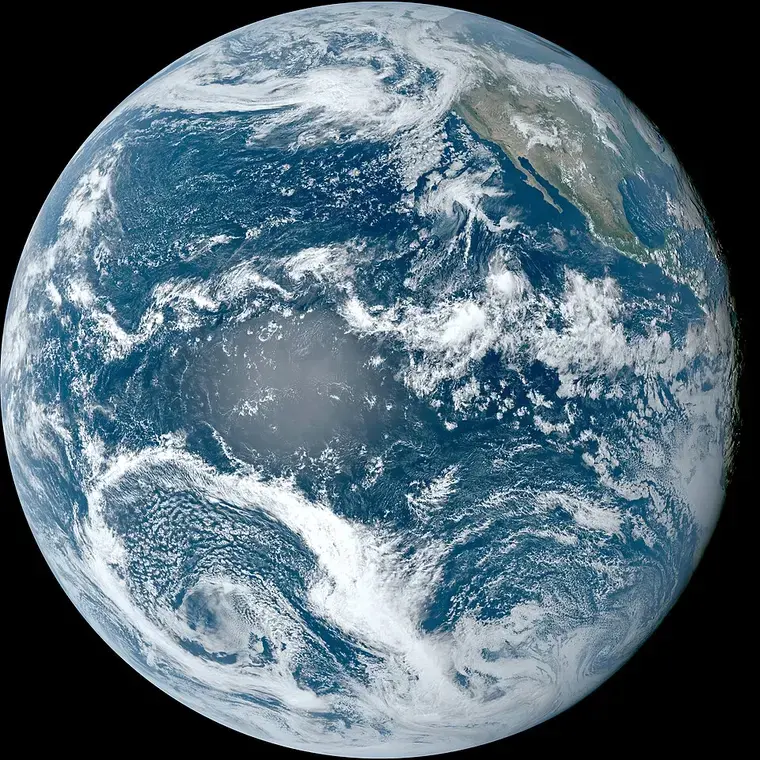
The ocean is the body of salt water that covers approximately 70.8% of Earth. The ocean is conventionally divided into large bodies of water, which are also referred to as oceans (in descending order by area: the Pacific Ocean, the Atlantic Ocean, the Indian Ocean, the Antarctic/Southern Ocean, and the Arctic Ocean), and are themselves mostly divided into seas, gulfs and subsequent bodies of water. The ocean contains 97% of Earth's water and is the primary component of Earth's hydrosphere, acting as a huge reservoir of heat for Earth's energy budget, as well as for its carbon cycle and water cycle, forming the basis for climate and weather patterns worldwide. The ocean is essential to life on Earth, harbouring most of Earth's animals and protist life, originating photosynthesis and therefore Earth's atmospheric oxygen, still supplying half of it.
Ocean scientists split the ocean into vertical and horizontal zones based on physical and biological conditions. Horizontally the ocean covers the oceanic crust, which it shapes. Where the ocean meets dry land it covers relatively shallow continental shelves, which are part of Earth's continental crust. Human activity is mostly coastal with high negative impacts on marine life. Vertically the pelagic zone is the open ocean's water column from the surface to the ocean floor. The water column is further divided into zones based on depth and the amount of light present. The photic zone starts at the surface and is defined to be "the depth at which light intensity is only 1% of the surface value" (approximately 200 m in the open ocean). This is the zone where photosynthesis can occur. In this process plants and microscopic algae (free-floating phytoplankton) use light, water, carbon dioxide, and nutrients to produce organic matter. As a result, the photic zone is the most biodiverse and the source of the food supply which sustains most of the ocean ecosystem. Light can only penetrate a few hundred more meters; the rest of the deeper ocean is cold and dark (these zones are called mesopelagic and aphotic zones).
Ocean temperatures depend on the amount of solar radiation reaching the ocean surface. In the tropics, surface temperatures can rise to over 30 °C. Near the poles where sea ice forms, the temperature in equilibrium is about -2 °C. In all parts of the ocean, deep ocean temperatures range between -2 °C and 5 °C. Constant circulation of water in the ocean creates ocean currents. Those currents are caused by forces operating on the water, such as temperature and salinity differences, atmospheric circulation (wind), and the Coriolis effect. Tides create tidal currents, while wind and waves cause surface currents. The Gulf Stream, Kuroshio Current, Agulhas Current and Antarctic Circumpolar Current are all major ocean currents. Such currents transport massive amounts of water, gases, pollutants and heat to different parts of the world, and from the surface into the deep ocean. All this has impacts on the global climate system.
Ocean water contains dissolved gases, including oxygen, carbon dioxide and nitrogen. An exchange of these gases occurs at the ocean's surface. The solubility of these gases depends on the temperature and salinity of the water. The carbon dioxide concentration in the atmosphere is rising due to CO2 emissions, mainly from fossil fuel combustion. As the oceans absorb CO2 from the atmosphere, a higher concentration leads to ocean acidification (a drop in pH value).
The ocean provides many benefits to humans such as ecosystem services, access to seafood and other marine resources, and a means of transport. The ocean is known to be the habitat of over 230,000 species, but may hold considerably more – perhaps over two million species. Yet, the ocean faces many environmental threats, such as marine pollution, overfishing, and the effects of climate change. Those effects include ocean warming, ocean acidification and sea level rise. The continental shelf and coastal waters are most affected by human activity.
Terminology
The terms "the ocean" or "the sea" used without specification refer to the interconnected body of salt water covering the majority of Earth's surface, i.e., the world ocean. It includes the Pacific, Atlantic, Indian, Antarctic/Southern, and Arctic oceans. As a general term, "the ocean" and "the sea" are often interchangeable.
Strictly speaking, a "sea" is a body of water (generally a division of the world ocean) partly or fully enclosed by land. The word "sea" can also be used for many specific, much smaller bodies of seawater, such as the North Sea or the Red Sea. There is no sharp distinction between seas and oceans, though generally seas are smaller, and are often partly (as marginal seas) or wholly (as inland seas) bordered by land.
In medieval Europe, the World Sea was the body of water that encircled the Continent (the mainland of Europe, Asia and Africa), and thus excluded the Mediterranean, Black and Caspian Seas. The contemporary term World Ocean was coined in the early 20th century by the Russian oceanographer Yuly Shokalsky to refer to the continuous ocean that covers and encircles most of Earth. The global, interconnected body of salt water is sometimes referred to as the World Ocean, the "global ocean" or the "great ocean". The concept of a continuous body of water with relatively unrestricted exchange between its components is critical in oceanography.
The word ocean comes from the figure in classical antiquity, Oceanus (Ōkeanós, ), the elder of the Titans in classical Greek mythology. Oceanus was believed by the ancient Greeks and Romans to be the divine personification of an enormous river encircling the world.
The concept of Ōkeanós could have an Indo-European connection. Greek Ōkeanós has been compared to the Vedic epithet ā-śáyāna-, predicated of the dragon Vṛtra-, who captured the cows/rivers. Related to this notion, the Okeanos is represented with a dragon-tail on some early Greek vases.
Natural history
Scientists believe that a sizable quantity of water would have been in the material that formed Earth. Water molecules would have escaped Earth's gravity more easily when it was less massive during its formation. This is called atmospheric escape.
During planetary formation, Earth possibly had magma oceans. Subsequently, outgassing, volcanic activity and meteorite impacts, produced an early atmosphere of carbon dioxide, nitrogen and water vapor, according to current theories.
The gases and the atmosphere are thought to have accumulated over millions of years. After Earth's surface had significantly cooled, the water vapor over time would have condensed, forming Earth's first oceans. The early oceans might have been significantly hotter than today and appeared green due to high iron content.
Geological evidence helps constrain the time frame for liquid water existing on Earth. A sample of pillow basalt (a type of rock formed during an underwater eruption) was recovered from the Isua Greenstone Belt and provides evidence that water existed on Earth 3.8 billion years ago. In the Nuvvuagittuq Greenstone Belt, Quebec, Canada, rocks dated at 3.8 billion years old by one study and 4.28 billion years old by another show evidence of the presence of water at these ages. If oceans existed earlier than this, any geological evidence either has yet to be discovered, or has since been destroyed by geological processes like crustal recycling. However, in August 2020, researchers reported that sufficient water to fill the oceans may have always been on the Earth since the beginning of the planet's formation. In this model, atmospheric greenhouse gases kept the oceans from freezing when the newly forming Sun had only 70% of its current luminosity.
The origin of Earth's oceans is unknown. Oceans are thought to have formed in the Hadean eon and may have been the cause for the emergence of life.
Geography
The entire ocean, containing 97% of Earth's water, spans 70.8% of Earth's surface, making it Earth's global ocean or world ocean. This makes Earth, along with its vibrant hydrosphere a "water world" or "ocean world", particularly in Earth's early history when the ocean is thought to have possibly covered Earth completely. The ocean's shape is irregular, unevenly dominating Earth's surface. This leads to the distinction of Earth's surface into land and water hemispheres, as well as the division of the ocean into different oceans.
Seawater covers about 361000000 km2 and the ocean's furthest pole of inaccessibility, known as "Point Nemo", in a region known as spacecraft cemetery of the South Pacific Ocean, at. This point is roughly 2688 km from the nearest land.
There are different customs to subdivide the ocean and are adjourned by smaller bodies of water such as bays, bights, gulfs, seas, and straits.
For practical and historical reasons, it is customary to divide the World Ocean into a set of five major oceans. By convention these are the Pacific, Atlantic, Indian, Arctic, and Southern (Antarctic) oceans. This five-ocean model only fully crystallized in the early 21st century, when the Southern Ocean, delineated by the Antarctic Circumpolar Current, was recognized by various government and international bodies: by the U.S. Board on Geographic Names since 1999, and by the International Hydrographic Organization since 2000.
The five principal oceans are listed below in descending order of area and volume:
Physical properties
Ocean water represents the largest body of water within the global water cycle (oceans contain 97% of Earth's water). Evaporation from the ocean moves water into the atmosphere to later rain back down onto land and the ocean. Oceans have a significant effect on the biosphere. The ocean as a whole is thought to cover approximately 90% of the Earth's biosphere. Oceanic evaporation, as a phase of the water cycle, is the source of most rainfall (about 90%), causing a global cloud cover of 67% and a consistent oceanic cloud cover of 72%. Ocean temperatures affect climate and wind patterns that affect life on land. One of the most dramatic forms of weather occurs over the oceans: tropical cyclones (also called "typhoons" and "hurricanes" depending upon where the system forms).
As the world's ocean is the principal component of Earth's hydrosphere, it is integral to life on Earth, forms part of the carbon cycle and water cycle, and – as a huge heat reservoir – influences climate and weather patterns.
The motions of the ocean surface, known as undulations or wind waves, are the partial and alternate rising and falling of the ocean surface. The series of mechanical waves that propagate along the interface between water and air is called swell – a term used in sailing, surfing and navigation. These motions profoundly affect ships on the surface of the ocean and the well-being of people on those ships who might suffer from sea sickness.
Wind blowing over the surface of a body of water forms waves that are perpendicular to the direction of the wind. The friction between air and water caused by a gentle breeze on a pond causes ripples to form. A stronger gust blowing over the ocean causes larger waves as the moving air pushes against the raised ridges of water. The waves reach their maximum height when the rate at which they are travelling nearly matches the speed of the wind. In open water, when the wind blows continuously as happens in the Southern Hemisphere in the Roaring Forties, long, organized masses of water called swell roll across the ocean. If the wind dies down, the wave formation is reduced, but already-formed waves continue to travel in their original direction until they meet land. The size of the waves depends on the fetch, the distance that the wind has blown over the water and the strength and duration of that wind. When waves meet others coming from different directions, interference between the two can produce broken, irregular seas.
Constructive interference can lead to the formation of unusually high rogue waves. Most waves are less than 3 m high and it is not unusual for strong storms to double or triple that height. Rogue waves, however, have been documented at heights above 25 m.
Chemical properties
Salinity is a measure of the total amounts of dissolved salts in seawater. It was originally measured via measurement of the amount of chloride in seawater and hence termed chlorinity. It is now standard practice to gauge it by measuring electrical conductivity of the water sample. Salinity can be calculated using the chlorinity, which is a measure of the total mass of halogen ions (includes fluorine, chlorine, bromine, and iodine) in seawater. According to an international agreement, the following formula is used to determine salinity:
The average ocean water chlorinity is about 19.2‰ (equal to 1.92%), and thus the average salinity is around 34.7‰ (3.47%).
Salinity has a major influence on the density of seawater. A zone of rapid salinity increase with depth is called a halocline. As seawater's salt content increases, so does the temperature at which its maximum density occurs. Salinity affects both the freezing and boiling points of water, with the boiling point increasing with salinity. At atmospheric pressure, normal seawater freezes at a temperature of about −2 °C.
Salinity is higher in Earth's oceans where there is more evaporation and lower where there is more precipitation. If precipitation exceeds evaporation, as is the case in polar and some temperate regions, salinity will be lower. Salinity will be higher if evaporation exceeds precipitation, as is sometimes the case in tropical regions. For example, evaporation is greater than precipitation in the Mediterranean Sea, which has an average salinity of 38‰, more saline than the global average of 34.7‰. Thus, oceanic waters in polar regions have lower salinity content than oceanic waters in tropical regions. However, when sea ice forms at high latitudes, salt is excluded from the ice as it forms, which can increase the salinity in the residual seawater in polar regions such as the Arctic Ocean.
Due to the effects of climate change on oceans, observations of sea surface salinity between 1950 and 2019 indicate that regions of high salinity and evaporation have become more saline while regions of low salinity and more precipitation have become fresher. It is very likely that the Pacific and Antarctic/Southern Oceans have freshened while the Atlantic has become more saline.
Marine life
Life within the ocean evolved 3 billion years prior to life on land. Both the depth and the distance from shore strongly influence the biodiversity of the plants and animals present in each region. The diversity of life in the ocean is immense, including:
Animals: most animal phyla have species that inhabit the ocean, including many that are found only in marine environments such as sponges, Cnidaria (such as corals and jellyfish), comb jellies, Brachiopods, and Echinoderms (such as sea urchins and sea stars). Many other familiar animal groups primarily live in the ocean, including cephalopods (includes octopus and squid), crustaceans (includes lobsters, crabs, and shrimp), fish, sharks, cetaceans (includes whales, dolphins, and porpoises). In addition, many land animals have adapted to living a major part of their life on the oceans. For instance, seabirds are a diverse group of birds that have adapted to a life mainly on the oceans. They feed on marine animals and spend most of their lifetime on water, many going on land only for breeding. Other birds that have adapted to oceans as their living space are penguins, seagulls and pelicans. Seven species of turtles, the sea turtles, also spend most of their time in the oceans.
Algae: algae is a "catch-all" term to include many photosynthetic, single-celled eukaryotes, such as green algae, diatoms, and dinoflagellates, but also multicellular algae, such as some red algae (including organisms like Pyropia, which is the source of the edible nori seaweed), and brown algae (including organisms like kelp).
Bacteria: ubiquitous single-celled prokaryotes found throughout the world.
Archaea: prokaryotes distinct from bacteria, that inhabit many environments of the ocean, as well as many extreme environments
Human uses of the oceans
The ocean has been linked to human activity throughout history. These activities serve a wide variety of purposes, including navigation and exploration, naval warfare, travel, shipping and trade, food production (e.g. fishing, whaling, seaweed farming, aquaculture), leisure (cruising, sailing, recreational boat fishing, scuba diving), power generation (see marine energy and offshore wind power), extractive industries (offshore drilling and deep sea mining), freshwater production via desalination.
Many of the world's goods are moved by ship between the world's seaports. Large quantities of goods are transported across the ocean, especially across the Atlantic and around the Pacific Rim. Many types of cargo including manufactured goods, are typically transported in standard sized, lockable containers that are loaded on purpose-built container ships at dedicated terminals. Containerization greatly boosted the efficiency and reduced the cost of shipping products by sea. This was a major factor in the rise of globalization and exponential increases in international trade in the mid-to-late 20th century.
Oceans are also the major supply source for the fishing industry. Some of the major harvests are shrimp, fish, crabs, and lobster. The biggest global commercial fishery is for anchovies, Alaska pollock and tuna. A report by FAO in 2020 stated that "in 2017, 34 percent of the fish stocks of the world's marine fisheries were classified as overfished". Fish and other fishery products from both wild fisheries and aquaculture are among the most widely consumed sources of protein and other essential nutrients. Data in 2017 showed that "fish consumption accounted for 17 percent of the global population's intake of animal proteins". To fulfill this need, coastal countries have exploited marine resources in their exclusive economic zone. Fishing vessels are increasingly venturing out to exploit stocks in international waters.
The ocean has a vast amount of energy carried by ocean waves, tides, salinity differences, and ocean temperature differences which can be harnessed to generate electricity. Forms of sustainable marine energy include tidal power, ocean thermal energy and wave power. Offshore wind power is captured by wind turbines placed out on the ocean; it has the advantage that wind speeds are higher than on land, though wind farms are more costly to construct offshore. There are large deposits of petroleum, as oil and natural gas, in rocks beneath the ocean floor. Offshore platforms and drilling rigs extract the oil or gas and store it for transport to land.
"Freedom of the seas" is a principle in international law dating from the seventeenth century. It stresses freedom to navigate the oceans and disapproves of war fought in international waters. Today, this concept is enshrined in the United Nations Convention on the Law of the Sea (UNCLOS).
Text adapted from the Wikipedia article “Ocean” (revision 1362422916, 2026-07-03), authors, licensed under CC BY-SA 4.0.