Space exploration Crossword Puzzle
Free printable educational crossword puzzle. Every clue is a sentence sourced directly from the Wikipedia article on Space exploration with the key terms blanked out.
Space exploration Crossword
Name: ____________________ Date: ______________
| 10E | ||||||||||||
| V | ||||||||||||
| O | ||||||||||||
| L | ||||||||||||
| U | ||||||||||||
| 8M | E | T | E | O | R | O | I | D | ||||
| I | ||||||||||||
| O | 3C | |||||||||||
| 6M | O | O | N | 9B | 1I | O | L | O | G | Y | ||
| E | N | M | ||||||||||
| S | 4M | D | E | |||||||||
| 2S | P | A | C | E | F | L | I | G | H | T | ||
| E | R | A | 12A | |||||||||
| 5N | A | S | A | S | ||||||||
| G | 7A | R | R | O | K | O | T | H | ||||
| E | S | R | ||||||||||
| 11R | O | C | K | E | T | O | ||||||
| E | N | |||||||||||
| R | A | |||||||||||
| O | U | |||||||||||
| I | T | |||||||||||
| D |
Across
- 2. The next step of commercialization of space was seen as human _____. (11 letters)
- 5. We Are The Explorers, _____ Promotional Video (Press Release. ) (4 letters)
- 6. The first woman to go to the _____ is planned for 2026. (4 letters)
- 7. The New Horizons mission also performed a flyby of the small planetesimal _____, in the Kuiper belt, in 2019. (8 letters)
- 8. The results indicated that the satellite was not punctured by a _____. (9 letters)
- 9. Astrobiology is the interdisciplinary study of life in the universe, combining aspects of astronomy, _____ and geology. (7 letters)
- 11. Develop multi-stage _____ capable of placing satellites, animals, and humans in space. (6 letters)
Down
- 1. The 2000s brought advancements in the national space-exploration programs of China, the European Union, Japan, and _____. (5 letters)
- 3. Some of the reasons are lack of natural resources, _____, nuclear war, and worldwide epidemic. (5 letters)
- 4. This phenomenon is also informally known as the "_____ Curse". (4 letters)
- 6. As of May 2013, the Mariner 10 and _____ missions have been the only missions that have made close observations of Mercury. (9 letters)
- 7. In November 2005, it landed on the _____ twice to collect samples. (8 letters)
- 10. It is focused primarily on the study of the origin, distribution and _____ of life. (9 letters)
- 12. a lack of space suits sized appropriately for female _____. (9 letters)
Clues are sentences from the Wikipedia article “Space exploration” (revision 1362422243, CC BY-SA 4.0). crosswordprint.com/printable-crosswords/astronomy/space-exploration/
Space exploration Word Search
Name: ____________________ Date: ______________
Words to Find
crosswordprint.com/printable-crosswords/astronomy/space-exploration/
Pick the word that completes each sentence from the Wikipedia article.
Is the sentence correct? Some sentences have one word altered.
Click a clue, then click the word it belongs to.
Unscramble each word. The clue is the sentence it was taken from.
How to Solve & Use the Answer Key
This is a fill-in crossword. Each clue is a sentence from the Wikipedia article on Space exploration, with the key term blanked out. The number in parentheses shows the letter count. Solve interactively on screen or check Show answers to view the answer key. To print a clean student worksheet, press Print Puzzle.
Space exploration Crossword Answer Key & Definitions
Show Complete Answers & Word Definitions
- 2 Across: SPACEFLIGHT — Spaceflight (also space flight) is an application of astronautics to fly objects, usually spacecraft, into or through outer space, either with or without humans on board. Wikipedia: Spaceflight
- 5 Across: NASA — The National Aeronautics and Space Administration (NASA ) is an independent agency of the U.S. Wikipedia: NASA
- 6 Across: MOON — The Moon is the only natural satellite of Earth. Wikipedia: Moon
- 7 Across: ARROKOTH — 486958 Arrokoth is a small, icy Kuiper belt object orbiting the Sun beyond Neptune and Pluto. Wikipedia: 486958 Arrokoth
- 8 Across: METEOROID — Meteoroids are distinguished as objects significantly smaller than asteroids, ranging in size from grains to objects up to 1 m wide. Wikipedia: Meteoroid
- 9 Across: BIOLOGY — Biology is the scientific study of life and living organisms. Wikipedia: Biology
- 11 Across: ROCKET — A rocket is an elongated flying vehicle that uses a rocket engine to accelerate without using any surrounding air. Wikipedia: Rocket
- 1 Down: INDIA — India, officially the Republic of India, is a country in South Asia. Wikipedia: India
- 3 Down: COMET — A comet is an icy, small Solar System body or interstellar object that warms and begins to release gases when passing close to the Sun, a process called outgassing. Wikipedia: Comet
- 4 Down: MARS — Mars is the fourth planet from the Sun. It is also known as the "Red Planet", for its orange-red appearance. Wikipedia: Mars
- 6 Down: MESSENGER
- 7 Down: ASTEROID — An asteroid is a minor planet—an object larger than a meteoroid (thus 1 meter or larger) that is neither a planet nor an identified comet—that orbits within the inner Solar System or is co-orbital with Jupiter (Trojan asteroids). Wikipedia: Asteroid
- 10 Down: EVOLUTION — Evolution is the change in the heritable characteristics of biological populations over successive generations. Wikipedia: Evolution
- 12 Down: ASTRONAUT — An astronaut (from the Ancient Greek ἄστρον, meaning 'star', and ναύτης, meaning 'sailor') is a person trained, equipped, and deployed by a human spaceflight program to serve as a commander or crew member of a spacecraft. Wikipedia: Astronaut
Definitions adapted from Wikipedia articles (week 2026-W41), CC BY-SA 4.0.
Read about Space exploration
Space exploration is the physical investigation of outer space by uncrewed robotic space probes and through human spaceflight.
While the observation of objects in space, known as astronomy, predates reliable recorded history, it was the development of large and relatively efficient rockets during the mid-twentieth century that allowed physical space exploration to become a reality. Common rationales for exploring space include advancing scientific research, national prestige, uniting different nations, ensuring the future survival of humanity, and developing military and strategic advantages against other countries.
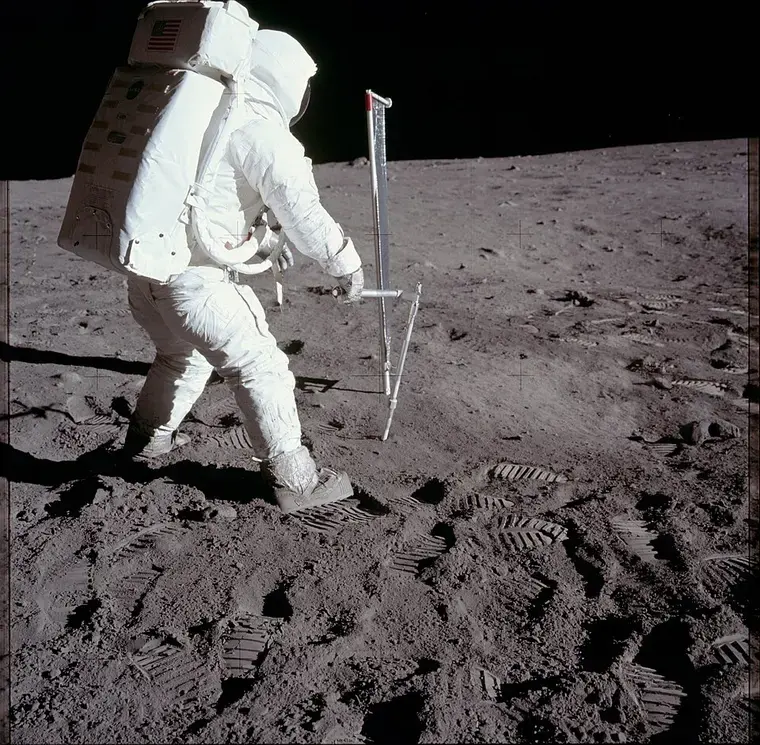
The early era of space exploration was driven by a "Space Race" in which the Soviet Union and the United States vied to demonstrate their technological superiority. Landmarks of this era include the launch of the first human-made object to orbit Earth, the Soviet Union's Sputnik 1, on 4 October 1957, and the first Moon landing by the American Apollo 11 mission on 20 July 1969. The Soviet space program achieved many of the first milestones, including the first living being in orbit in 1957, the first human spaceflight (Yuri Gagarin aboard Vostok 1) in 1961, the first spacewalk (by Alexei Leonov) on 18 March 1965, the first automatic landing on another celestial body in 1966, and the launch of the first space station (Salyut 1) in 1971.
In the 1970s, focus shifted from one-off flights to renewable hardware, such as the Space Shuttle program, and from competition to cooperation, the foremost example being the International Space Station (ISS), built between 1998 and 2011.
The 2000s brought advancements in the national space-exploration programs of China, the European Union, Japan, and India. The 2010s saw the rise of the private space industry in earnest with the development of private launch vehicles, space capsules, and satellite manufacturing. In the 2020s, the two primary global programs gaining traction are Moon-focused: the Chinese-led International Lunar Research Station and the U.S.-led Artemis Program, with its plan to build the Artemis Base Camp on the Moon, each with a set of international partners.
History of exploration
The first telescope is said to have been invented in 1608 in the Netherlands by an eyeglass maker named Hans Lippershey, but their first recorded use in astronomy was by Galileo Galilei in 1609. In 1668 Isaac Newton built his own reflecting telescope, the first fully functional telescope of this kind, and a landmark for future developments due to its superior features over the previous Galilean telescope.
A string of discoveries in the Solar System (and beyond) followed, then and in the next centuries: the mountains of the Moon, the phases of Venus, the main satellites of Jupiter and Saturn, the rings of Saturn, many comets, the asteroids, the new planets Uranus and Neptune, and many more satellites.
The Orbiting Astronomical Observatory 2 was the first space telescope launched 1968, but the launch of the Hubble Space Telescope in 1990 set a milestone. As of 1 December 2022, there were 5,284 confirmed exoplanets discovered. The Milky Way is estimated to contain 100–400 billion stars and more than 100 billion planets. There are at least 2 trillion galaxies in the observable universe. HD1 is the most distant known object from Earth, reported as 33.4 billion light-years away.
MW 18014 was a German V-2 rocket test launch that took place on 20 June 1944, at the Peenemünde Army Research Center in Peenemünde. It was the first human-made object to reach outer space, attaining an apogee of 176 kilometers, which is well above the Kármán line. It was a vertical test launch. Although the rocket reached space, it did not reach orbital velocity, and therefore returned to Earth in an impact, becoming the first sub-orbital spaceflight. In 1949, the Bumper-WAC reached an altitude of 393 km, becoming the first human-made object to enter space, according to NASA.
The first successful orbital launch was of the Soviet uncrewed Sputnik 1 ("Satellite 1") mission on 4 October 1957. The satellite weighed about 83 kg, and is believed to have orbited Earth at a height of about 250 km. It had two radio transmitters (20 and 40 MHz), which emitted "beeps" that could be heard by radios around the globe. Analysis of the radio signals was used to gather information about the electron density of the ionosphere, while temperature and pressure data were encoded in the duration of radio beeps. The results indicated that the satellite was not punctured by a meteoroid. Sputnik 1 was launched by an R-7 rocket. It burned up upon re-entry on 3 January 1958.
Targets of exploration
Starting in the mid-20th century probes and then human missions were sent into Earth orbit, and then on to the Moon. Also, probes were sent throughout the known Solar System, and into Solar orbit. Uncrewed spacecraft have been sent into orbit around Saturn, Jupiter, Mars, Venus, and Mercury by the 21st century, and the most distance active spacecraft, Voyager 1 and 2 traveled beyond 100 times the Earth-Sun distance. The instruments were enough though that it is thought they have left the Sun's heliosphere, a sort of bubble of particles made in the Galaxy by the Sun's solar wind.
The Sun is a major focus of space exploration. Being above the atmosphere in particular and Earth's magnetic field gives access to the solar wind and infrared and ultraviolet radiations that cannot reach Earth's surface. The Sun generates most space weather, which can affect power generation and transmission systems on Earth and interfere with, and even damage, satellites and space probes. Numerous spacecraft dedicated to observing the Sun, beginning with the Apollo Telescope Mount, have been launched and still others have had solar observation as a secondary objective. Parker Solar Probe, launched in 2018, will approach the Sun to within 1/9th the orbit of Mercury.
Mercury remains the least explored of the Terrestrial planets. As of May 2013, the Mariner 10 and MESSENGER missions have been the only missions that have made close observations of Mercury. MESSENGER entered orbit around Mercury in March 2011, to further investigate the observations made by Mariner 10 in 1975 (Munsell, 2006b). A third mission to Mercury, scheduled to arrive in 2025, BepiColombo is to include two probes. BepiColombo is a joint mission between Japan and the European Space Agency. MESSENGER and BepiColombo are intended to gather complementary data to help scientists understand many of the mysteries discovered by Mariner 10's flybys.
Flights to other planets within the Solar System are accomplished at a cost in energy, which is described by the net change in velocity of the spacecraft, or delta-v. Due to the relatively high delta-v to reach Mercury and its proximity to the Sun, it is difficult to explore and orbits around it are rather unstable.
Venus was the first target of interplanetary flyby and lander missions and, despite one of the most hostile surface environments in the Solar System, has had more landers sent to it (nearly all from the Soviet Union) than any other planet in the Solar System. The first flyby was the 1961 Venera 1, though the 1962 Mariner 2 was the first flyby to successfully return data. Mariner 2 has been followed by several other flybys by multiple space agencies often as part of missions using a Venus flyby to provide a gravitational assist en route to other celestial bodies. In 1967, Venera 4 became the first probe to enter and directly examine the atmosphere of Venus. In 1970, Venera 7 became the first successful lander to reach the surface of Venus and by 1985 it had been followed by eight additional successful Soviet Venus landers which provided images and other direct surface data. Starting in 1975, with the Soviet orbiter Venera 9, some ten successful orbiter missions have been sent to Venus, including later missions which were able to map the surface of Venus using radar to pierce the obscuring atmosphere.
Text adapted from the Wikipedia article “Space exploration” (revision 1362422243, 2026-07-03), authors, licensed under CC BY-SA 4.0.