Solar System Crossword Puzzle
Free printable educational crossword puzzle. Every clue is a sentence sourced directly from the Wikipedia article on Solar System with the key terms blanked out. Kids version →
Solar System Crossword
Name: ____________________ Date: ______________
| 2C | |||||||||||
| L | |||||||||||
| I | |||||||||||
| 10G | E | O | C | E | N | T | R | I | S | M | |
| A | |||||||||||
| 11B | A | S | 7A | L | T | ||||||
| T | E | ||||||||||
| 6V | M | 5H | |||||||||
| E | O | A | |||||||||
| 13U | R | A | N | U | S | U | |||||
| U | P | M | |||||||||
| 1H | E | L | I | O | S | P | H | E | R | E | |
| E | A | ||||||||||
| 3A | 8U | R | O | R | A | ||||||
| N | E | ||||||||||
| 9A | P | H | E | L | I | O | N | ||||
| V | 12C | ||||||||||
| 4S | U | P | E | R | N | O | V | A | |||
| U | R | L | |||||||||
| P | S | L | |||||||||
| E | E | I | |||||||||
| R | S | ||||||||||
| B | I | ||||||||||
| U | O | ||||||||||
| B | N | ||||||||||
| B | |||||||||||
| L | |||||||||||
| E |
Across
- 1. This creates the _____ and a decreasing temperature gradient across the Solar System. (11 letters)
- 3. Saturn has a magnetosphere capable of producing weak _____., Saturn has 293 confirmed satellites, grouped into: (6 letters)
- 4. The bubble is suffused with high-temperature plasma, suggesting that it may be the product of several recent _____. (9 letters)
- 9. A body's closest approach to the Sun is called its perihelion, whereas its most distant point from the Sun is called its _____. (8 letters)
- 10. Heliocentrism did not triumph immediately over _____, but the work of Copernicus had its champions, notably Johannes Kepler. (11 letters)
- 11. In the past, Mercury was volcanically active, producing smooth _____ plains similar to the Moon. (6 letters)
- 13. Inner satellites, which orbit inside _____'s ring system. (6 letters)
Down
- 2. The planet has a complex _____ and weather system, with conditions differing drastically between _____ regions. (7 letters)
- 4. The latter feature is an hourglass-shaped cavity or _____ in the interstellar medium roughly 300 light-years across. (11 letters)
- 5. Its orbit is significantly less eccentric and inclined than those of Makemake or _____. (6 letters)
- 6. Here planets formed that are mainly rocky, which are Mercury, _____, Earth, and Mars. (5 letters)
- 7. Titan is the only satellite in the Solar System to have a substantial _____. (10 letters)
- 8. (0.98–1.02 AU) is the only place in the _____ where life and surface liquid water are known to exist. (8 letters)
- 12. It extends from about 10 AU to about 40 AU, and was probably created by _____ within the Kuiper belt. (9 letters)
Clues are sentences from the Wikipedia article “Solar System” (revision 1362703372, CC BY-SA 4.0). crosswordprint.com/printable-crosswords/astronomy/solar-system/
Solar System Word Search
Name: ____________________ Date: ______________
Words to Find
crosswordprint.com/printable-crosswords/astronomy/solar-system/
Pick the word that completes each sentence from the Wikipedia article.
Is the sentence correct? Some sentences have one word altered.
Click a clue, then click the word it belongs to.
Unscramble each word. The clue is the sentence it was taken from.
How to Solve & Use the Answer Key
This is a fill-in crossword. Each clue is a sentence from the Wikipedia article on Solar System, with the key term blanked out. The number in parentheses shows the letter count. Solve interactively on screen or check Show answers to view the answer key. To print a clean student worksheet, press Print Puzzle.
Solar System Crossword Answer Key & Definitions
Show Complete Answers & Word Definitions
- 1 Across: HELIOSPHERE — The heliosphere is the magnetosphere, astrosphere, and outermost atmospheric layer of the Sun. Wikipedia: Heliosphere
- 3 Across: AURORA — An aurora ( aurorae or auroras) is a natural light display in Earth's upper atmosphere caused by charged particles from the Sun colliding with atoms in the atmosphere. Wikipedia: Aurora
- 4 Across: SUPERNOVA — A supernova (supernovae) is a powerful and luminous explosion of a star. Wikipedia: Supernova
- 9 Across: APHELION — An apsis ( (third declension); ) is the farthest or nearest point in the orbit of a planetary body about its primary body. Wikipedia: Apsis
- 10 Across: GEOCENTRISM — Geocentrism is a superseded astronomical model description of the Universe with Earth at the center. Wikipedia: Geocentrism
- 11 Across: BASALT — Basalt; ) is an aphanitic (fine-grained) extrusive igneous rock formed from the rapid cooling of low-viscosity lava rich in magnesium and iron (mafic lava) exposed at or very near the surface of a rocky planet or moon. Wikipedia: Basalt
- 13 Across: URANUS — Uranus is the seventh planet from the Sun. Wikipedia: Uranus
- 2 Down: CLIMATE — Climate is the long-term weather pattern in a region, typically averaged over 30 years. Wikipedia: Climate
- 4 Down: SUPERBUBBLE
- 5 Down: HAUMEA — Haumea (minor-planet number 136108) is a dwarf planet located beyond Neptune's orbit. Wikipedia: Haumea
- 6 Down: VENUS — Venus is the second planet from the Sun. Similar in size and mass to Earth, Venus has no liquid water, and its atmosphere is far thicker and denser than that of any other rocky body in the Solar System. Wikipedia: Venus
- 7 Down: ATMOSPHERE — An atmosphere is a layer of gases that envelop an astronomical object, held in place by the gravity of the object. Wikipedia: Atmosphere
- 8 Down: UNIVERSE — The universe comprises all of existence: all forms of matter and energy, and the structures they form, from sub-atomic particles to entire galactic filaments. Wikipedia: Universe
- 12 Down: COLLISION — In physics, a collision is any event in which two or more bodies exert forces on each other in a relatively short time. Wikipedia: Collision
Definitions adapted from Wikipedia articles (week 2026-W41), CC BY-SA 4.0.
Read about Solar System
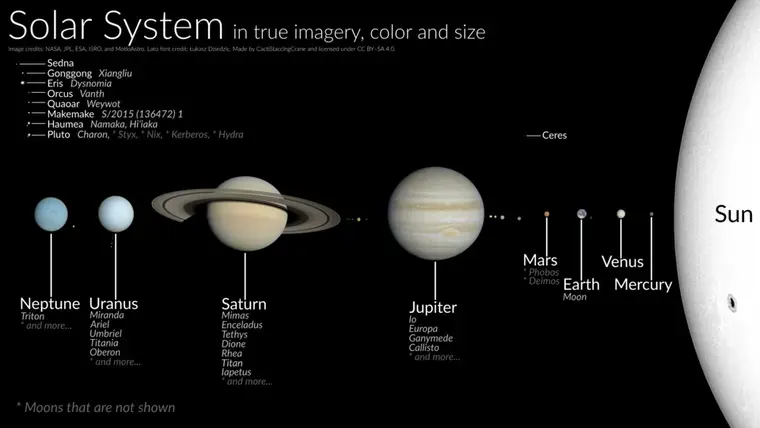
The Solar System is the gravitationally bound system of the Sun and the masses that orbit it, most prominently its eight planets, of which Earth is one. The Solar System is an isolated single-star planetary system (not part of a larger star system) within the Milky Way Galaxy. The system formed about 4.6 billion years ago when a dense region of a molecular cloud collapsed, creating the Sun and a protoplanetary disc from which the orbiting bodies assembled.
The Sun accounts for 99.86% of the Solar System's total mass. Inside the Sun's core, hydrogen is fused into helium, releasing energy that is emitted through the Sun's photosphere. This creates the heliosphere and a decreasing temperature gradient across the Solar System.
The next most massive objects of the system are the eight planets, which by definition dominate the orbits they occupy. Closest to the Sun in order of increasing distance are the terrestrial planets – Mercury, Venus, Earth and Mars. These four planets are part of the inner Solar System. Earth and Mars are the only planets that orbit within the Sun's habitable zone, in which sunlight can keep surface water liquid under atmospheric pressure. Beyond the frost line at about five astronomical units (AU), are the planets of the outer Solar System: two gas giants (Jupiter and Saturn) and two ice giants (Uranus and Neptune). Jupiter and Saturn possess nearly 90% of the non-stellar mass of the Solar System.
Objects of planetary mass that do not dominate their orbit but directly orbit the Sun are called dwarf planets. The International Astronomical Union's Minor Planet Center lists, Pluto,,, and as dwarf planets. Four other Solar System objects are generally identified as such:,,, and. Less massive than the dwarf planets are the vast number of small Solar System bodies, such as asteroids, comets, centaurs, meteoroids, and interplanetary dust clouds. The dwarf planet Ceres and many of these smaller bodies are located in the asteroid belt (between Mars's and Jupiter's orbit), while all other dwarf planets are members of populations of trans-Neptunian objects, which may be found in the Kuiper belt just outside Neptune or in the further scattered disc.
Many objects in the Solar System do not orbit the Sun directly and are instead natural satellites, commonly called 'moons', of larger bodies. These can be found throughout the Solar System in sizes from planetary-mass moons at their largest to much less massive moonlets at their smallest. The largest two moons (Ganymede of Jupiter and Titan of Saturn) are larger (though less massive) than the smallest planet (Mercury), while the seven most massive, which includes Earth's Moon, are more massive and larger than any of the dwarf planets.
Definition
The Solar System includes the Sun and all objects that are bound to it by gravity and orbit it.
The International Astronomical Union describes the Solar System as all objects that are bound by the gravity of the Sun, the Sun itself, its eight planets, and the other celestial bodies which orbit it. NASA describes the solar system as including the Sun and its planetary system.
Capitalization of the name varies. When not used as a proper noun and written without capitalization, "solar system" may refer to either the Solar System itself or any planetary system reminiscent of the Solar System. The International Astronomical Union, the authoritative body regarding astronomical nomenclature, specifies capitalizing the names of all individual astronomical objects but uses mixed "Solar System" and "solar system" structures in their naming guidelines document.
Formation and evolution
The Solar System formed at least 4.568 billion years ago from the gravitational collapse of a region within a large molecular cloud. This initial cloud was likely several light-years across and probably birthed several stars. As is typical of molecular clouds, this one consisted mostly of hydrogen, with some helium, and small amounts of heavier elements fused by previous generations of stars.
As the pre-solar nebula collapsed, conservation of angular momentum caused it to rotate faster. The center, where most of the mass collected, became increasingly hotter than the surroundings. As the contracting nebula spun faster, it began to flatten into a protoplanetary disc with a diameter of roughly 200 AU and a hot, dense protostar at the center. The planets formed by accretion from this disc, in which dust and gas gravitationally attracted each other, coalescing to form ever larger bodies. Hundreds of protoplanets may have existed in the early Solar System, but they either merged or were destroyed or ejected, leaving the planets, dwarf planets, and leftover minor bodies.
In the inner Solar System, heat from the accretion process exceeded the boiling point of hydrocarbon molecules for the first million years, leading to low carbon content for the inner planets. The boundary for this process has been dubbed the soot line. As the Solar System disk cooled, this line moved inward and now lies within Earth's orbit around the Sun. Material other than metals and silicates, due to their higher boiling points, could not persist in solid form. Here planets formed that are mainly rocky, which are Mercury, Venus, Earth, and Mars. Because these refractory materials only comprised a small fraction of the solar nebula, the terrestrial planets could not grow very large.
The giant planets (Jupiter, Saturn, Uranus, and Neptune) formed further out, beyond the frost line, the point between the orbits of Mars and Jupiter where material is cool enough for volatile icy compounds to remain solid. The ices that formed these planets were more plentiful than the metals and silicates that formed the terrestrial inner planets, allowing them to grow massive enough to capture large atmospheres of hydrogen and helium, the lightest and most abundant elements. Leftover debris that never became planets congregated in regions such as the asteroid belt, Kuiper belt, and Oort cloud.
Within 50 million years, the pressure and density of hydrogen in the center of the protostar became great enough for it to begin thermonuclear fusion. As helium accumulates at its core, the Sun is growing brighter; early in its main-sequence life its brightness was 70% that of what it is today. The temperature, reaction rate, pressure, and density increased until hydrostatic equilibrium was achieved: the thermal pressure counterbalancing the force of gravity. At this point, the Sun became a main-sequence star. Solar wind from the Sun created the heliosphere and swept away the remaining gas and dust from the protoplanetary disc into interstellar space.
General characteristics
Astronomers sometimes divide the Solar System structure into separate regions. The inner Solar System includes Mercury, Venus, Earth, Mars, and the bodies in the asteroid belt. The outer Solar System includes Jupiter, Saturn, Uranus, Neptune, and the bodies in the Kuiper belt. Since the discovery of the Kuiper belt, the outermost parts of the Solar System are considered a distinct region consisting of the objects beyond Neptune.
The principal component of the Solar System is the Sun, a G-type main-sequence star that contains 99.86% of the system's known mass and dominates it gravitationally. The Sun's four largest orbiting bodies, the giant planets, account for 99% of the remaining mass, with Jupiter and Saturn together comprising more than 90%. The remaining objects of the Solar System (including the four terrestrial planets, the dwarf planets, moons, asteroids, and comets) together comprise less than 0.002% of the Solar System's total mass.
The Sun is composed of roughly 98% hydrogen and helium, as are Jupiter and Saturn. A composition gradient exists in the Solar System, created by heat and light pressure from the early Sun; those objects closer to the Sun, which are more affected by heat and light pressure, are composed of elements with high melting points. Objects farther from the Sun are composed largely of materials with lower melting points. The boundary in the Solar System beyond which those volatile substances could coalesce is known as the frost line, and it lies at roughly five times the Earth's distance from the Sun.
The planets and other large objects in orbit around the Sun lie near the invariable plane of the Solar System, as does Earth's orbit, known as the ecliptic, and most closely the orbit of Jupiter, with an inclination to it of 0.3219°. Smaller icy objects such as comets frequently orbit at significantly greater angles to this plane. Most of the planets in the Solar System have secondary systems of their own, being orbited by natural satellites called moons. All of the largest natural satellites are in synchronous rotation, with one face permanently turned toward their parent. The four giant planets have planetary rings, thin discs of tiny particles that orbit them in unison.
As a result of the formation of the Solar System, planets and most other objects orbit the Sun in the same direction that the Sun is rotating. That is, counter-clockwise, as viewed from above Earth's north pole. There are exceptions, such as Halley's Comet. Most of the larger moons orbit their planets in prograde direction, matching the direction of planetary rotation; Neptune's moon Triton is the largest to orbit in the opposite, retrograde manner. Most larger objects rotate around their own axes in the prograde direction relative to their orbit, though the rotation of Venus is retrograde.
Sun
The Sun is the Solar System's star and by far its most massive component. Its large mass (332,900 Earth masses), which comprises 99.86% of all the mass in the Solar System, produces temperatures and densities in its core high enough to sustain nuclear fusion of hydrogen into helium. This releases an enormous amount of energy, mostly radiated into space as electromagnetic radiation peaking in visible light.
Because the Sun fuses hydrogen at its core, it is a main-sequence star. More specifically, it is a G2-type main-sequence star, where the type designation refers to its effective temperature. Hotter main-sequence stars are more luminous but shorter lived. The Sun's temperature is intermediate between that of the hottest stars and that of the coolest stars. Stars brighter and hotter than the Sun are rare, whereas substantially dimmer and cooler stars, known as red dwarfs, make up about 75% of the fusor stars in the Milky Way.
The Sun is a population I star, having formed in the galaxy's spiral arms. It has a higher abundance of elements heavier than hydrogen and helium ("metals" in astronomical parlance) than the older population II stars in the galactic bulge and halo. Elements heavier than hydrogen and helium were formed in the cores of ancient and exploding stars, so the first generation of stars had to die before the universe could be enriched with these atoms. The oldest stars contain few metals, whereas stars born later have more. This higher metallicity is thought to have been crucial to the Sun's development of a planetary system because the planets formed from the accretion of "metals".
The region of space dominated by the Solar magnetosphere is the heliosphere, which spans much of the Solar System. Along with light, the Sun radiates a continuous stream of charged particles (a plasma) called the solar wind. This stream spreads outwards at speeds from 900000 km/h to 2880000 km/h, filling the vacuum between the bodies of the Solar System. The result is a thin, dusty atmosphere, called the interplanetary medium, which extends to at least 100 AU.
Activity on the Sun's surface, such as solar flares and coronal mass ejections, disturbs the heliosphere, creating space weather and causing geomagnetic storms. Coronal mass ejections and similar events blow a magnetic field and huge quantities of material from the surface of the Sun. The interaction of this magnetic field and material with Earth's magnetic field funnels charged particles into Earth's upper atmosphere, where its interactions create aurorae seen near the magnetic poles. The largest stable structure within the heliosphere is the heliospheric current sheet, a spiral form created by the actions of the Sun's rotating magnetic field on the interplanetary medium.
Inner Solar System
The inner Solar System is the region comprising the terrestrial planets and the asteroids. Composed mainly of silicates and metals, the objects of the inner Solar System are relatively close to the Sun; the radius of this entire region is less than the distance between the orbits of Jupiter and Saturn. This region is within the frost line, which is a little less than 5 AU from the Sun.
The four terrestrial or inner planets have dense, rocky compositions, few or no moons, and no ring systems. They are composed largely of refractory minerals such as silicateswhich form their crusts and mantlesand metals such as iron and nickel which form their cores. Three of the four inner planets (Venus, Earth, and Mars) have atmospheres substantial enough to generate weather; all have impact craters and tectonic surface features, such as rift valleys and volcanoes.
(0.31–0.59 AU from the Sun) is the smallest planet in the Solar System. Its surface is grayish, with an expansive rupes (cliff) system generated from thrust faults and bright ray systems formed by impact event remnants. The surface has widely varying temperature, with the equatorial regions ranging from -170 C at night to 420 C during sunlight. In the past, Mercury was volcanically active, producing smooth basaltic plains similar to the Moon. It is likely that Mercury has a silicate crust and a large iron core. Mercury has a very tenuous atmosphere, consisting of solar-wind particles and ejected atoms. Mercury has no natural satellites.
(0.72–0.73 AU) has a reflective, whitish atmosphere that is mainly composed of carbon dioxide. At the surface, the atmospheric pressure is ninety times as dense as on Earth's sea level. Venus has a surface temperatures over 400 C, mainly due to the amount of greenhouse gases in the atmosphere. The planet lacks a protective magnetic field to protect against stripping by the solar wind, which suggests that its atmosphere is sustained by volcanic activity. Its surface displays extensive evidence of volcanic activity with stagnant lid tectonics. Venus has no natural satellites.
(0.98–1.02 AU) is the only place in the universe where life and surface liquid water are known to exist. Earth's atmosphere contains 78% nitrogen and 21% oxygen, which is the result of the presence of life. The planet has a complex climate and weather system, with conditions differing drastically between climate regions. The solid surface of Earth is dominated by green vegetation, deserts and white ice sheets. Earth's surface is shaped by plate tectonics that formed the continental masses. Earth's planetary magnetosphere shields the surface from radiation, limiting atmospheric stripping and maintaining life habitability.
Outer Solar System
The outer region of the Solar System is home to the giant planets and their large moons. The centaurs and many short-period comets orbit in this region. Due to their greater distance from the Sun, the solid objects in the outer Solar System contain a higher proportion of volatiles such as water, ammonia, and methane, than planets of the inner Solar System because their lower temperatures allow these compounds to remain solid, without significant sublimation.
The four outer planets, called giant planets or Jovian planets, collectively make up 99% of the mass orbiting the Sun. All four giant planets have multiple moons and a ring system, although only Saturn's rings are easily observed from Earth. Jupiter and Saturn are composed mainly of gases with extremely low melting points, such as hydrogen, helium, and neon, hence their designation as gas giants. Uranus and Neptune are ice giants, meaning they are largely composed of 'ice' in the astronomical sense (chemical compounds with melting points of up to a few hundred kelvins such as water, methane, ammonia, hydrogen sulfide, and carbon dioxide.) Icy substances comprise the majority of the satellites of the giant planets and small objects that lie beyond Neptune's orbit.
(4.95–5.46 AU) is the biggest and most massive planet in the Solar System. On its surface, there are orange-brown and white cloud bands moving via the principles of atmospheric circulation, with giant storms swirling on the surface such as the Great Red Spot and white 'ovals'. Jupiter possesses a strong enough magnetosphere to redirect ionizing radiation and cause auroras on its poles., Jupiter has 115 confirmed satellites, which can roughly be sorted into three groups:
The Amalthea group, consisting of Metis, Adrastea, Amalthea, and Thebe. They orbit substantially closer to Jupiter than other satellites. Materials from these natural satellites are the source of Jupiter's faint ring.
The Galilean moons, consisting of Ganymede, Callisto, Io, and Europa. They are the largest moons of Jupiter and exhibit planetary properties.
Trans-Neptunian region
Beyond the orbit of Neptune lies the area of the "trans-Neptunian region", with the doughnut-shaped Kuiper belt, home of Pluto and several other dwarf planets, and an overlapping disc of scattered objects, which is tilted toward the plane of the Solar System and reaches much further out than the Kuiper belt. The entire region is still largely unexplored. It appears to consist overwhelmingly of many thousands of small worldsthe largest having a diameter only a fifth that of Earth and a mass far smaller than that of the Mooncomposed mainly of rock and ice. This region is sometimes described as the "third zone of the Solar System", enclosing the inner and the outer Solar System.
The Kuiper belt is a great ring of debris similar to the asteroid belt, but consisting mainly of objects composed primarily of ice. It extends between 30 and 50 AU from the Sun. It is composed mainly of small Solar System bodies, although the largest few are probably large enough to be dwarf planets. There are estimated to be over 100,000 Kuiper belt objects with a diameter greater than 50 km, but the total mass of the Kuiper belt is thought to be only a tenth or even a hundredth the mass of Earth. Many Kuiper belt objects have satellites, and most have orbits that are substantially inclined (~10°) to the plane of the ecliptic.
The Kuiper belt can be roughly divided into the "classical" belt and the resonant trans-Neptunian objects. The latter have orbits whose periods are in a simple ratio to that of Neptune: for example, going around the Sun twice for every three times that Neptune does, or once for every two. The classical belt consists of objects having no resonance with Neptune, and extends from roughly 39.4 to 47.7 AU. Members of the classical Kuiper belt are sometimes called "cubewanos", after the first of their kind to be discovered, originally designated 1992 QB1, (and has since been named Albion); they are still in near primordial, low-eccentricity orbits.
There is strong consensus among astronomers that five members of the Kuiper belt are. Many dwarf planet candidates are being considered, pending further data for verification.
(29.7–49.3 AU) is the largest known object in the Kuiper belt. Pluto has a relatively eccentric orbit, inclined 17 degrees to the ecliptic plane. Pluto has a 2:3 resonance with Neptune, meaning that Pluto orbits twice around the Sun for every three Neptunian orbits. Kuiper belt objects whose orbits share this resonance are called plutinos. Pluto has five moons: Charon, Styx, Nix, Kerberos, and Hydra.
Text adapted from the Wikipedia article “Solar System” (revision 1362703372, 2026-07-05), authors, licensed under CC BY-SA 4.0.