Solar System Crossword Puzzle for Kids
Free printable educational crossword puzzle. Every clue is a plain-English sentence from the Simple English Wikipedia article on Solar System, with the key word blanked out. Standard version →
Solar System Crossword
Name: ____________________ Date: ______________
| 9S | |||||||||||||||||||
| M | |||||||||||||||||||
| A | |||||||||||||||||||
| L | |||||||||||||||||||
| L | 4P | ||||||||||||||||||
| 1S | E | A | |||||||||||||||||
| 10W | A | T | E | R | R | ||||||||||||||
| 2S | A | 7T | O | G | E | T | H | E | R | ||||||||||
| A | 3M | A | T | 6E | R | I | A | L | S | ||||||||||
| T | O | A | |||||||||||||||||
| U | O | 12O | R | B | I | T | 13M | ||||||||||||
| 8A | R | O | U | N | D | T | O | ||||||||||||
| N | 5H | E | L | P | E | D | |||||||||||||
| E | |||||||||||||||||||
| 11C | L | O | U | D |
Across
- 3. In this hot area, only tough _____ like metals and rocks could stay solid. (9 letters)
- 5. These changes _____ shape the Solar System into the way we see it today. (6 letters)
- 7. The Solar System is held _____ by gravity, with the Sun at the center. (8 letters)
- 8. Everything else in the Solar System moves _____ the Sun. (6 letters)
- 10. Ceres makes up about one-third of the asteroid belt’s total mass and is made mostly of rock and _____ ice. (5 letters)
- 11. This material was left over from the _____ that formed the Sun. (5 letters)
- 12. The planets all _____ the Sun in the same direction. (5 letters)
Down
- 1. These are cold, thick areas in space where new _____ are often born. (4 letters)
- 2. This is how the giant planets like Jupiter and _____ were able to form. (6 letters)
- 3. Over time, the pieces joined to form the _____. (4 letters)
- 4. There are a few main _____ of the Solar System. (5 letters)
- 6. Its diameter is more than 11 times that of _____. (5 letters)
- 9. After most of the _____ pieces were gone, the growth slowed down. (7 letters)
- 13. One of the biggest _____ is the Sweden Solar System. (5 letters)
Clues are sentences from the Simple English Wikipedia article “Solar System” (revision 10856984, CC BY-SA 4.0). crosswordprint.com/printable-crosswords/astronomy/solar-system-for-kids/
Solar System Word Search
Name: ____________________ Date: ______________
Words to Find
crosswordprint.com/printable-crosswords/astronomy/solar-system-for-kids/
Pick the word that completes each sentence from the Simple English Wikipedia article.
Is the sentence correct? Some sentences have one word altered.
Click a clue, then click the word it belongs to.
Unscramble each word. The clue is the sentence it was taken from.
How to Solve & Use the Answer Key
This is a fill-in crossword. Each clue is a sentence from the Simple English Wikipedia article on Solar System, with the key term blanked out. The number in parentheses shows the letter count. Solve interactively on screen or check Show answers to view the answer key. To print a clean student worksheet, press Print Puzzle.
Solar System Crossword Answer Key & Definitions
Show Complete Answers & Word Definitions
- 3 Across: MATERIALS — Material is what everything that you can touch is made of. Simple English Wikipedia: Material
- 5 Across: HELPED
- 7 Across: TOGETHER
- 8 Across: AROUND
- 10 Across: WATER — Water is a simple chemical compound made of two hydrogen atoms and one oxygen atom. Simple English Wikipedia: Water
- 11 Across: CLOUD — A cloud is water vapour in the atmosphere (sky) that has condensed into very small water droplets or ice crystals that appear in visible shapes or formations above the ground. Simple English Wikipedia: Cloud
- 12 Across: ORBIT — An orbit is the path that an object takes in space when it goes around a star, a planet, or a moon. Simple English Wikipedia: Orbit
- 1 Down: STAR — A star is a very large ball of bright, glowing, hot matter in space. Simple English Wikipedia: Star
- 2 Down: SATURN — Saturn is the sixth planet from the Sun in our solar system. Simple English Wikipedia: Saturn
- 3 Down: MOON — The Moon, also known as Luna, is Earth's only natural satellite (the only object which orbits the Earth and is not man-made). Simple English Wikipedia: Moon
- 4 Down: PARTS
- 6 Down: EARTH — Earth is the third planet from the Sun and the only place known where life exists. Simple English Wikipedia: Earth
- 9 Down: SMALLER — Smaller were an English Britpop band from Liverpool, active during the 1990s. Wikipedia: Smaller
- 13 Down: MODEL — Model, models, or modeling can mean: An abstract (idea, theory, simulation) or smaller approximation of an object or system for testing. Simple English Wikipedia: Model
Definitions adapted from Simple English Wikipedia and Wikipedia articles (week 2026-W41), CC BY-SA 4.0.
Read about Solar System
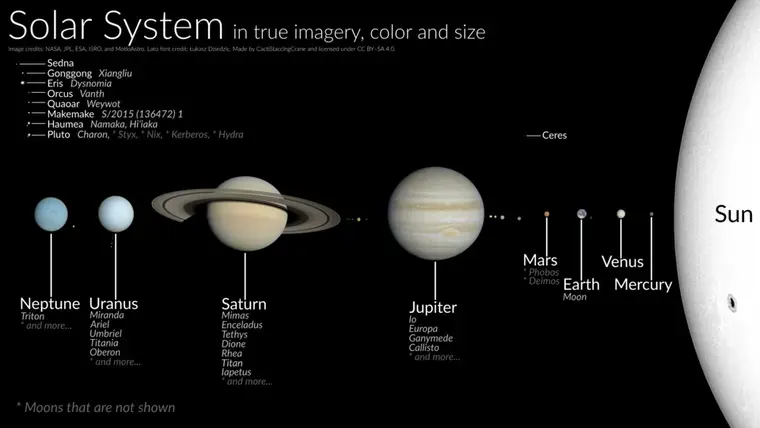
The Solar System is a group of space objects that are held together by gravity, with the Sun in the center. The Sun is a huge ball of hot glowing gas that gives off light and heat. Everything else in the Solar System moves around the Sun. The Solar System formed about 4.6 billion years ago when a giant cloud of gas and dust collapsed and started to spin. Scientists call this process the solar nebula theory. As the cloud collapsed, gravity caused it to spin faster and flatten into a disk. The Sun formed at the center, while the remaining material in the disk slowly stuck together to form planets through a process called accretion.
Most of the material went into forming the Sun, and the rest became planets and other objects. There are eight main planets, including Earth, and many moons that orbit them. There are also dwarf planets like Pluto, as well as asteroids, comets, meteoroids, and tiny particles called interplanetary dust. Our Solar System is part of a galaxy called the Milky Way. It lies in a part of the galaxy called the Orion Arm, about 27,000 light-years from the center of the Milky Way.
There are eight planets in our Solar System. Starting from the closest to the Sun, they are: Mercury, Venus, Earth, Mars, Jupiter, Saturn, Uranus, and Neptune. Scientists often group them into two main types. Terrestrial planets (Mercury, Venus, Earth, and Mars) are small and made mostly of rock and metal. Giant planets include gas giants (Jupiter and Saturn), made mostly of hydrogen and helium, and ice giants (Uranus and Neptune), which have more icy materials like water, methane, and ammonia. Each planet moves around the Sun in an oval-shaped path called an ellipse. These paths are all mostly in the same flat area of space, called the ecliptic plane. The ecliptic plane is the flat, disk-shaped region formed by the rotation of the original cloud of gas and dust. Because the planets formed from this rotating disk, they orbit the Sun in nearly the same plane, with only slight variations in their tilt.
Many planets have moons, which are natural objects that orbit them. Some planets, like Saturn and Jupiter, also have rings made of ice and dust particles that circle around them.
Far beyond the planet Neptune is a region called the Kuiper Belt. This area is filled with icy objects, including small worlds called dwarf planets, like Pluto, Haumea, and Makemake. These objects are made mostly of rock and ice and orbit the Sun just like the planets, but they are much smaller. Even farther out is a zone called the scattered disk, and beyond that is a mysterious, faraway area called the Oort Cloud. Scientists think the Oort Cloud is a huge, invisible shell of icy objects surrounding the Solar System. It may be where long-period comets come from, those that take hundreds or thousands of years to travel around the Sun. These distant regions are at the edge of the Sun’s power. The Sun’s gravity and solar wind stretch out to form a giant bubble called the heliosphere. This marks the boundary of the Sun’s influence, even farther than where the planets orbit.
Formation and Evolution of the Solar System
The formation and evolution of the Solar System began 4.6 billion years ago with the gravitational collapse of a small part of a giant molecular cloud. The solar nebula was the cloud of gas and dust that eventually formed the Sun and all the planets. This cloud did not just appear out of nowhere. It came from the interstellar medium, which is the thin, spread-out stuff that fills the space between stars. The part of space that formed our solar system was probably in a giant molecular cloud. These are cold, thick areas in space where new stars are often born. That’s why scientists sometimes call them stellar nurseries. These clouds were made mostly of hydrogen and helium, the two lightest elements. But they also had tiny amounts of heavier elements like carbon, oxygen, silicon, and iron. These heavier elements were made by older stars that had exploded in huge blasts called supernovas. When these stars exploded, they sent these elements out into space, mixing them into the cloud. Because of these ingredients, our part of the cloud had everything needed to form rocky planets like Earth and even the building blocks of life.
The formation of our Solar System began with a triggering event, something that caused part of a giant cloud of gas and dust to start collapsing. Scientists are not completely sure what started it, but there are a couple of good guesses. One idea is that a nearby supernova, a huge explosion at the end of a star’s life, sent out a powerful shockwave. This shockwave may have hit the cloud, pushing and squeezing the gas and dust until it became dense enough for gravity to take over. Another possibility is that small instabilities inside the cloud caused it to start collapsing on its own. Once gravity became stronger than the pressure trying to push the gas outward, the center of the cloud started to collapse inward. As it collapsed, it began to spin and flatten, forming a thicker, spinning area called the protosolar nebula. This was the early stage of what would eventually become the Sun and planets.
As the center of the giant cloud of gas and dust collapsed, it started to spin faster. This happened because of a rule in physics called conservation of angular momentum, kind of like how a figure skater spins faster when they pull their arms in. As the spinning increased, the cloud also flattened into a disk. In the middle of this spinning disk, more and more gas and dust gathered, making the center hotter and denser. As this cloud got smaller, most of the material started gathering in the center, forming a growing ball of gas called a protostar. This was the very early stage of what would become the Sun. As more gas and dust fell into the center, the protostar got hotter and denser. The particles inside began to crash into each other more often, causing the pressure to rise. When the core reached a temperature of about 10 million Kelvin, a powerful reaction called nuclear fusion started. During fusion, hydrogen atoms joined together to form helium, and this released a huge amount of energy. At this moment, the Sun officially came to life as a main-sequence star. Once fusion began, the Sun started giving off strong light, heat, and solar wind, a stream of tiny, charged particles. This wind helped blow away the extra gas and dust in the inner Solar System. This clearing-out process is called photoevaporation. It helped stop more material from falling into the Sun and made room for the planets to start forming. Even though the Sun was still young, it now had strong gravity and energy that controlled everything around it. The Sun had become the center of the Solar System.
Surrounding the young Sun was a large, spinning disk of gas and dust called the protoplanetary disk. This material was left over from the cloud that formed the Sun. The disk was flat like a pancake and rotated around the Sun. This disk was not the same all over, it had different temperatures in different places. The part closest to the Sun was very hot because of the Sun’s strong light and heat. In this hot area, only tough materials like metals and rocks could stay solid. These materials came together to form the rocky planets like Mercury, Venus, Earth, and Mars. Farther away from the Sun, the disk was much cooler. In this colder area, things like water, ammonia, and methane could freeze into ice. These icy and gassy materials helped form the gas and ice giants, planets like Jupiter, Saturn, Uranus, and Neptune. So, the different temperatures in the disk helped decide what kind of planets would form in different parts of the Solar System. This model, known as the nebular hypothesis, was developed in the 18th (1700s) century by Emanuel Swedenborg, Immanuel Kant, and Pierre-Simon Laplace. It has been adjusted by scientific disciplines such as astronomy, physics, geology, and planetary science. As our knowledge of space has grown, the models have been changed to account for the new observations.
One important part of the protoplanetary disk was something called the snow line (also known as the ice line). This was an invisible boundary in the disk that marked the point where it was cold enough for water and other gases to freeze into ice. Inside the snow line, closer to the Sun, it was too hot, so only rock and metal could stick together and form solid objects. That’s why the inner planets, like Earth and Mars, are made mostly of rock. Beyond the snow line, it was much cooler, and there were lots of ices in addition to rock. These ices made it easier for large planet cores to grow quickly. Once these big cores formed, they had strong enough gravity to pull in lots of gas from the disk around them. This is how the giant planets like Jupiter and Saturn were able to form.
General Characteristics of the Solar System
The Solar System is held together by gravity, with the Sun at the center. The Sun is so huge that it makes up more than 99.8% of all the mass in the entire Solar System. Because of its strong gravity, all the major objects, like planets, moons, asteroids, and comets, orbit around the Sun. This setup is called the heliocentric system, which means “Sun-centered.” The Solar System is divided into different regions, and each region has its own kinds of space objects and special features.
Closest to the Sun are the terrestrial planets: Mercury, Venus, Earth, and Mars. These planets are small, rocky, and heavy, made mostly of rock and metal. This part of the Solar System is called the inner Solar System, and all the planets here are packed close together. Just past Mars is the asteroid belt. This is a doughnut-shaped area filled with many rocky objects. These space rocks did not come together to form a planet, mostly because Jupiter’s strong gravity kept pulling things apart. The asteroid belt is like a border zone between the inner rocky planets and the outer giant planets.
Farther from the Sun are the giant planets. First come Jupiter and Saturn, known as gas giants because they are made mostly of hydrogen and helium. Then come Uranus and Neptune, called ice giants because they have more icy materials like water, ammonia, and methane. These outer planets are very big, have many moons, and also have ring systems, though not all are as big as Saturn’s rings. Beyond Neptune is the Kuiper Belt, a cold, flat region full of icy objects, including dwarf planets like Pluto. There are also many tiny frozen bodies out there. Even farther away is something called the Oort Cloud. It is a giant, round cloud of icy objects that surrounds the Solar System. Scientists think this is where long-period comets come from. It is also where the Sun’s gravity starts to fade.
The objects in the Solar System are grouped into different categories based on how they move and what they are made of. First, there are the planets, like Earth and Jupiter. These are big enough to control their orbits by pulling in or pushing away other objects nearby. Next are dwarf planets, like Pluto, Eris, and Haumea. These are round like planets, but they do not clear their orbits, which means other objects still share their paths around the Sun. Then we have natural satellites, which are moons that orbit planets. Finally, there are small solar system bodies like asteroids, comets, and meteoroids. These are smaller chunks of rock, metal, or ice that travel through space in all kinds of orbits.
The Solar System is huge, way bigger than what humans can easily imagine. The distances and sizes of the planets and other space objects are so big that it is hard to picture them using everyday ideas. The Sun is the biggest thing in the Solar System. It is so massive that it makes up almost all the mass in the entire Solar System. The Sun’s radius is about 700,000 kilometers (or 400,000 miles). Even though Earth feels big to us, about 1.3 million Earth's would fit inside the Sun. Jupiter is the largest planet. It is 5.2 times farther from the Sun than Earth and is so big that over 1,300 Earths could fit inside it. Its diameter is more than 11 times that of Earth. On the other hand, Mercury, the smallest planet, is just a little bigger than Earth’s Moon. And even smaller are dwarf planets like Pluto and tiny space rocks like comets and asteroids, which can be just a few kilometers wide.
Orbits of the planets
The Earth's orbit around the Sun is nearly a perfect circle, but in a very slightly oval shaped orbit, an elliptical orbit. The other planets in the Solar System also orbit the Sun in slightly elliptical orbits. Mercury has a more elliptical orbit than the others, and there is obviously some explanation for this. Some of the smaller objects orbit the Sun in very eccentric orbits. The planets all orbit the Sun in the same direction.
A full account of the planetary motion needs an account of the n-body problem, which is not treated on this wiki. A page can be found on En wiki.
Discovery and exploration
For thousands of years, people had no need for a name for the "Solar System". They thought the Earth stayed still at the center of everything (geocentrism). The Greek philosopher Aristarchus of Samos suggested that there was a special order in the sky. Nicolaus Copernicus was the first to develop a mathematical system that described what we now call the "Solar System". This was called a "new system of the world". In the 17th century, Galileo Galilei, Johannes Kepler and Isaac Newton began to understand physics more clearly. People began to accept the idea that the Earth is a planet that moves around the Sun, and that the planets are worlds, and that all worlds are governed by the same physical laws. More recently, telescopes and space probes sometimes let us see details directly. All inner planets have surface features. The gas giants (as the name suggests) have surfaces whose make-up is gradually being discovered.
The eight planets
The planets are the biggest objects that go around the Sun. It took people many years of using telescopes to find the objects that were farthest away. New planets might still be found, and more small objects are found every year. Most of the planets have moons that orbit around them just as the planets orbit the Sun. There are over 400 of these moons in the Solar System.
Dwarf planets
Pluto was discovered by American astronomer Clyde Tombaugh in 1930. It was declared the ninth planet of the Solar System.
Pluto's planet status changed in 2006, when the International Astronomical Union (IAU) decided on a definition of the word "planet" for the first time. By this definition, Pluto was not a planet due to its irregular orbit and size. Thus, Pluto lost its planet status.
Eris was first announced in 2005. It was found to be 27% more massive than Pluto. Pluto did not fit in with the rest of the planets. So, the IAU defined a new category called "dwarf planet", into which Pluto did fit, along with some other small Solar System bodies. These small bodies are sometimes called plutinos.
There is an unknown number of dwarf planets in the Solar System. As of 2025, these nine small Solar System bodies are often called dwarf planets:
Structure
There are a few main parts of the Solar System. Here they are in order from the Sun, with the planets numbered, and dwarf planets marked with letters.
The first four planets closest to the Sun are called the inner planets. They are small and dense terrestrial planets, with solid surfaces. They are made up of mostly rock and metal with a distinct internal structure and a similar size. Three also have an atmosphere. The study of the four planets gives information about geology outside the Earth.
Terrestrial planets region contains the four planets closest to the sun, all are rocky planets
Giant planets region contains the four largest planets. Jupiter and Saturn are gas giants, while Uranus and Neptune are ice giants;
The Oort cloud is separate from the trans-Neptune region, and much farther out. It contains the long-period comets.
Text adapted from the Simple English Wikipedia article “Solar System” (revision 10856984, 2026-05-15), authors, licensed under CC BY-SA 4.0.