Dinosaur Crossword Puzzle
Free printable educational crossword puzzle. Every clue is a sentence sourced directly from the Wikipedia article on Dinosaur with the key terms blanked out.
Dinosaur Crossword
Name: ____________________ Date: ______________
| 12E | 13P | ||||||||||||
| C | R | ||||||||||||
| O | E | ||||||||||||
| 14C | L | C | |||||||||||
| 1H | E | R | B | I | V | O | R | O | U | S | |||
| O | G | C | |||||||||||
| C | I | I | |||||||||||
| 10M | E | S | O | Z | O | I | C | A | |||||
| D | A | L | |||||||||||
| I | L | I | 3M | ||||||||||
| L | 7F | T | A | ||||||||||
| 8R | E | P | T | I | L | E | Y | M | |||||
| A | A | 11G | M | ||||||||||
| 4O | R | N | I | T | H | I | S | C | H | I | A | ||
| H | A | L | |||||||||||
| 5S | E | N | |||||||||||
| 6K | E | R | A | T | I | N | |||||||
| E | |||||||||||||
| L | |||||||||||||
| 2C | R | E | T | A | C | E | O | U | S | ||||
| T | |||||||||||||
| A | |||||||||||||
| 9V | E | L | O | C | I | R | A | P | T | O | R |
Across
- 1. The smallest _____ non-avialan dinosaurs included Microceratus and Wannanosaurus, at about 60 cm long each. (11 letters)
- 2. There were three general dinosaur faunas in the Late _____. (10 letters)
- 4. Both definitions cover the same known genera: Dinosauria = _____ + Saurischia. (12 letters)
- 6. Fossils of _____-based skin coverings or bony skin coverings are known from most major groups of dinosaurs. (7 letters)
- 8. Dinosaurs are a diverse group of warmblooded _____ of the clade Dinosauria. (7 letters)
- 9. It included a _____ attacking a Protoceratops, providing evidence that dinosaurs did indeed attack each other. (12 letters)
- 10. The mode of _____ dinosaur body masses is between 1 and 10 MT. (8 letters)
Down
- 3. These losses left behind a land fauna of crocodylomorphs, dinosaurs, _____, pterosaurians, and turtles. (6 letters)
- 5. A variety of other _____ features are shared by dinosaurs. (8 letters)
- 7. Because _____ are often associated with birds, _____ dinosaurs are often touted as the missing link between birds and dinosaurs. (7 letters)
- 11. In Europe, dinosaur fossils were generally believed to be the remains of _____ and other biblical creatures. (5 letters)
- 12. Dinosaurs are varied from taxonomic, morphological and _____ standpoints. (10 letters)
- 13. However, there is ample evidence of _____ or superprecociality among many dinosaur species, particularly theropods. (12 letters)
- 14. Dinosaurs belong to a group known as archosaurs, which also includes modern _____. (11 letters)
Clues are sentences from the Wikipedia article “Dinosaur” (revision 1362307567, CC BY-SA 4.0). crosswordprint.com/printable-crosswords/animals/dinosaur/
Dinosaur Word Search
Name: ____________________ Date: ______________
Words to Find
crosswordprint.com/printable-crosswords/animals/dinosaur/
Pick the word that completes each sentence from the Wikipedia article.
Is the sentence correct? Some sentences have one word altered.
Click a clue, then click the word it belongs to.
Unscramble each word. The clue is the sentence it was taken from.
How to Solve & Use the Answer Key
This is a fill-in crossword. Each clue is a sentence from the Wikipedia article on Dinosaur, with the key term blanked out. The number in parentheses shows the letter count. Solve interactively on screen or check Show answers to view the answer key. To print a clean student worksheet, press Print Puzzle.
Dinosaur Crossword Answer Key & Definitions
Show Complete Answers & Word Definitions
- 1 Across: HERBIVOROUS — A herbivore is an animal anatomically or physiologically evolved to feed on plants, especially upon vascular tissues such as foliage, fruits or seeds, as the main component of its diet. Wikipedia: Herbivore
- 2 Across: CRETACEOUS — The Cretaceous is a geological period that lasted from about 143.1 to 66 Ma (million years ago). Wikipedia: Cretaceous
- 4 Across: ORNITHISCHIA — Ornithischia is an extinct clade of mainly herbivorous dinosaurs characterized by a pelvic structure superficially similar to that of birds. Wikipedia: Ornithischia
- 6 Across: KERATIN — Keratin is one of a family of structural fibrous proteins also known as scleroproteins. Wikipedia: Keratin
- 8 Across: REPTILE — Reptiles, as commonly defined, are tetrapod vertebrate animals with an ectothermic metabolism and amniotic development. Wikipedia: Reptile
- 9 Across: VELOCIRAPTOR — Velociraptor is a genus of small dromaeosaurid dinosaurs that lived in Asia during the Late Cretaceous epoch, about 75 million to 71 million years ago (Mya). Wikipedia: Velociraptor
- 10 Across: MESOZOIC — The Mesozoic Era is an era of Earth's geological history, lasting from about, comprising the Triassic, Jurassic and Cretaceous Periods. Wikipedia: Mesozoic
- 3 Down: MAMMAL — A mammal is a vertebrate animal of the class Mammalia. Wikipedia: Mammal
- 5 Down: SKELETAL — A skeleton is the structural frame that supports the body of most animals. Wikipedia: Skeleton
- 7 Down: FEATHER — Feathers are epidermal growths that form a distinctive outer covering, or plumage, on both avian (bird) and some non-avian dinosaurs and other archosaurs. Wikipedia: Feather
- 11 Down: GIANT — In folklore, giants (from Ancient Greek: gigas, cognate giga-) are beings of humanoid appearance, but are at times prodigious in size and strength or bear an otherwise notable appearance. Wikipedia: Giant
- 12 Down: ECOLOGICAL — Ecology is the natural science of the relationships among living organisms and their environment. Wikipedia: Ecology
- 13 Down: PRECOCIALITY — Precocial species in birds and mammals are those in which the young are relatively mature and mobile from the moment of birth or hatching. Wikipedia: Precociality and altriciality
- 14 Down: CROCODILIAN — Crocodilia is an order of semiaquatic, predatory reptiles that are known as crocodilians. Wikipedia: Crocodilia
Definitions adapted from Wikipedia articles (week 2026-W41), CC BY-SA 4.0.
Read about Dinosaur
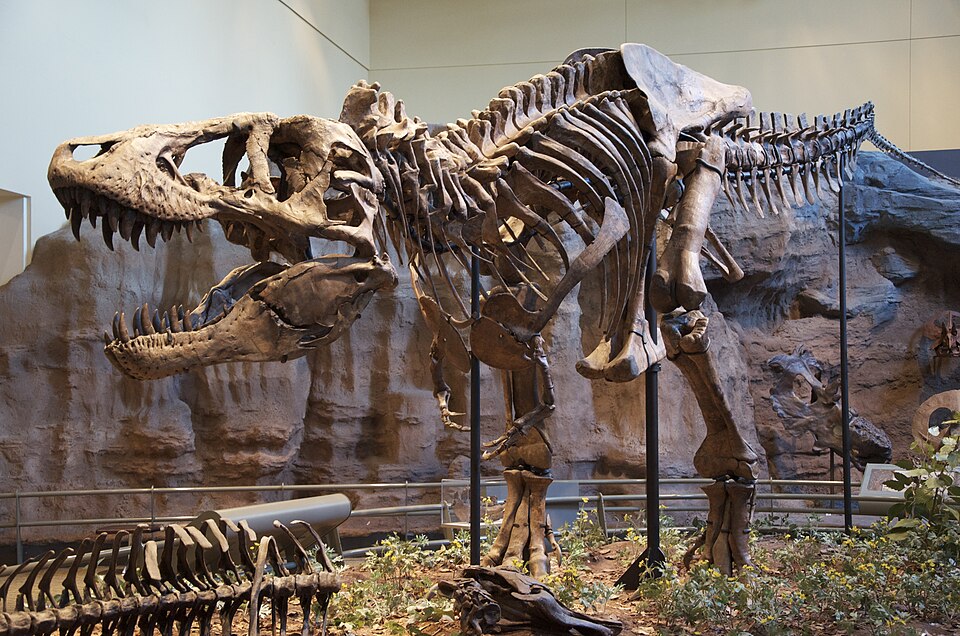
Dinosaurs are a diverse group of warmblooded reptiles of the clade Dinosauria. They existed through most of the Mesozoic era, first appearing early in the Triassic period. They became the dominant terrestrial vertebrates after the Triassic–Jurassic extinction event 201.3 mya and their dominance continued throughout the Jurassic and Cretaceous periods. The fossil record shows that birds are feathered dinosaurs, having evolved from earlier theropods during the Late Jurassic epoch, and are the only dinosaur lineage known to have survived the Cretaceous–Paleogene extinction event approximately 66 mya. Dinosaurs can therefore be divided into avian dinosaurs—birds—and the extinct non-avian dinosaurs, which are all dinosaurs other than birds.
Dinosaurs are varied from taxonomic, morphological and ecological standpoints. Birds, at over 11,000 living species, are among the most diverse groups of vertebrates. Using fossil evidence, paleontologists have identified over 900 distinct genera and more than 1,000 different species of non-avian dinosaurs. Dinosaurs are represented on every continent by both extant species (birds) and fossil remains. Through most of the 20th century, before birds were recognized as dinosaurs, most of the scientific community believed dinosaurs to have been sluggish and cold-blooded. Most research conducted since the 1970s, however, has indicated that dinosaurs were active animals with elevated metabolisms and numerous adaptations for social interaction. Evidence shows that all dinosaurs had erect legs similar to that of birds and many mammals, as opposed to the sprawling leg stance of cold-blooded tetrapods. Some were herbivorous, others carnivorous. Evidence suggests that all dinosaurs were egg-laying, and that nest-building was a trait shared by many dinosaurs, both avian and non-avian.
While dinosaurs were ancestrally bipedal, many extinct groups included quadrupedal species, and some were able to shift between these stances. Elaborate display structures such as horns or crests are common to all dinosaur groups, and some extinct groups developed skeletal modifications such as bony armor and spines. While the dinosaurs' modern-day surviving avian lineage (birds) are generally small due to the constraints of flight, many non-avian dinosaurs were large-bodied—the largest sauropod dinosaurs are estimated to have reached lengths of 39.7 m and heights of 18 m and were the largest land animals of all time.
The first dinosaur fossils were recognized in the early 19th century, with the name "dinosaur" (meaning "terrible lizard") being coined by Sir Richard Owen in 1842 to refer to these "great fossil lizards". Since then, mounted fossil dinosaur skeletons have been major attractions at museums worldwide, and dinosaurs have become an enduring part of popular culture. The large sizes of some dinosaurs, as well as their seemingly monstrous and fantastic nature, have ensured their regular appearance in best-selling books and films, such as the Jurassic Park franchise. Persistent public enthusiasm for the animals has resulted in significant funding for dinosaur science, and new discoveries are regularly covered by the media.
Definition
Under phylogenetic nomenclature, dinosaurs are usually defined as the group consisting of the most recent common ancestor (MRCA) of Triceratops and modern birds (Neornithes), and all its descendants. It has also been suggested that Dinosauria be defined with respect to the MRCA of Megalosaurus and Iguanodon, because these were two of the three genera cited by Richard Owen when he recognized the Dinosauria. Both definitions cover the same known genera: Dinosauria = Ornithischia + Saurischia. This includes major groups such as ankylosaurians (armored herbivorous quadrupeds), stegosaurians (plated herbivorous quadrupeds), ceratopsians (bipedal or quadrupedal herbivores with neck frills), pachycephalosaurians (bipedal herbivores with thick skulls), ornithopods (bipedal or quadrupedal herbivores including "duck-bills"), theropods (mostly bipedal carnivores and birds), and sauropodomorphs (mostly large herbivorous quadrupeds with long necks and tails).
Birds are the sole surviving dinosaurs. In traditional taxonomy, birds were considered a separate class that had evolved from dinosaurs. However, most contemporary paleontologists reject the traditional style of classification based on anatomical similarity, in favor of phylogenetic taxonomy based on deduced ancestry, in which each group is defined as all descendants of a given founding genus. Birds belong to the dinosaur subgroup Maniraptora, which are coelurosaurs, which are theropods, which are saurischians.
Research by Matthew G. Baron, David B. Norman, and Paul M. Barrett in 2017 suggested a radical revision of dinosaurian systematics. Phylogenetic analysis by Baron et al. recovered the Ornithischia as being closer to the Theropoda than the Sauropodomorpha, as opposed to the traditional union of theropods with sauropodomorphs. This would cause sauropods and kin to fall outside traditional dinosaurs, so they re-defined Dinosauria as the last common ancestor of Triceratops horridus, Passer domesticus and Diplodocus carnegii, and all of its descendants, to ensure that sauropods and kin remain included as dinosaurs. They also resurrected the clade Ornithoscelida to refer to the group containing Ornithischia and Theropoda.
Using one of the above definitions, dinosaurs can be generally described as archosaurs with hind limbs held erect beneath the body. Other prehistoric animals, including pterosaurs, mosasaurs, ichthyosaurs, plesiosaurs, and Dimetrodon, while often popularly conceived of as dinosaurs, are not taxonomically classified as dinosaurs. Pterosaurs are distantly related to dinosaurs, being members of the clade Ornithodira. The other groups mentioned are, like dinosaurs and pterosaurs, members of Sauropsida (the reptile and bird clade), except Dimetrodon (which is a synapsid). None of them had the erect hind limb posture characteristic of true dinosaurs.
Dinosaurs were the dominant terrestrial vertebrates of the Mesozoic Era, especially the Jurassic and Cretaceous periods. Other groups of animals were restricted in size and niches; mammals, for example, rarely exceeded the size of a domestic cat and were generally rodent-sized carnivores of small prey. Dinosaurs have always been recognized as an extremely varied group: over 900 non-avian dinosaur genera have been confidently identified (2018) with 1124 species (2016). Estimates put the total number of dinosaur genera preserved in the fossil record at 1850, nearly 75% still undiscovered, and the number that ever existed (in or out of the fossil record) at 3,400. A 2016 estimate put the number of dinosaur species living in the Mesozoic at 1,543–2,468, compared to the number of modern-day birds (avian dinosaurs) at 10,806 species.
History of study
Dinosaur fossils have been known for millennia, although their true nature was not recognized. Chinese authors have long recognised remains of prehistoric animals as "dragon bones". Huayang Guo Zhi, a gazetteer compiled by Chang Qu during the Western Jin Dynasty (265–316), reported the discovery of dragon bones at Wucheng in Sichuan Province. These "dragon bones" were and still are often used as ingredients for remedies in Traditional Chinese Medicine. While these "dragon bones" have often popularly been claimed to be dinosaur bones, all known historical examples of vertebrate "dragon bones" from China are actually from Cenozoic mammals. However, a village in Henan, central China was reported in 2007 to have spent the previous several decades excavating and using real dinosaur bones as "dragon bones" for TCM purposes. In Europe, dinosaur fossils were generally believed to be the remains of giants and other biblical creatures.
Scholarly descriptions of what would now be recognized as dinosaur bones first appeared in the late 17th century in England. Part of a bone, now known to have been the femur of a Megalosaurus, was recovered from a limestone quarry at Cornwell near Chipping Norton, Oxfordshire, in 1676. The fragment was sent to Robert Plot, Professor of Chemistry at the University of Oxford and first curator of the Ashmolean Museum, who published a description in his The Natural History of Oxford-shire (1677). He correctly identified the bone as the lower extremity of the femur of a large animal, and recognized that it was too large to belong to any known species. He therefore concluded it to be the femur of a huge human, perhaps a Titan or another type of giant featured in legends. Edward Lhuyd, a friend of Sir Isaac Newton, published Lithophylacii Britannici ichnographia (1699), the first scientific treatment of what would now be recognized as a dinosaur. In it he described and named a sauropod tooth, "Rutellum impicatum", that had been found in Caswell, near Witney, Oxfordshire.
Between 1815 and 1824, the Rev William Buckland, the first Reader of Geology at the University of Oxford, collected more fossilized bones of Megalosaurus and became the first person to describe a non-avian dinosaur in a scientific journal. The second non-avian dinosaur genus to be identified, Iguanodon, was purportedly discovered in 1822 by Mary Ann Mantell, the wife of English geologist Gideon Mantell, though this is disputed and some historians say Gideon had acquired remains years earlier. Gideon Mantell recognized similarities between his fossils and the bones of modern iguanas and published his findings in 1825.
The study of these "great fossil lizards" soon became of great interest to European and American scientists, and in 1842 the English paleontologist Sir Richard Owen coined the term "dinosaur", using it to refer to the "distinct tribe or sub-order of Saurian Reptiles" that were then being recognized in England and around the world. The term is derived. Though the taxonomic name has often been interpreted as a reference to dinosaurs' teeth, claws, and other fearsome characteristics, Owen intended it also to evoke their size and majesty. Owen recognized that the remains that had been found so far, Iguanodon, Megalosaurus and Hylaeosaurus, shared distinctive features, and so decided to present them as a distinct taxonomic group. As clarified by British geologist and historian Hugh Torrens, Owen had given a presentation about fossil reptiles to the British Association for the Advancement of Science in 1841, but reports of the time show that Owen did not mention the word "dinosaur", nor recognize dinosaurs as a distinct group of reptiles in his address. He introduced the Dinosauria only in the revised text version of his talk published in April 1842. With the backing of Prince Albert, the husband of Queen Victoria, Owen established the Natural History Museum, London, to display the national collection of dinosaur fossils and other biological and geological exhibits.
In 1858, William Parker Foulke discovered the first known American dinosaur in marl pits in the small town of Haddonfield, New Jersey. (Although fossils had been found before, their nature had not been correctly discerned.) The creature was named Hadrosaurus foulkii. It was an extremely important find: Hadrosaurus was one of the first nearly complete dinosaur skeletons found (the first was in 1834, in Maidstone, England), and it was clearly a bipedal creature. This was a revolutionary discovery as, until that point, most scientists had believed dinosaurs walked on four feet, like other lizards. Foulke's discoveries sparked a wave of interests in dinosaurs in the United States, known as Dinosaur Mania.
Evolutionary history
Dinosaurs diverged from their archosaur ancestors during the Middle to Late Triassic epochs, roughly 20 million years after the devastating Permian–Triassic extinction event wiped out an estimated 96% of all marine species and 70% of terrestrial vertebrate species approximately 252 million years ago. The oldest dinosaur fossils known from substantial remains date to the Carnian epoch of the Triassic period and have been found primarily in the Ischigualasto and Santa Maria Formations of Argentina and Brazil, and the Pebbly Arkose Formation of Zimbabwe.
The Ischigualasto Formation (radiometrically dated at 231–230 million years old) has produced the early saurischian Eoraptor, originally considered a member of the Herrerasauridae but now considered to be an early sauropodomorph, along with the herrerasaurids Herrerasaurus and Sanjuansaurus, and the sauropodomorphs Chromogisaurus, Eodromaeus, and Panphagia. Eoraptor likely resemblance to the common ancestor of all dinosaurs suggests that the first dinosaurs would have been small, bipedal predators. The Santa Maria Formation (radiometrically dated to be older, at 233.23 million years old) has produced the herrerasaurids Gnathovorax and Staurikosaurus, along with the sauropodomorphs Bagualosaurus, Buriolestes, Guaibasaurus, Macrocollum, Nhandumirim, Pampadromaeus, Saturnalia, and Unaysaurus. The Pebbly Arkose Formation, which is of uncertain age but was likely comparable to the other two, has produced the sauropodomorph Mbiresaurus, along with an unnamed herrerasaurid.
Less well-preserved remains of the sauropodomorphs Jaklapallisaurus and Nambalia, along with the early saurischian Alwalkeria, are known from the Upper Maleri and Lower Maleri Formations of India. The Carnian-aged Chañares Formation of Argentina preserves primitive, dinosaur-like ornithodirans such as Lagosuchus and Lagerpeton in Argentina, making it another important site for understanding dinosaur evolution. These ornithodirans support the model of early dinosaurs as small, bipedal predators. Dinosaurs may have appeared as early as the Anisian epoch of the Triassic, approximately 243 million years ago, which is the age of Nyasasaurus from the Manda Formation of Tanzania. However, its known fossils are too fragmentary to identify it as a dinosaur or only a close relative. The referral of the Manda Formation to the Anisian is also uncertain. Regardless, dinosaurs existed alongside non-dinosaurian ornithodirans for a period of time, with estimates ranging from 5–10 million years to 21 million years.
When dinosaurs appeared, they were not the dominant terrestrial animals. The terrestrial habitats were occupied by various types of archosauromorphs and therapsids, like cynodonts and rhynchosaurs. Their main competitors were the pseudosuchians, such as aetosaurs, ornithosuchids and rauisuchians, which were more successful than the dinosaurs. Most of these other animals became extinct in the Triassic, in one of two events. First, at about 215 million years ago, a variety of basal archosauromorphs, including the protorosaurs, became extinct. This was followed by the Triassic–Jurassic extinction event (about 201 million years ago), that saw the end of most of the other groups of early archosaurs, like aetosaurs, ornithosuchids, phytosaurs, and rauisuchians. Rhynchosaurs and dicynodonts survived (at least in some areas) at least as late as early –mid Norian and late Norian or earliest Rhaetian stages, respectively, and the exact date of their extinction is uncertain. These losses left behind a land fauna of crocodylomorphs, dinosaurs, mammals, pterosaurians, and turtles. The first few lines of early dinosaurs diversified through the Carnian and Norian stages of the Triassic, possibly by occupying the niches of the groups that became extinct. Also notably, there was a heightened rate of extinction during the Carnian pluvial event.
Dinosaur evolution after the Triassic followed changes in vegetation and the location of continents. In the Late Triassic and Early Jurassic, the continents were connected as the single landmass Pangaea, and there was a worldwide dinosaur fauna mostly composed of coelophysoid carnivores and early sauropodomorph herbivores. Gymnosperm plants (particularly conifers), a potential food source, radiated in the Late Triassic. Early sauropodomorphs did not have sophisticated mechanisms for processing food in the mouth, and so must have employed other means of breaking down food farther along the digestive tract. The general homogeneity of dinosaurian faunas continued into the Middle and Late Jurassic, where most localities had predators consisting of ceratosaurians, megalosauroids, and allosauroids, and herbivores consisting of stegosaurian ornithischians and large sauropods. Examples of this include the Morrison Formation of North America and Tendaguru Beds of Tanzania. Dinosaurs in China show some differences, with specialized metriacanthosaurid theropods and unusual, long-necked sauropods like Mamenchisaurus. Ankylosaurians and ornithopods were also becoming more common, but primitive sauropodomorphs had become extinct. Conifers and pteridophytes were the most common plants. Sauropods, like earlier sauropodomorphs, were not oral processors, but ornithischians were evolving various means of dealing with food in the mouth, including potential cheek-like organs to keep food in the mouth, and jaw motions to grind food. Another notable evolutionary event of the Jurassic was the appearance of true birds, descended from maniraptoran coelurosaurians.
Classification
Dinosaurs belong to a group known as archosaurs, which also includes modern crocodilians. Within the archosaur group, dinosaurs are differentiated most noticeably by their gait. Dinosaur legs extend directly beneath the body, whereas the legs of lizards and crocodilians sprawl out to either side.
Collectively, dinosaurs as a clade are divided into two primary branches, Saurischia and Ornithischia. Saurischia includes those taxa sharing a more recent common ancestor with birds than with Ornithischia, while Ornithischia includes all taxa sharing a more recent common ancestor with Triceratops than with Saurischia. Anatomically, these two groups can be distinguished most noticeably by their pelvic structure. Early saurischians—"lizard-hipped", from the Greek sauros (σαῦρος) meaning "lizard" and ischion (ἰσχίον) meaning "hip joint"—retained the hip structure of their ancestors, with a pubis bone directed cranially, or forward. This basic form was modified by rotating the pubis backward to varying degrees in several groups (Herrerasaurus, therizinosauroids, dromaeosaurids, and birds). Saurischia includes the theropods (exclusively bipedal and with a wide variety of diets) and sauropodomorphs (long-necked herbivores which include advanced, quadrupedal groups).
By contrast, ornithischians—"bird-hipped", from the Greek ornis (ὀρνίς) meaning "bird" and ischion (ἰσχίον) meaning "hip joint"—had a pelvis that superficially resembled a bird's pelvis: the pubic bone was oriented caudally (rear-pointing). Unlike birds, the ornithischian pubis also usually had an additional forward-pointing process. Ornithischia includes a variety of species that were primarily herbivores.
Despite the terms "bird hip" (Ornithischia) and "lizard hip" (Saurischia), birds are not part of Ornithischia. Birds instead belong to Saurischia, the "lizard-hipped" dinosaurs—birds evolved from earlier dinosaurs with "lizard hips".
The following cladogram showing the relationships of dinosaur groups is simplified after Michael Benton, 2015:
Paleobiology
Knowledge about dinosaurs is derived from a variety of fossil and non-fossil records, including fossilized bones, feces, trackways, gastroliths, feathers, impressions of skin, internal organs and other soft tissues. Many fields of study contribute to our understanding of dinosaurs, including physics (especially biomechanics), chemistry, biology, and the Earth sciences (of which paleontology is a sub-discipline). Two topics of particular interest and study have been dinosaur size and behavior.
Current evidence suggests that dinosaur average size varied through the Triassic, Early Jurassic, Late Jurassic and Cretaceous. Predatory theropod dinosaurs, which occupied most terrestrial carnivore niches during the Mesozoic, most often fall into the 100 to 1000 kg category when sorted by estimated weight into categories based on order of magnitude, whereas recent predatory carnivoran mammals peak in the 10 to 100 kg category. The mode of Mesozoic dinosaur body masses is between 1 and 10 MT. This contrasts sharply with the average size of Cenozoic mammals, estimated by the National Museum of Natural History as about 2 to 5 kg.
The sauropods were the largest and heaviest dinosaurs. For much of the dinosaur era, the smallest sauropods were larger than anything else in their habitat, and the largest was an order of magnitude more massive than anything else that has since walked the Earth. Giant prehistoric mammals such as Paraceratherium (the largest land mammal ever) were dwarfed by the giant sauropods, and only modern whales approach or surpass them in size. There are several proposed advantages for the large size of sauropods, including protection from predation, reduction of energy use, and longevity, but it may be that the most important advantage was dietary. Large animals are more efficient at digestion than small animals, because food spends more time in their digestive systems. This also permits them to subsist on food with lower nutritive value than smaller animals. Sauropod remains are mostly found in rock formations interpreted as dry or seasonally dry, and the ability to eat large quantities of low-nutrient browse would have been advantageous in such environments.
Scientists will probably never be certain of the largest and smallest dinosaurs to have ever existed. This is because only a tiny percentage of animals were ever fossilized and most of these remain buried in the earth. Few non-avian dinosaur specimens that are recovered are complete skeletons, and impressions of skin and other soft tissues are rare. Rebuilding a complete skeleton by comparing the size and morphology of bones to those of similar, better-known species is an inexact art, and reconstructing the muscles and other organs of the living animal is, at best, a process of educated guesswork.
The tallest and heaviest dinosaur known from good skeletons is Giraffatitan brancai (previously classified as a species of Brachiosaurus). Its remains were discovered in Tanzania between 1907 and 1912. Bones from several similar-sized individuals were incorporated into the skeleton now mounted and on display at the Museum für Naturkunde in Berlin; this mount is 12 m tall and 21.8 to 22.5 m long, and would have belonged to an animal that weighed between and kilograms ( and lb). The longest complete dinosaur is the 27 m long Diplodocus, which was discovered in Wyoming in the United States and displayed in Pittsburgh's Carnegie Museum of Natural History in 1907. The longest dinosaur known from good fossil material is Patagotitan: the skeleton mount in the American Museum of Natural History in New York is 37 meters long. The Museo Municipal Carmen Funes in Plaza Huincul, Argentina, has an Argentinosaurus reconstructed skeleton mount that is 39.7 m long.
Origin of birds
The possibility that dinosaurs were the ancestors of birds was first suggested in 1868 by Thomas Henry Huxley. After the work of Gerhard Heilmann in the early 20th century, the theory of birds as dinosaur descendants was abandoned in favor of the idea of them being descendants of generalized thecodonts, with the key piece of evidence being the supposed lack of clavicles in dinosaurs. However, as later discoveries showed, clavicles (or a single fused wishbone, which derived from separate clavicles) were not actually absent; they had been found as early as 1924 in Oviraptor, but misidentified as an interclavicle. In the 1970s, John Ostrom revived the dinosaur–bird theory, which gained momentum in the coming decades with the advent of cladistic analysis, and a great increase in the discovery of small theropods and early birds. Of particular note have been the fossils of the Jehol Biota, where a variety of theropods and early birds have been found, often with feathers of some type. Birds share over a hundred distinct anatomical features with other theropod dinosaurs. They are most closely allied with maniraptoran coelurosaurs. A minority of scientists, most notably Alan Feduccia and Larry Martin, have proposed other evolutionary paths, including revised versions of Heilmann's basal archosaur proposal, or that maniraptoran theropods are the ancestors of birds but themselves are not dinosaurs, only convergent with dinosaurs.
Feathers are one of the most recognizable characteristics of modern birds, and a trait that was also shared by several non-avian dinosaurs. Based on the current distribution of fossil evidence, it appears that feathers were an ancestral dinosaurian trait, though one that may have been selectively lost in some species. Direct fossil evidence of feathers or feather-like structures has been discovered in a diverse array of species in many non-avian dinosaur groups, both among saurischians and ornithischians. Simple, branched, feather-like structures are known from heterodontosaurids, primitive neornithischians, and theropods, and primitive ceratopsians. Evidence for true, vaned feathers similar to the flight feathers of modern birds has been found only in the theropod subgroup Maniraptora, which includes oviraptorosaurs, troodontids, dromaeosaurids, and birds. Feather-like structures known as pycnofibres have also been found in pterosaurs.
However, researchers do not agree on whether these structures share a common origin between lineages (i.e., they are homologous), or if they were the result of widespread experimentation with skin coverings among ornithodirans. If the former is the case, filaments may have been common in the ornithodiran lineage and evolved before the appearance of dinosaurs themselves. Research into the genetics of American alligators has revealed that crocodylian scutes do possess feather-keratins during embryonic development, but these keratins are not expressed by the animals before hatching. The description of feathered dinosaurs has not been without controversy in general; perhaps the most vocal critics have been Alan Feduccia and Theagarten Lingham-Soliar, who have proposed that some purported feather-like fossils are the result of the decomposition of collagenous fiber that underlaid the dinosaurs' skin, and that maniraptoran dinosaurs with vaned feathers were not actually dinosaurs, but convergent with dinosaurs. However, their views have for the most part not been accepted by other researchers, to the point that the scientific nature of Feduccia's proposals has been questioned.
Archaeopteryx was the first fossil found that revealed a potential connection between dinosaurs and birds. It is considered a transitional fossil, in that it displays features of both groups. Brought to light just two years after Charles Darwin's seminal On the Origin of Species (1859), its discovery spurred the nascent debate between proponents of evolutionary biology and creationism. This early bird is so dinosaur-like that, without a clear impression of feathers in the surrounding rock, at least one specimen was mistaken for the small theropod Compsognathus. Since the 1990s, a number of additional feathered dinosaurs have been found, providing even stronger evidence of the close relationship between dinosaurs and modern birds. Many of these specimens were unearthed in the lagerstätten of the Jehol Biota. If feather-like structures were indeed widely present among non-avian dinosaurs, the lack of abundant fossil evidence for them may be due to the fact that delicate features like skin and feathers are seldom preserved by fossilization and thus often absent from the fossil record.
Because feathers are often associated with birds, feathered dinosaurs are often touted as the missing link between birds and dinosaurs. However, the multiple skeletal features also shared by the two groups represent another important line of evidence for paleontologists. Areas of the skeleton with important similarities include the neck, pubis, wrist (semi-lunate carpal), arm and pectoral girdle, furcula (wishbone), and breast bone. Comparison of bird and dinosaur skeletons through cladistic analysis strengthens the case for the link.
Text adapted from the Wikipedia article “Dinosaur” (revision 1362307567, 2026-07-03), authors, licensed under CC BY-SA 4.0.