Ancient Egypt Crossword Puzzle for Kids
Free printable educational crossword puzzle. Every clue is a plain-English sentence from the Simple English Wikipedia article on Ancient Egypt, with the key word blanked out. Standard version →
Ancient Egypt Crossword
Name: ____________________ Date: ______________
| 8I | |||||||||||||||||
| M | |||||||||||||||||
| P | |||||||||||||||||
| O | |||||||||||||||||
| 1P | E | R | I | O | 13D | S | |||||||||||
| T | E | ||||||||||||||||
| A | V | ||||||||||||||||
| N | E | ||||||||||||||||
| 11S | T | I | L | L | 6S | ||||||||||||
| Y | O | O | |||||||||||||||
| M | P | C | 7R | ||||||||||||||
| B | 9A | E | I | 2M | E | D | I | C | I | N | E | ||||||
| 4K | N | O | W | L | E | D | G | E | C | ||||||||
| L | O | 10T | H | O | U | G | H | T | |||||||||
| N | Y | ||||||||||||||||
| 5K | I | N | G | 12D | O | M | |||||||||||
| I | |||||||||||||||||
| S | |||||||||||||||||
| T | |||||||||||||||||
| R | |||||||||||||||||
| 3B | U | I | L | D | I | N | G | ||||||||||
| C | |||||||||||||||||
| T | |||||||||||||||||
| S |
Across
- 1. During some _____, the Egyptian government was challenged and sometimes overthrown. (7 letters)
- 2. They performed surgery, set broken bones, and even used _____ like honey, breast milk, and gazelle's milk. (8 letters)
- 3. They are the best-known pyramid structures and are some of the largest ever _____. (8 letters)
- 4. Ancient Egyptians had some advanced medical _____ for their time. (9 letters)
- 5. This language was used during the Old _____ and the First Intermediate Period. (7 letters)
- 10. The Egyptian rulers, called pharaohs, were _____ to be close to the gods. (7 letters)
- 11. Even after people stopped speaking this kind of Egyptian, writers _____ used it when they wrote books. (5 letters)
Down
- 6. Because they were settled, _____ became more complex. (7 letters)
- 7. Their religion had many gods, and its priests were powerful and _____. (4 letters)
- 8. All kinds of animals were _____ to Egypt. (9 letters)
- 9. Egypt grew _____ the Nile River and was at its most powerful in the 2nd millennium BC. (5 letters)
- 11. The same _____ can serve different purposes in different contexts. (6 letters)
- 12. Ancient Egypt was divided into many different _____, called sepats. (9 letters)
- 13. By about 5500 BC, small tribes living in the Nile Valley had _____ into a series of cultures. (9 letters)
Clues are sentences from the Simple English Wikipedia article “Ancient Egypt” (revision 10895630, CC BY-SA 4.0). crosswordprint.com/printable-crosswords/ancient-history/ancient-egypt-for-kids/
Ancient Egypt Word Search
Name: ____________________ Date: ______________
Words to Find
crosswordprint.com/printable-crosswords/ancient-history/ancient-egypt-for-kids/
Pick the word that completes each sentence from the Simple English Wikipedia article.
Is the sentence correct? Some sentences have one word altered.
Click a clue, then click the word it belongs to.
Unscramble each word. The clue is the sentence it was taken from.
How to Solve & Use the Answer Key
This is a fill-in crossword. Each clue is a sentence from the Simple English Wikipedia article on Ancient Egypt, with the key term blanked out. The number in parentheses shows the letter count. Solve interactively on screen or check Show answers to view the answer key. To print a clean student worksheet, press Print Puzzle.
Ancient Egypt Crossword Answer Key & Definitions
Show Complete Answers & Word Definitions
- 1 Across: PERIODS
- 2 Across: MEDICINE — Medicine is the science that treats and prevents diseases in humans. Simple English Wikipedia: Medicine
- 3 Across: BUILDING — A building is an enclosed structure. A building is made using solid materials, a roof and walls. Simple English Wikipedia: Building
- 4 Across: KNOWLEDGE — Knowledge is the collection of facts, skills, and understanding that people gain through learning, experience, thinking, or discovery. Simple English Wikipedia: Knowledge
- 5 Across: KINGDOM — A kingdom is the most common type of monarchy. Simple English Wikipedia: Kingdom
- 10 Across: THOUGHT — Thought is the operation of the brain in conscious activity. Simple English Wikipedia: Thought
- 11 Across: STILL — A still is a tool used to clean a liquid. Simple English Wikipedia: Still
- 6 Down: SOCIETY — Society is the term to describe human beings together as a collective entity – the sum of their social networks and social interactions. Simple English Wikipedia: Society
- 7 Down: RICH — Wealth often means that much money is available. Simple English Wikipedia: Wealth
- 8 Down: IMPORTANT — Importance is a property of entities that matter or make a difference. Wikipedia: Importance
- 9 Down: ALONG
- 11 Down: SYMBOL — A symbol is a drawing, shape, or an object that represents an idea, object, or amount of something. Simple English Wikipedia: Symbol
- 12 Down: DISTRICTS — A district is an area or locality. In some places, it is a kind of local government. Simple English Wikipedia: District
- 13 Down: DEVELOPED
Definitions adapted from Simple English Wikipedia and Wikipedia articles (week 2026-W41), CC BY-SA 4.0.
Read about Ancient Egypt
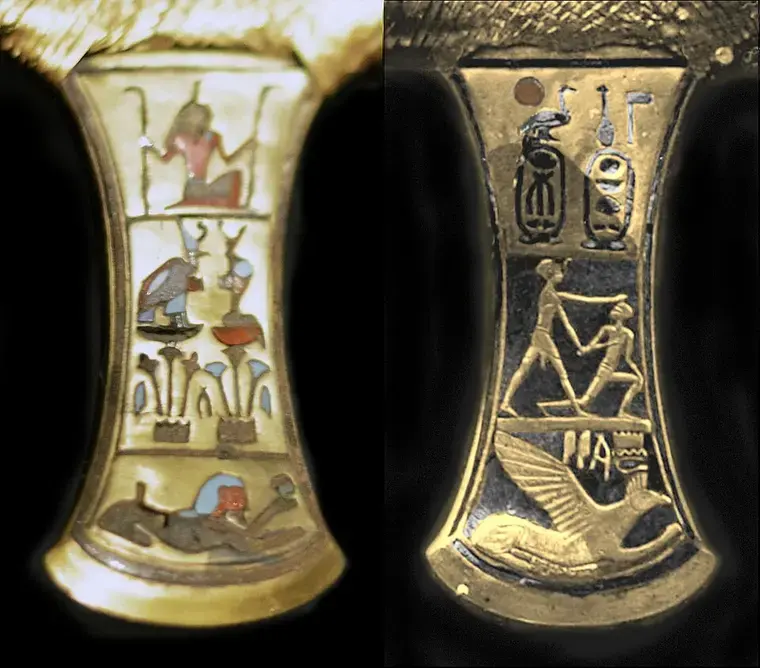
Ancient Egypt was a society that began around 3150 BC and lasted until 30 BC, when it was invaded by the Romans.
Egypt grew along the Nile River and was at its most powerful in the 2nd millennium BC. Its land stretched from the Nile Delta to Nubia, a kingdom located mostly in present-day Sudan.
With the water from the Nile, crops were generally good. They were grown after the water from the Nile floods went down.
The Egyptians created a way of writing using hieroglyphics. They also built huge temples and tombs, traded with other areas, and had a powerful army.
Their religion had many gods, and its priests were powerful and rich. The Egyptian rulers, called pharaohs, were thought to be close to the gods.
History
People have lived along the Nile for a very long time, according to archaeologists, who study objects left by ancient people. The fertile flood plains of the Nile allowed people to begin farming. By the 10th millennium BC, the people in Egypt had begun growing cereal grains like wheat and barley.
Because they were farming, people stayed in one place, instead of living a nomadic lifestyle like their ancestors. Because they were settled, society became more complex. That was an important step in the history of human civilization.
This period in Egyptian history is called "predynastic," as it happened before the large dynastic kingdoms were formed.
By about 5500 BC, small tribes living in the Nile Valley had developed into a series of cultures. Each had begun farming crops and animals. Each had its own types of pottery and personal items such as combs, bracelets, and beads. In Upper Egypt, the southern part of the country, the Badarian was one of the earliest cultures. It is known for its high-quality pottery, stone tools, and its use of copper. It was followed by the Amratian and the Gerzian cultures.
First Intermediate Period (7th to 11th Dynasties, 2180 – 2050 BC)
Government
Ancient Egypt was divided into many different districts, called sepats. The first divisions were created during the Predynastic Period, but they became small city-states that ruled themselves.
When the first pharaoh came to power, the sepats remained and were much like the counties in many countries today. They stayed basically the same for a long time. There were 42 of them, and each was ruled by a governor, chosen by the pharaoh. In later years. the districts were called nomes, and the governor was called a nomarch.
Ancient Egypt had many different taxes, but there was no real money and so people paid each other with goods or work. The person who watched the tax collection was a scribe, and all of the tax collectors in Egypt had to state every day how many taxes they had collected.
People paid different taxes based on the work that they did; for example, craftsmen paid in goods, and hunters and fishermen paid with food. Every household in the country paid a labour tax every year by helping with work for the country like mining or working on canals. Many rich Egyptians paid poorer people to do the work for them.
Language
This language has been found on pottery carvings. "Archaic" means very old.
This language was used during the Old Kingdom and the First Intermediate Period. It has been found in pyramids and Egyptian tombs. It was the first version of the language to use the plural, which shows that people were discussing more than one object at a time.
This language is called Classic Egyptian. It has been found all over objects and tombs in Egypt, including Egyptian coffins. Books on science and society were written during this time, and many of the things that are known about religion of the time are written in Classic Egyptian. Even after people stopped speaking this kind of Egyptian, writers still used it when they wrote books.
This is the language of the New Kingdom, which was the best time in Egypt's history. Much knowledge was shared during this time, and so many very old books were found that were written in Late Egyptian. Many people believe that this version of the language was much like what the Egyptians spoke.
Writing
Egypt had writing called hieroglyphics, which is one of the two oldest written languages in history. (The other is Sumerian cuneiform.) Hieroglyphic writing dates to c. 3200 BC and has around 500 symbols. A hieroglyph represents a word, a sound, or a symbol to show what the sign means. The same symbol can serve different purposes in different contexts.
Hieroglyphs on stone monuments and in tombs were for public purposes. It was art and often propaganda.
Priests used this script for everyday writing on papyrus, wood, or cloth. It was a cursive form of writing, called hieratic, which was quicker and easier to write.
Formal hieroglyphs may be read in rows or columns in either direction but are typically written from right to left. Hieratic was always written from right to left, usually in horizontal rows.
This was the script that ordinary people used and became the main writing style in ancient Egypt. This form of writing and formal hieroglyphs accompanies the Greek text on the Rosetta Stone.
Literature
Some ancient Egyptian literature has survived to the present day. There are teaching texts such as the Maxims of Ptahhotep, the Instructions of Amenemope, and the Ebers papyrus. The Ebers papyrus is one of the earliest medical texts ever found.
A poem about the ruin of Egyptian society--some think it is about the story in Exodus, a book in the Jewish/Christian Bible.
A series of stories about the Pharaoh Khufu told by his sons.
An ancient adventure story about a priest who goes to collect gifts from a king.
Religion
Religion was very important to Ancient Egyptians. The centre of any Egyptian town was the temple, a building that was used for everything from the town hall to a university, in addition to its religious services.
Because they were so religious, Egyptians created much art depicting many different kinds of divine (holy) creatures, including the pharaoh, who was thought to be a god.
The afterlife was also very important to Egyptians, who are known for mummifying their dead. The mummies are important to scientists today because they provide information about how the Egyptians lived.
All of the gods were important, but some were more important than others.
Isis was the goddess of the sky. Another major god was Ra, who was the god of the sun. The less well-known god of the Nile and crocodiles was named Sobek, which is a rather unusual name.
Agriculture
The rich fertile soil came from annual floodings of the Nile River. The ancient Egyptians produced plenty of food, which allowed the population to devote more time and resources to cultural, technological, and artistic pursuits. Ancient Egyptian taxes were assessed based on the amount of land a person owned.
Most animals were kept as food. Some animals were kept as pets. All kinds of animals were important to Egypt. Ancient Egyptians understood the animals that they kept: goats, pigs, ducks, cows, and geese.
Farming in Egypt depended on the cycle of the Nile. The Egyptians recognized three seasons: Akhet (flooding), Peret (planting), and Shemu (harvesting). The flooding season lasted from June to September. The flooding on the river's banks left a layer of mineral-rich silt ideal for growing crops.
After the floodwaters had receded, the growing season lasted from October to February. Farmers plowed and planted seeds in the fields, which were irrigated with ditches and canals. Egypt receives little rainfall and so farmers relied on the Nile to water their crops.p514
From March to May, farmers used sickles to harvest their crops, which were then threshed with a flail to separate the straw from the grain. Winnowing removed the chaff from the grain, which was then ground into flour, brewed to make beer, or stored for later use.p506
Text adapted from the Simple English Wikipedia article “Ancient Egypt” (revision 10895630, 2026-06-22), authors, licensed under CC BY-SA 4.0.