Nouns That Start With A, F or Any Letter
Choose a first letter and see the nouns that start with it, common words first. Narrow the list to animals, food, people, places, plants or other categories.
584 nouns start with A — 422 common. Showing the 120 most common.
Made with Crossword Print · crosswordprint.com/nouns-that-start-with/
Nouns That Start With is a free tool that lists English nouns beginning with the letter or letters you choose, such as nouns that start with F, nouns beginning with A, or nouns starting with B. It runs in your browser and needs no sign-up. The list opens on the most common nouns starting with A, so results appear as soon as the page loads. You can narrow the list by a longer starting pattern, an ending, word length, or a noun category, which helps when you need animals that start with a letter or foods that start with a letter. Teachers, writers, puzzle makers and word-game players can all use it to build quick lists.
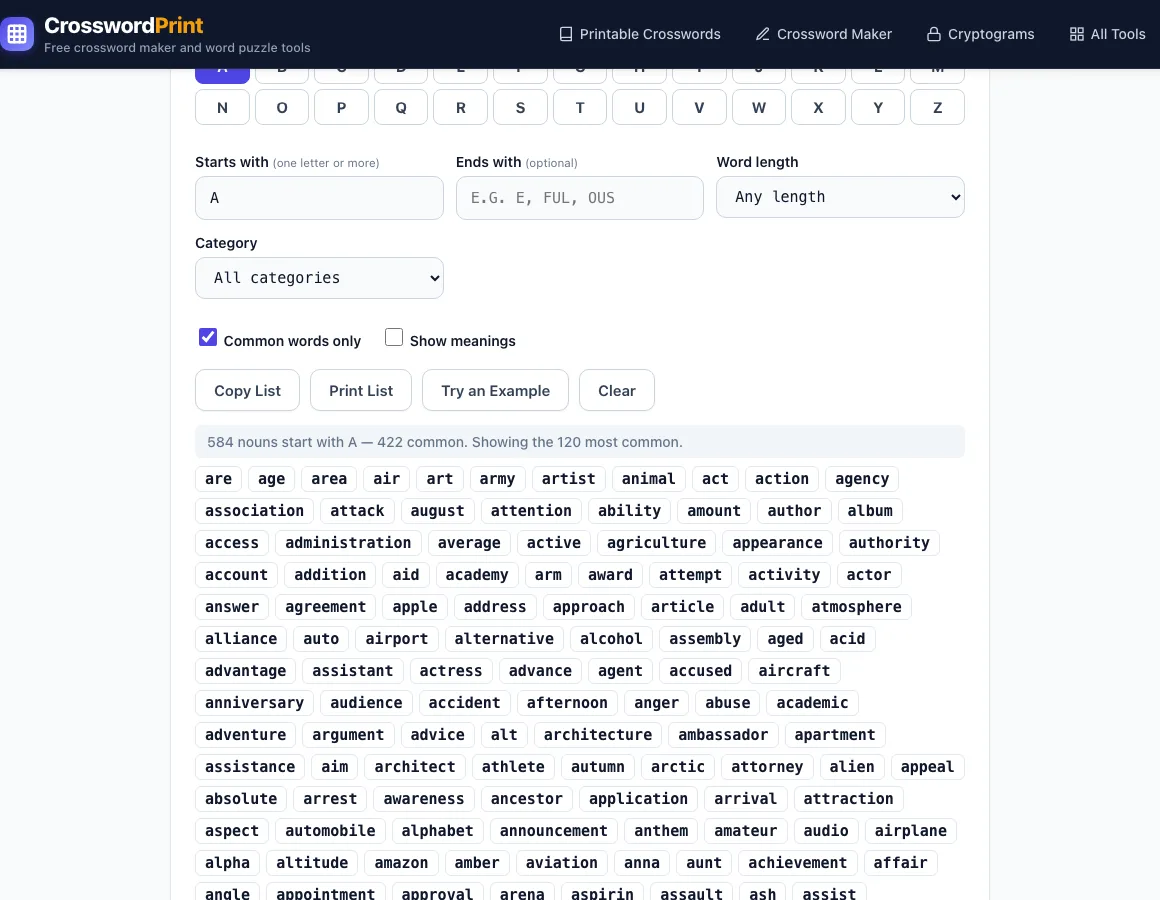
How to use the Nouns That Start With tool
- Pick a letter with the A–Z letter chips at the top of the tool.
- To narrow the beginning further, type up to 6 letters in the “Starts with” box, such as “th” or “un”.
- To match an ending, type up to 6 letters in the “Ends with” box, such as “ful” or “ous”.
- Open the “Word length” select and choose Any length, 3 to 11 letters, or 12 or more.
- Open the Category select and choose a noun group: people, animals, food & drink, plants, places, things we make & use, body, feelings, nature & weather, or All categories.
- Keep “Common words only” on to hide rare words, or turn it off to see every match.
- Turn on “Show meanings” to put a short definition under each word.
- Read the count line, then scroll the list. Tap any word to see its part of speech and up to 2 meanings. Press “Show all” to see past the first 400 words.
Copy List copies the words one per line. Print List opens a sheet with a title that matches your filters, in 4 columns, with meanings in 2 of them. Try an Example fills in a sample search, and Clear resets everything. Your search is saved in the address bar, so a bookmarked or shared link opens the same list. Printed lists are free for commercial use too, for example in KDP books or Etsy printables.
What is a noun? (person, place, thing, idea)
A noun names a person, place, thing or idea. Examples include teacher (person), city (place), kite (thing) and freedom (idea). This tool lists only nouns, so every word you see names something you could point to or think about.
The list is built from WordNet 3.0, a lexical database from Princeton University that labels each word’s part of speech. A word is kept only if WordNet treats it as a noun and it also appears in the tool’s 54,000-word English list. Words WordNet mainly treats as verbs or adjectives are left out, even when they can also be nouns. Plurals are left out too, so you will see “cat” but not “cats.”
Common vs proper nouns: why are proper nouns left out?
A common noun names a general thing, like dog, river or village. A proper noun names one specific person, place or thing, and is written with a capital letter, like Paris or Sarah. Proper nouns, meaning names of people and places, are not listed here, so a search for nouns starting with P will show words like pencil and planet, not Paris or Peter.
The “Common words only” setting, which is on by default, hides rare words. The total is 8,850 nouns, and 6,447 of them are common. Turn the setting off when you want the full set, including uncommon words that are harder to use in everyday writing.
Nouns that start with a letter by category
Pick a letter, then choose a group in the Category menu: people, animals, food & drink, plants, places, things we make & use, body, feelings, or nature & weather. The list then shows only nouns of that kind, such as the animals that start with K: kitten, koala, kiwi, kangaroo and kookaburra. This is handy for alphabet books, classroom games and quick quizzes. The groups come from WordNet, which files each sense of a noun under one category, so a word with several meanings can land in a group you did not expect.
Frequently asked questions
Can I find animals that start with a letter?
Yes. Choose a letter, then pick “animals” in the Category select. For K, the common animal nouns are kitten, koala, kiwi, kangaroo and kookaburra.
Can I use this for Scattergories or Categories?
Yes. Pick a letter and a category such as animals, food & drink or places, then print or copy the list. Category labels come from WordNet and are mostly, but not always, correct, so check any word that looks out of place before you play.
Why isn’t a word I expected in the list?
Words are left out if they are plurals, proper names, or mainly verbs or adjectives. Rare words are also hidden while “Common words only” is on. Turn that setting off to see more matches.
Is what I type sent anywhere?
No. The tool runs in your browser, and nothing you type is sent anywhere.
How many nouns start with a given letter?
The count line under the results shows the number for your search. For example, 599 nouns start with A, with 437 of them common. N has 163 nouns, with 131 common, and K has 63, with 49 common.
Can I use the printed noun lists for commercial purposes, such as Amazon KDP or Etsy?
Yes. Lists you make here are free to use for any purpose, including classroom packs, KDP activity books, Etsy printables and print-on-demand products, royalty-free and with no attribution needed. The only limit is that you may not copy the tool itself to run a competing service.
Related tools
- Adjectives That Start With: Use it when you need describing words instead of naming words.
- Verbs That Start With: Use it to find action words for a letter-based game or lesson.
- Words That Start With: Use it when you want every word type for a letter, not just nouns.
- Acrostic Poem Generator: Use it to build a poem where each line starts with a letter from your word.
- Random Word Generator: Use it to pull unexpected words for a writing prompt or game.
- Word Finder: Use it when you know some letters or patterns and need matching words.
- Syllable Counter: Use it to check how many syllables a noun has, for poems or rhythm.
- 5 Letter Words: Use it for word puzzles that require exactly five letters.
About nouns
In grammar, a noun is a word that represents a concrete or abstract thing, like living creatures, places, actions, events, qualities, states of existence, and ideas. To summarize this, nouns signify an object or idea. A noun may serve as an object or subject within a phrase, clause, or sentence.
In linguistics, nouns constitute a lexical category (part of speech) defined according to how its members combine with members of other lexical categories. The syntactic occurrence of nouns differs among languages.
In English, prototypical nouns are common nouns or proper nouns that can occur with determiners, articles and attributive adjectives, and can function as the head of a noun phrase. According to traditional and popular classification, pronouns are distinct from nouns, but in much modern theory they are considered a subclass of nouns. Every language has various linguistic and grammatical distinctions between nouns and verbs.
Classification
Nouns can have a number of different properties and are often sub-categorized based on various of these criteria, depending on their occurrence in a language. Nouns may be classified according to morphological properties such as which prefixes or suffixes they take, and also their relations in syntax – how they combine with other words and expressions of various types.
Many such classifications are language-specific, given the obvious differences in syntax and morphology. In English for example, it might be noted that nouns are words that can co-occur with definite articles (as stated at the start of this article), but this could not apply in Russian, which has no definite articles.
In some languages common and proper nouns have grammatical gender, typically masculine, feminine, and neuter. The gender of a noun (as well as its number and case, where applicable) will often require agreement in words that modify or are used along with it. In French for example, the singular form of the definite article is le for masculine nouns and la for feminine; adjectives and certain verb forms also change (sometimes with the simple addition of -e for feminine). Grammatical gender often correlates with the form of the noun and the inflection pattern it follows; for example, in both Italian and Romanian most nouns ending in -a are feminine. Gender can also correlate with the sex or social gender of the noun's referent, particularly in the case of nouns denoting people (and sometimes animals), though with exceptions (the feminine French noun personne can refer to a male or a female person).
In Modern English, even common nouns like hen and princess and proper nouns like Alicia do not have grammatical gender (their femininity has no relevance in syntax), though they denote persons or animals of a specific sex. The gender of a pronoun must be appropriate for the item referred to: "The girl said the ring was from her new boyfriend, but he denied it was from him" (three nouns; and three gendered pronouns: or four, if this her is counted as a possessive pronoun).
A proper noun (sometimes called a proper name, though the two terms normally have different meanings) is a noun that represents a unique entity (India, Pegasus, Jupiter, Confucius, Pequod) – as distinguished from common nouns (or appellative nouns), which describe a class of entities (country, animal, planet, person, ship). In Modern English, most proper nouns – unlike most common nouns – are capitalized regardless of context (Albania, Newton, Pasteur, America), as are many of the forms that are derived from them (the common noun in "he's an Albanian"; the adjectival forms in "he's of Albanian heritage" and "Newtonian physics", but not in "pasteurized milk"; the second verb in "they sought to Americanize us").
Text adapted from the Wikipedia article “Noun” (revision 1358395188, 2026-06-08), authors, licensed under CC BY-SA 4.0. Shortened: some sections and paragraphs were left out, and reference markers, images and templates were removed; wording is otherwise unchanged. This text remains available under the same licence.