Morse Code Translator
Type text or dots and dashes and the translation appears as you type. Play it as sound, save a WAV, or let the page listen to a Morse recording.
Play it as sound
Decode Morse from sound
Works on a clear beep from one steady tone, such as a recording, a practice file, or another device playing Morse. Noisy radio, speech or music in the background can fail.
Morse heard:
Key it in (reading Morse from a picture)
The tool cannot read a picture for you. Look at the dots and dashes in your picture and tap them in here: the text appears as you go.
Decoded:
Morse Code Chart
Dot = 1 unit, dash = 3 units, gap inside a letter = 1, between letters = 3, between words = 7.
The Morse Code Translator is a free Morse code decoder and generator: it converts plain text into Morse code and Morse code back into readable text. It runs entirely in your browser, and needs no sign-up. The result updates live as you type, so you can translate English to Morse code or check a Morse message letter by letter.
You can also play Morse as sound, download it as a WAV file, or decode a recording of Morse code. Letters, numbers and common punctuation all have codes, so it doubles as a Morse code number translator. To decipher Morse from an image, read the dots and dashes and tap them into the key-it-in panel; the page cannot scan pictures itself.
How to use the Morse Code Translator
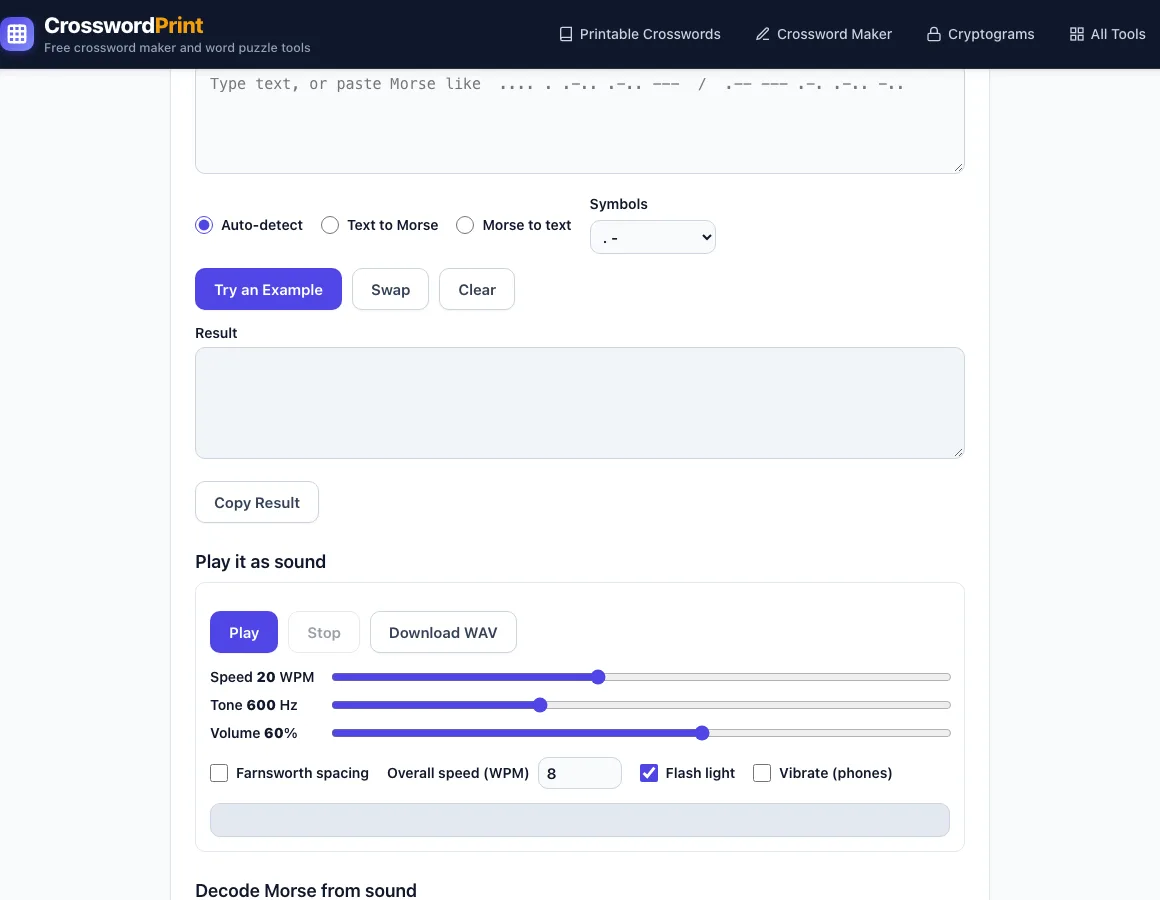
- Type or paste into the box labelled “Your text or Morse code”. The output appears as you type.
- Leave Direction set to “Auto-detect” (the default). Input made only of dots, dashes, spaces, “/”, “|”, “#” and line breaks is read as Morse. Anything else is read as text.
- To force a direction, pick “Text to Morse” or “Morse to text” from the Direction radios.
- Choose a style from the “Symbols” select: “. -”, “• −” or “· —”.
- Check the output. In Text to Morse, letters are separated by a space and words by " / “. In Morse to text, a word break can be “/”, “|”, three or more spaces, or a newline.
- To hear the Morse, press “Play”. Set Speed (5–40 WPM, default 20), Tone (400–1000 Hz, default 600) and Volume (default 60%) first if you want.
- To keep the audio, press “Download WAV” to save morse-code.wav.
- To decode a recording, press “Choose Audio File” (WAV, MP3, OGG or M4A) or “Listen with Microphone”. Then press “Use in Translator” to copy the heard Morse into the main box.
“Try an Example” rotates through three samples, “Swap” exchanges input and output, “Clear” empties the box, and “Copy Result” copies the output. “Print Chart” prints a Morse chart with the timing rules.
How does Morse code work (dots, dashes, timing units)?
Morse code represents each character as a pattern of short signals (dots) and long signals (dashes). It was developed in the 1830s and 1840s for the electric telegraph, with Samuel Morse and Alfred Vail associated with its early form.
Timing is measured in units. A dot lasts 1 unit and a dash lasts 3 units. The gap between parts of a letter is 1 unit, the gap between letters is 3 units, and the gap between words is 7 units. The standard word PARIS is 50 units long, so at 20 WPM one unit lasts 1200 ÷ 20 = 60 ms.
What is the Morse code alphabet (letters and numbers)?
The International (ITU) code covers A–Z, 0–9 and these punctuation marks: . , ? ’ ! / ( ) & : ; = + - _ " $ @. Short codes are easiest to learn: E is “.” and T is “-”, while A is “.-”, N is “-.” and S is “…”. Numbers are five symbols long, so 0 is “—–” and 1 is “.—-”.
The tool also gives accented letters Ä, Ö, Ü, É, Ñ, À and Ç a code. Characters with no code appear as “#”.
What does SOS look like in Morse code?
SOS is “… — …”, three dots, three dashes and three dots. It is the distress signal, and it is sent as one run-together group with no letter gaps, so it is a single prosign rather than three separate letters.
In the tool, type
Is this the international Morse code?
Yes. The tool uses International (ITU) Morse for letters, numbers and the punctuation listed above. It also accepts prosigns such as
Older versions of the code exist, such as American Morse, which uses different patterns. Check a chart if you are working with an older source.
How do I decode Morse code by sound or from an audio file?
The decoder finds the tone frequency by itself. It then measures how long each beep and silence lasts, separates dots from dashes and works out the speed. It shows “Heard text”, the Morse it heard, and a line such as “Tone about 600 Hz, speed about 20.0 WPM”. You can type a value in the optional Tone field, or leave it blank for automatic detection.
The decoder needs one clear tone. Noisy radio, speech or music usually fail.
How do I read Morse code from a picture?
The tool cannot read images. Instead, use the “Key it in” panel, which has Dot, Dash, Letter Gap, Word Gap and Backspace buttons. You can also press the large straight-key button: a short press makes a dot and a long press makes a dash. Space and Enter work too.
Set “Key speed” (5–40 WPM, default 12). Turn on “Add gaps automatically when I pause” if you want pauses to insert gaps. The decoded text updates as you go.
Can I download Morse code as audio?
Yes. Press “Download WAV” to save morse-code.wav, a 16-bit mono file at 22,050 Hz. Audio longer than 10 minutes is refused with a message, so split long texts into shorter parts.
Frequently asked questions
Is the Morse Code Translator free, and does it upload what I type?
Yes, it is free and needs no sign-up. It runs entirely in your browser, and nothing you type is sent to a server. It makes no external requests.
What happens to characters that have no Morse code?
They appear as “#” in the output, and the status line says “No Morse code for:” followed by the characters. Accented letters Ä, Ö, Ü, É, Ñ, À and Ç do have codes.
Why is my input read as text when I meant Morse?
Auto-detect only reads input as Morse when it contains nothing but dots, dashes (including • · – — _ variants), “/”, “|”, “#”, spaces and newlines. Any other character makes it read as text. Choose “Morse to text” from the Direction radios to force the translation.
What is Farnsworth spacing?
Farnsworth spacing keeps each character at your chosen speed but stretches the gaps between them. Set “Overall speed (WPM)” (default 8) to control how slow the whole message sounds. It is useful for learning, because you hear each character clearly and still have time to think between them.
Can I see or feel the Morse without sound?
Yes. “Flash light” is on by default and blinks a lamp bar in time with the signal. “Vibrate (phones)” works on phones where the browser supports it.
Can I translate other languages, such as Polish kod Morse’a?
The tool uses International Morse, so plain Latin letters work in any language. Of the accented letters, only Ä, Ö, Ü, É, Ñ, À and Ç have codes; others, such as Polish Ą or Ł, show as “#”.
Related tools
- Cipher Identifier: use it when you have encoded text and need to find out what kind of cipher it might be.
- Caesar Cipher: use it to shift letters by a fixed amount, a common beginner cipher.
- Atbash Cipher: use it to reverse the alphabet, so A becomes Z and B becomes Y.
- Pigpen Cipher: use it to convert letters into the grid-based symbols of the pigpen cipher.
- Polybius Square: use it to encode letters as coordinates in a 5×5 grid.
- Letter to Number Converter: use it to turn letters into their alphabet positions.
- Cryptogram Solver: use it when you have a substitution cipher and want help finding the letters.
- Cryptograms: use it to practise solving cryptogram puzzles.
About Morse code
Operator proficiency
Morse code speed is measured in words per minute (WPM) or characters per minute (CPM). Characters have differing lengths because they contain differing numbers of dits and dahs. Consequently, words also have different lengths in terms of dot duration, even when they contain the same number of characters. For this reason, some standard word is adopted for measuring operators' transmission speeds: Two such standard words in common use are and. Operators skilled in Morse code can often understand ("copy") code in their minds at rates in excess of 40 WPM.
In addition to knowing, understanding, and being able to copy the standard written alpha-numeric and punctuation characters or symbols at high speeds, skilled high-speed operators must also be fully knowledgeable of all of the special unwritten Morse code symbols for the standard Prosigns for Morse code and the meanings of these special procedural signals in standard Morse code communications protocol.
International contests in code copying are still occasionally held. In July 1939 at a contest in Asheville, North Carolina in the United States, Theodore Roosevelt McElroy set a still-standing record for Morse copying, 75.2 WPM. Pierpont (2004) also notes that some operators may have passed 100 WPM. By this time, they are "hearing" phrases and sentences rather than words. The fastest speed ever sent by a straight key was achieved in 1942 by Harry Turner (d. 1992) who reached 35 WPM in a demonstration at a U.S. Army base. To accurately compare code copying speed records of different eras it is useful to keep in mind that different standard words (50 dit durations versus 60 dit durations) and different interword gaps (5 dit durations versus 7 dit durations) may have been used when determining such speed records. For example, speeds run with the standard word and the standard may differ by up to 20%.
Today among amateur operators there are several organizations that recognize high-speed code ability, one group consisting of those who can copy Morse at 60 WPM. Also, Certificates of Code Proficiency are issued by several amateur radio societies, including the American Radio Relay League. Their basic award starts at 10 WPM with endorsements as high as 40 WPM, and are available to anyone who can copy the transmitted text. Members of the Boy Scouts of America may put a Morse interpreter's strip on their uniforms if they meet the standards for translating code at 5 WPM.
Through May 2013, the First, Second, and Third Class (commercial) Radiotelegraph Licenses using code tests based upon the standard word were still being issued in the United States by the Federal Communications Commission. The First Class license required 20 WPM code group and 25 WPM text code proficiency, the others 16 WPM code group test (five letter blocks sent as simulation of receiving encrypted text) and 20 WPM code text (plain language) test. It was also necessary to pass written tests on operating practice and electronics theory. A unique additional demand for the First Class was a requirement of a year of experience for operators of shipboard and coast stations using Morse. This allowed the holder to be chief operator on board a passenger ship. However, since 1999 the use of satellite and very high-frequency maritime communications systems (GMDSS) has made them obsolete. (By that point meeting experience requirement for the First was very difficult.)
Learning methods
People learning Morse code using the Farnsworth method are taught to send and receive letters and other symbols at their full target speed, that is with normal relative timing of the dits, dahs, and spaces within each symbol for that speed. The Farnsworth method is named for Donald R. "Russ" Farnsworth, also known by his call sign,. However, initially exaggerated spaces between symbols and words are used, to give "thinking time" to make the sound "shape" of the letters and symbols easier to learn. The spacing can then be reduced with practice and familiarity.
Another popular teaching method is the Koch method, published in 1936 by the German engineer and former Nazi stormtrooper Ludwig Koch, which uses the full target speed from the outset but begins with just two characters. Once strings containing those two characters can be copied with 90% accuracy, an additional character is added, and so on until the full character set is mastered.
In North America, many thousands of individuals have increased their code recognition speed (after initial memorization of the characters) by listening to the regularly scheduled code practice transmissions broadcast by, the station at the American Radio Relay League's headquarters or by listening to the archived recordings available at its website. the United States military taught Morse code as an 81 day self-paced course, having phased out more traditional classes.
Visual mnemonic charts have been devised over the ages. Baden-Powell included one in the Girl Guides handbook in 1918.
In the United Kingdom, many people learned the Morse code by means of a series of words or phrases that have the same rhythm as a Morse character. For instance, in Morse is dah dah di dah, which can be memorized by the phrase "God Save the Queen", and the Morse for is di di dah dit, which can be memorized as "Did she like it?"
Text adapted from the Wikipedia article “Morse code” (revision 1361967354, 2026-07-01), authors, licensed under CC BY-SA 4.0. Shortened: some sections and paragraphs were left out, and reference markers, images and templates were removed; wording is otherwise unchanged. This text remains available under the same licence.