Printable Daily Crossword Puzzle of the Day
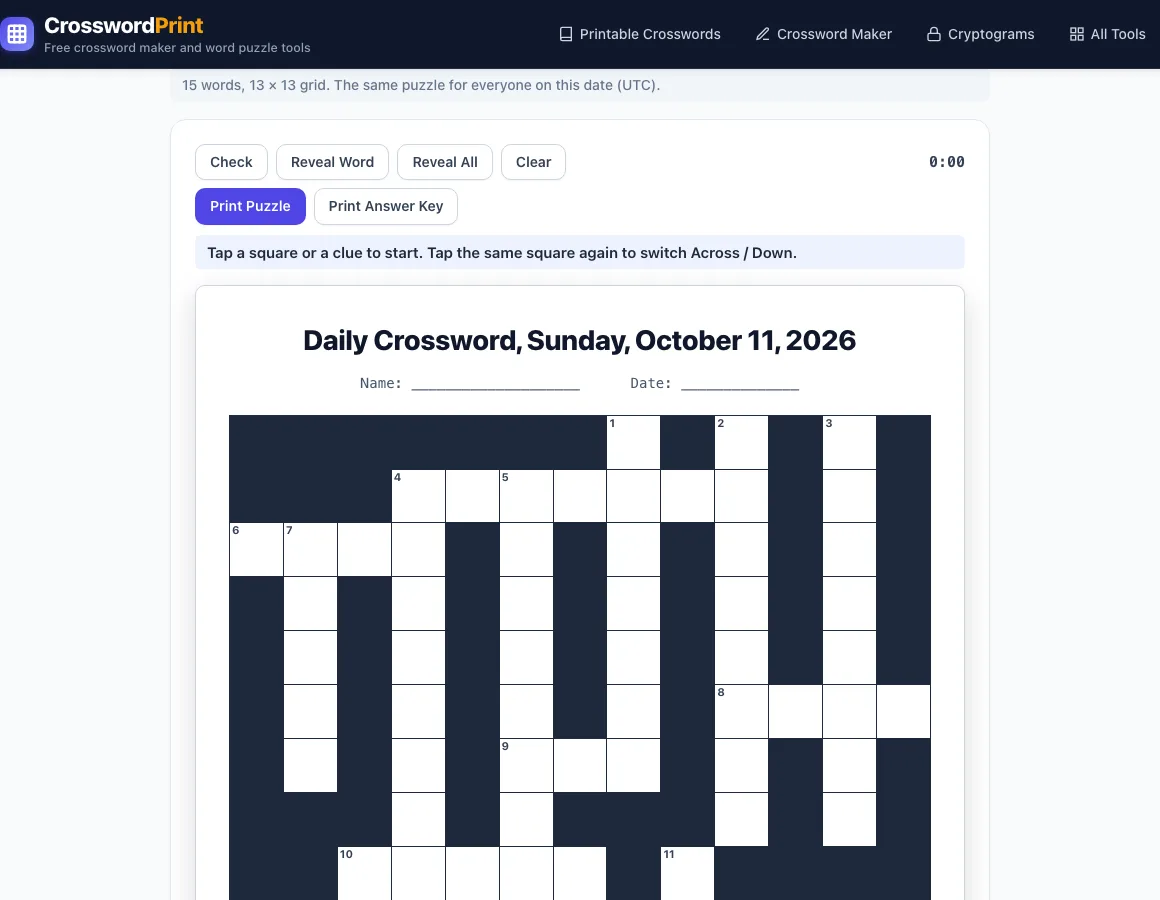
A new crossword every day, the same for everyone. Solve it on screen, print it with an answer key, or go back through the last 7 days.
Daily Crossword
Name: ____________________ Date: ______________
Across
Down
Daily Crossword · crosswordprint.com/daily-crossword/ · Clues: WordNet 3.0, Princeton University
Answer Key
Across
Down
Daily Crossword · crosswordprint.com/daily-crossword/ · Clues: WordNet 3.0, Princeton University
The Daily Crossword is a free, printable crossword puzzle of the day that runs in your browser. Everyone who opens it on the same UTC date gets the same puzzle, made of around 15 words in a grid of up to 13 by 13 squares. There is no sign-up and nothing to download, and it works on phone, tablet and computer. You can solve the puzzle on screen or print a clean sheet and an answer key, so it also works as a printable daily crossword for home or the classroom. The puzzle is built in your browser, and nothing you type is uploaded. The grid and answer key you print are free to use in classroom packs or in products you sell.
How to use the Daily Crossword
- Open the page. Today’s puzzle loads, and the date above the grid says “today, UTC”.
- Click or tap a square and type. The cursor moves along the word.
- Click the same square again, or press Space, to switch between Across and Down.
- Use the arrow keys to move around the grid, and press Tab to jump to the next word.
- Click a clue in the list to jump to its word. The current clue appears above the grid.
- Press Check to mark wrong letters in red and correct ones in green. It also reports how many squares are left.
- If you get stuck, press Reveal Word to fill in the selected word, or Reveal All to fill the whole grid. Clear empties the grid and resets the timer.
To try an earlier puzzle, use the date strip above the grid, which shows Today and the previous 7 days. To print, press Print Puzzle for the grid and clues, with a Name and Date line, or Print Answer Key for the filled grid and numbered answers. The sheets are set for US Letter, so choose A4 in the print dialog if you need it. Progress is not saved if you reload the page, so finish or print before you leave.
When does the daily crossword change?
The daily crossword changes at 00:00 UTC, not at your local midnight. The date is the seed the generator uses, so everyone who opens the page on the same UTC date gets the same puzzle. On US Eastern time that is 8 pm (EDT) or 7 pm (EST) the evening before, so the new puzzle can appear earlier in the day than you expect if you live west of the UK.
Can I print the crossword puzzle of the day?
Yes. Press Print Puzzle to print the title and date, a Name and Date line, the numbered grid and the Across and Down clues. Print Answer Key prints a separate page with the filled grid and the answers by number. Any puzzle in the 8-day archive can be printed too: open that day first, then press the print button.
Where do the words and clues come from?
The answers are everyday English words from this site’s own word list, picked at random from a pool of 3,380 common words of 3 to 10 letters, a mix of very common, familiar and harder ones. Plurals, -ed and -ing forms of other words, proper nouns and offensive words are left out. The clues are short definitions from WordNet 3.0, a dictionary database from Princeton University. A clue is dropped if it contains the answer or an obvious form of it, or if it is too short, too vague or contains digits. The number of letters is shown in brackets after each clue, for example “An open way for travel or transportation (4)” for ROAD.
Can I play yesterday’s crossword?
Yes, for the 7 days before today. The date strip shows eight puzzles in all, and each one is a link with the date in the address, such as /daily-crossword/?d=2026-10-04. A date outside that window, a future date or a malformed date shows today’s puzzle with a short note. There is only one page, not a separate page for each day.
How do I solve a crossword?
Start with the clues you are sure of. Write each answer into the grid across (left to right) or down, and remember that the number marks the first square of each answer. Where two answers cross they share one letter, so every word you solve gives you a letter for the word that crosses it. Move back and forth between across and down clues, and use Check once you have a few words filled in to catch mistakes early.
Frequently asked questions
Is the daily crossword free?
Yes. There is no sign-up, no account and no download. It works on phone, tablet and computer.
Can I use the puzzles commercially, for example on Etsy or Amazon KDP?
Yes. The grid, layout and answer key are free for commercial use, royalty-free, and need no credit. That covers uses such as Amazon KDP books, Etsy printables, classroom packs and Teachers Pay Teachers. The clues are WordNet 3.0 definitions, copyright Princeton University, used under a licence that allows any use without fee as long as the WordNet copyright notice stays with copies. The printed sheet has a footer crediting WordNet, and the full notice is on the Licences page. The only limit is that you may not copy the generator or site to run a competing service.
Is this the same as a newspaper crossword?
No. This is an independent crossword built from a word list: the words cross at shared letters, with numbered squares and black squares between them. It is not a copy of any newspaper puzzle and is not affiliated with any newspaper or publisher.
Does the Daily Crossword save my progress?
No. Progress is not saved if you reload the page. The timer starts with your first letter and stops with a “Solved!” message when the grid is correct.
Related tools
- Crossword Maker: use it when you want to build your own crossword from your own words and clues.
- Mini Crossword Maker: use it for a small, quick grid that suits a short classroom warm-up.
- Free Printable Crossword Puzzles: use it to browse ready-to-print crosswords for home or school.
- Crossword Solver: use it when you are stuck on a clue and need help finding a matching word.
- Cryptograms: use it for a different word puzzle where you decode a hidden quote letter by letter.
- Criss-Cross Puzzle Maker: use it to make a criss-cross grid from a list of words you choose.
- Word Finder: use it to look up words by letters, length or pattern when you need ideas for an answer.
About crossword puzzles
A crossword is a word game consisting of a grid of black and white squares with numbers on the corners, into which solvers enter words or phrases ("entries") crossing each other horizontally ("across") and vertically ("down") according to a set of clues. Each white square is typically filled with one letter, while the black squares are used to separate entries. The first white square in each entry is typically numbered to correspond to its clue.
Crosswords commonly appear in newspapers and magazines. The earliest crosswords that resemble their modern form were popularized by the New York World in the 1910s. Many variants of crosswords are popular around the world, including cryptic crosswords and many language-specific variants.
Crossword construction in modern times usually involves the use of software. Constructors choose a theme (except for themeless puzzles), place the theme answers in a grid which is usually rotationally symmetric, fill in the rest of the grid, and then write clues.
A person who constructs or solves crosswords is called a "cruciverbalist". The word "cruciverbalist" appears to have been coined in the 1970s from the Latin roots crucis, meaning 'cross', and verbum, meaning 'word'.
History
The phrase "cross word puzzle" was first written in 1862 by Our Young Folks in the United States. Crossword-like puzzles, for example Double Diamond Puzzles, appeared in the magazine St. Nicholas, published since 1873. Another crossword puzzle appeared on September 14, 1890, in the Italian magazine Il Secolo Illustrato della Domenica. It was designed by Giuseppe Airoldi and titled "Per passare il tempo" ("To pass the time"). Airoldi's puzzle was a four-by-four grid with no shaded squares; it included horizontal and vertical clues.
Crosswords in England during the 19th century were of an elementary kind, apparently derived from the word square, a group of words arranged so the letters read alike vertically and horizontally, and printed in children's puzzle books and various periodicals.
On December 21, 1913, Arthur Wynne, a journalist born in Liverpool, England, published a "word-cross" puzzle in the New York World that embodied most of the features of the modern genre. This puzzle is frequently cited as the first crossword puzzle, and Wynne as the inventor. An illustrator later reversed the "word-cross" name to "cross-word".
Crossword puzzles became a regular weekly feature in the New York World, and spread to other newspapers; the Pittsburgh Press, for example, was publishing them at least as early as 1916 and The Boston Globe by 1917.
By the 1920s, the crossword phenomenon was starting to attract notice. In October 1922, newspapers published a comic strip by Clare Briggs entitled "Movie of a Man Doing the Cross-Word Puzzle", with an enthusiast muttering "87 across 'Northern Sea Bird'!!??!?!!? Hm-m-m starts with an 'M', second letter is 'U'... I'll look up all the words starting with an 'M-U...' mus-musi-mur-murd—Hot Dog! Here 'tis! Murre!" In 1923 a humorous squib in The Boston Globe has a wife ordering her husband to run out and "rescue the papers... the part I want is blowing down the street." "What is it you're so keen about?" "The Cross-Word Puzzle. Hurry, please, that's a good boy." In The New Yorker inaugural issue, from 1925, the "Jottings About Town" section observed, "Judging from the number of solvers in the subway and 'L' trains, the crossword puzzle bids fair to become a fad with New Yorkers." In 1922, the New York Public Library reported that "The latest craze to strike libraries is the crossword puzzle", and complained that when "the puzzle 'fans' swarm to the dictionaries and encyclopedias so as to drive away readers and students who need these books in their daily work, can there be any doubt of the Library's duty to protect its legitimate readers?"
Text adapted from the Wikipedia article “Crossword” (revision 1359762625, 2026-06-17), authors, licensed under CC BY-SA 4.0. Shortened: some sections and paragraphs were left out, and reference markers, images and templates were removed; wording is otherwise unchanged. This text remains available under the same licence.