Cipher Decoder and Identifier
Paste a coded message and press Identify and Decode. You get the likely cipher types and the decoded readings, most English-like first.
Your text in numbers
Likely cipher types
Decoded readings, most English-like first
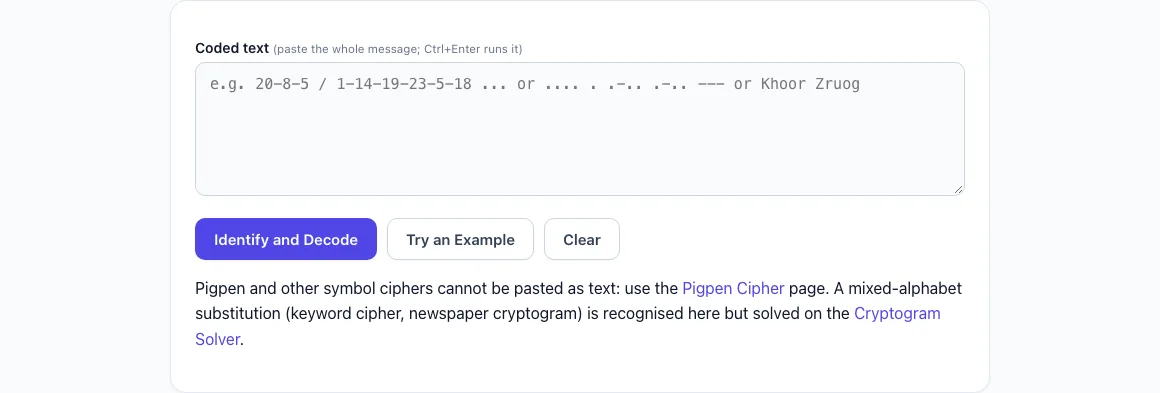
Pigpen and other symbol ciphers cannot be pasted as text: use the Pigpen Cipher page. A mixed-alphabet substitution (keyword cipher, newspaper cryptogram) is recognised here but solved on the Cryptogram Solver.
The Cipher Decoder and Identifier is a free cipher decoder that runs in your browser. Paste coded text, press Identify and Decode, and it tests the most common ciphers and codes, then ranks the readings by how English they look. No sign-up is needed, and nothing you type is sent to a server.
You do not need to know the cipher or the key. The tool tries Caesar shifts, Atbash, affine keys, Morse, A1Z26, binary, hex, Base64, Base32, Baconian, Polybius and tap code, rail fence, columnar transposition, and Vigenère and Beaufort.
Use it as a ciphertext decoder or cipher solver when you need to decipher codes from a puzzle, a geocache or an escape room, whether the clue says cipher or cypher. Simple substitution ciphers, such as keyword ciphers and cryptograms, are detected but sent to the cryptogram solver instead of being solved here.
How to use the Cipher Decoder and Identifier
- Paste your coded text into the box labelled Coded text. Use at least 25 letters where you can. Shorter texts give unreliable statistics, and the page warns you.
- Press Identify and Decode, or press Ctrl+Enter (Windows) or Cmd+Enter (Mac). If the box is empty, the page asks you to paste the coded text first.
- Read Your text in numbers. Check the length, letter count, characters used, the index of coincidence and the letter bar chart, where English frequencies are marked.
- Read Likely cipher types. Each guess has a confidence percentage and a reason. Where a dedicated tool exists, a link appears.
- Read Decoded readings, most English-like first. The top six are shown. Select Show all to see up to 40.
- Select Copy to keep a reading, or Open dedicated tool to continue with that cipher’s own page. Use the “N of M words recognised” figure to judge how English a result is.
- Select Clear to start again. Select Try an Example to load one of four rotating examples (Vigenère, rail fence, Morse or A1Z26).
The tool analyses only the first 5,000 characters and stops after about 3 seconds. For rail fence or columnar readings without spaces, it adds word breaks and labels them “word breaks added by the tool”.
How to identify a cipher (what kind of code is this)
Start by looking at the characters. Some codes are easy to recognise by their alphabet alone. Only dots and dashes means Morse. Only 0 and 1 in groups of 8 means binary. Digits 0–9 and letters A–F mean hex. Letters, digits, +, / and = at the end suggest Base64. Numbers from 1 to 26 mean A1Z26, and digit pairs from 11 to 55 suggest Polybius.
If the characters look like ordinary letters, check their frequencies. English letter frequencies that still give unreadable text point to transposition, such as rail fence or columnar. Flat frequencies point to a polyalphabetic cipher such as Vigenère.
What is the index of coincidence?
The index of coincidence is the chance that two letters picked at random from a text are the same. Ordinary English gives about 0.066 (between 0.065 and 0.068), and random letters give about 0.038. Substitution and transposition ciphers keep the English value, because they move or relabel letters without flattening their frequencies. Polyalphabetic ciphers like Vigenère push the value down toward 0.038–0.05.
How to decode a cipher without the key
Most classic ciphers can be broken without the key by testing every possible key and ranking the results by how English they look. A Caesar shift has only 25 keys, so each one can be tried. Affine keys are also a small set, and the tool tests all of them.
The ranking is what matters. A wrong key gives gibberish, and the right key gives words. The tool measures the share of words found in a 17,156-word list and combines it with letter-trigram statistics, which show how often three-letter groups appear in English.
How to solve a Vigenère cipher
A Vigenère cipher shifts each letter by a letter of a repeating key, so the same letter can be encrypted differently in different places. To solve it, first find the key length. Split the text into columns, one for each key position, and find the length where each column’s index of coincidence looks most like English.
Each column is then a simple Caesar-type shift. Find each key letter by comparing the column against English letter frequencies with chi-squared, then refine the whole key. This needs enough text, roughly 8 to 10 times the key length in letters. A 13-letter key in 60 letters usually fails.
How to decode a rail fence cipher
A rail fence cipher writes the message in a zigzag across a set number of rails, then reads the rows out one after another. It does not change the letters, so the English frequencies stay the same, but the words are scrambled. To decode it, try each rail count and starting offset, then keep the result that reads as English.
For example, the text WDDVNALAHW INENTIDAEI DWTALMRTEH IHTOEFUHHE CBHTEEFADK DPTTWETSOE NEHRNEAHS (spaced in groups of ten here for reading; the tool ignores the spaces) decodes with 4 rails to “WE FOUND THE HIDDEN CAVE BEHIND THE WATERFALL AND MARKED THE PATH WITH WHITE STONES”. The tool tries 2 to 10 rails with all offsets.
Why can it not solve my substitution cipher?
A simple substitution cipher replaces each letter with a fixed different letter, often from a scrambled keyword alphabet. Its index of coincidence looks like English, but its letter frequencies do not match English, and a Caesar shift cannot undo a scrambled alphabet. The tool detects this pattern and sends you to the cryptogram solver instead of guessing here.
Frequently asked questions
Is the Cipher Decoder free, and is my text uploaded?
Yes, it is free and needs no sign-up. It runs entirely in your browser, and nothing you type is sent to a server.
How accurate is this cipher decoder?
On 161 test ciphertexts across 21 types, built with our own encoders, the right type was in the top 3 every time, and the plaintext was recovered every time. Real messages may be harder, especially short ones.
Which ciphers are not supported?
Playfair, Hill, autokey, ADFGVX and Enigma are not attempted. Pigpen symbols cannot be pasted as text, so a note points you to the pigpen page.
Can it decode Base64 or hex?
Yes. It tries Base64, Base32, hex, binary and decimal ASCII automatically, and it can chain two steps, such as Base64 followed by a Caesar shift.
What is a Roman cipher?
A Roman cipher usually means the Caesar cipher, the shift cipher used by Julius Caesar. The tool tries all 25 Caesar shifts and labels ROT13 as a special case.
What does the confidence percentage mean?
It shows how strongly the tool favours that cipher type. Treat it as a ranking aid, and check the decoded text yourself to confirm the result.
Related tools
- Caesar Cipher: use it when you suspect a simple letter shift and want to try a specific shift.
- Atbash Cipher: use it when letters seem to be reversed in the alphabet (A becomes Z).
- Morse Code Translator: use it for text made only of dots and dashes.
- Polybius Square: use it for digit pairs from 11 to 55 or tap code.
- Pigpen Cipher: use it for messages written in pigpen symbols.
- Letter to Number Converter: use it to turn letters into numbers or numbers back into letters, as in A1Z26.
- Cryptogram Solver: use it for simple substitution ciphers, such as keyword ciphers and cryptograms.
- Cryptograms: use it to practise solving substitution puzzles.
- Playfair Cipher: use it when the text has an even number of letters, no doubled pairs and no J.
- Rail Fence Cipher: use it when the message has the right letters in a scrambled order.
About classical ciphers
In cryptography, a classical cipher is a type of cipher that was used historically but, for the most part, has fallen into disuse. In contrast to modern cryptographic algorithms, most classical ciphers are very simple to break with modern technology, and usually can also be solved by hand. The term includes the simple systems used since Greek and Roman times, the elaborate Renaissance ciphers, World War II cryptography such as the Enigma machine, and others.
Conversely, modern strong cryptography relies on new algorithms and computers developed since the 1970s.
Cryptanalysis of classical ciphers
Classical ciphers are commonly quite easy to break. Many of the classical ciphers can be broken even if the attacker only knows sufficient ciphertext and hence they are susceptible to a ciphertext-only attack. Some classical ciphers (e.g., the Caesar cipher) have a small key space. These ciphers can be broken with a brute force attack, that is by simply trying out all keys. Substitution ciphers can have a large key space, but are often susceptible to a frequency analysis, because for example frequent letters in the plaintext language correspond to frequent letters in the ciphertexts. Polyalphabetic ciphers such as the Vigenère cipher prevent a simple frequency analysis by using multiple substitutions. However, more advanced techniques such as the Kasiski examination can still be used to break these ciphers.
On the other hand, modern ciphers are designed to withstand much stronger attacks than ciphertext-only attacks. A good modern cipher must be secure against a wide range of potential attacks including known-plaintext attacks and chosen-plaintext attacks as well as chosen-ciphertext attacks. For these ciphers an attacker should not be able to find the key even if they know any amount of plaintext and corresponding ciphertext and even if they could select plaintext or ciphertext themselves. Classical ciphers do not satisfy these much stronger criteria and hence are no longer of interest for serious applications.
Some techniques from classical ciphers can be used to strengthen modern ciphers. For example, the MixColumns step in AES is a Hill cipher.
There are old real conversations encrypted with classical cipher that have been made public. Thus, a person interested in decrypting classical cipher can practice on real conversations.
Text adapted from the Wikipedia article “Classical cipher” (revision 1338688126, 2026-02-16), authors, licensed under CC BY-SA 4.0. Shortened: some sections and paragraphs were left out, and reference markers, images and templates were removed; wording is otherwise unchanged. This text remains available under the same licence.