Atbash Cipher Decoder and Encoder
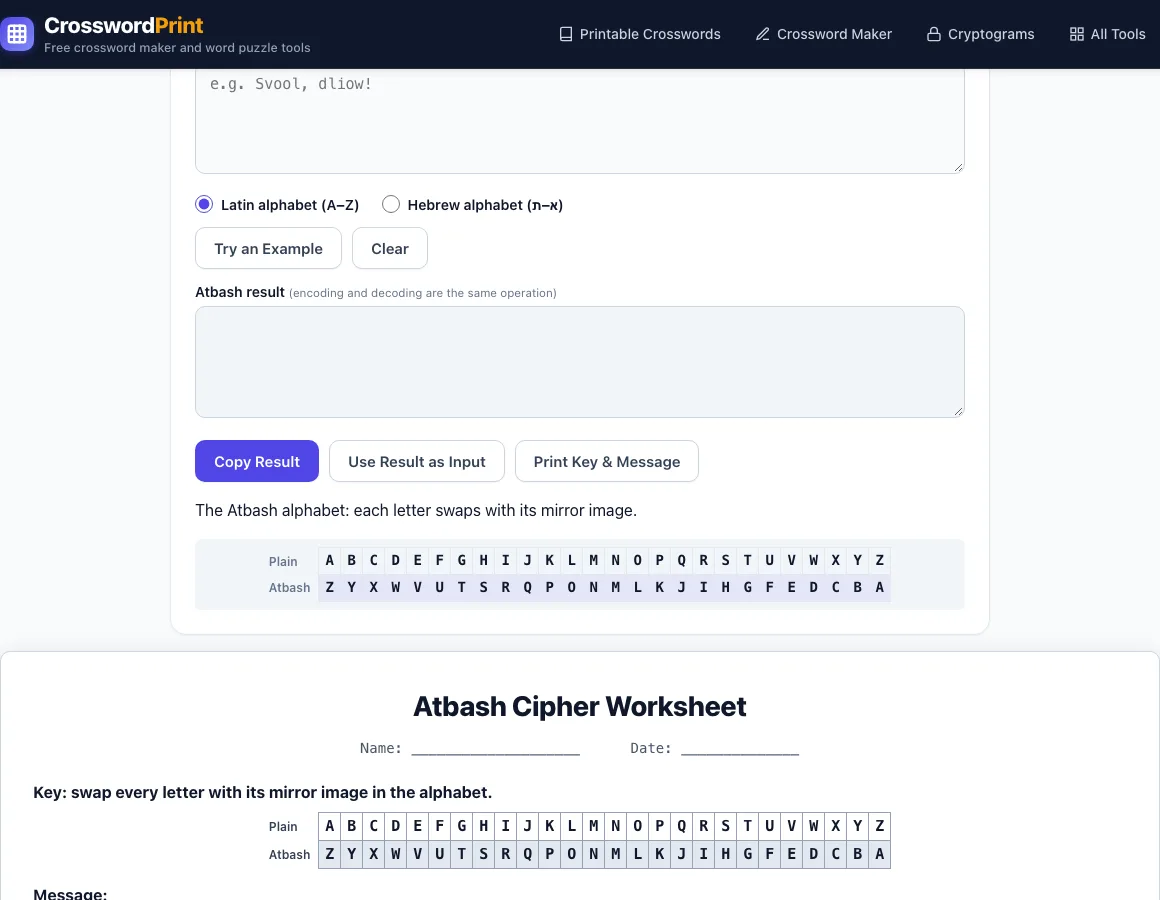
Type or paste your text. The Atbash result appears as you type, and the same step decodes a message or codes one.
The Atbash alphabet: each letter swaps with its mirror image. Hebrew final forms (ך ם ן ף ץ) are read as their base letters (כ מ נ פ צ), and the result is written in base letters.
Atbash Cipher Worksheet
Name: ____________________ Date: ______________
Key: swap every letter with its mirror image in the alphabet.
Message:
Write the answer here:
Made with Crossword Print · crosswordprint.com/atbash-cipher/
The Atbash cipher decoder and encoder is a free online tool for the Atbash code (Atbash for short), a substitution method that swaps each letter with its partner in the reversed alphabet: A becomes Z, B becomes Y, and so on. Type or paste text into the “Your text” box and the Atbash result updates as you type. You can choose the Latin alphabet (A–Z) or the Hebrew alphabet (א–ת). The tool runs entirely in your browser, needs no sign-up, and does not send anything you type to a server. It suits puzzles, class activities, and checking an Atbash message by hand.
How to use the Atbash Cipher
- Choose an alphabet. Latin alphabet (A–Z) is selected by default. Pick Hebrew alphabet (א–ת) for Hebrew text.
- Type or paste your message into the “Your text” box.
- Read the “Atbash result” box. It updates as you type.
- Check the Plain and Atbash rows under the result to see each letter’s partner.
- Click “Copy Result” to copy the output.
- To decode a message, paste the coded text into “Your text” and read the result.
- In Hebrew mode, read the note under the box: final letter forms such as ך and ם are changed as their base letters, so the result always uses base letters.
- Look at the status line. It shows “N letters converted”, or says nothing was changed when the text has no letters from the chosen alphabet.
“Try an Example” loads a sample message so you can see the output before using your own text. “Clear” empties the input. “Use Result as Input” moves the output into the input box, which is useful for checking a round trip. “Print Key & Message” prints a worksheet with the key table, the current coded message, three answer lines, and a Name/Date line, which works well as a classroom code-breaking sheet. The alphabet you choose is remembered the next time you visit.
The worksheets you print are free for home, classroom and commercial use, so you can put them in escape-room kits, teaching packs or printables you sell.
What is the Atbash cipher?
Atbash is a substitution cipher that replaces each letter with the letter in the mirror position of the alphabet. The first letter becomes the last, the second becomes the second-to-last, and so on. The Latin pairs are A–Z, B–Y, C–X, D–W, E–V, F–U, G–T, H–S, I–R, J–Q, K–P, L–O, and M–N.
How does the Atbash cipher work?
Count each letter’s position from 1 for A to 26 for Z. The coded letter sits at position 27 minus the original position, so A (position 1) becomes Z (26), and H (8) becomes S (19). Case, digits, spaces and punctuation stay as they are, and only letters change. For example, “Hello, World!” becomes “Svool, Dliow!”. Each capital or lowercase letter keeps its case, so H becomes S and e becomes v.
How to decode Atbash?
Decoding uses the same table, applied to the coded text. Find each coded letter in the Atbash row and read the Plain letter above it. Because the pairs work in both directions, you can use the same table either way. Try this coded line: “Sviv rh gsv Zgyzhs xrksvi: sld rg dliph!” Each word converts back to plain English, giving “Here is the Atbash cipher: how it works!” Working by hand, write the alphabet and the reversed alphabet on paper, one above the other, to check each letter quickly.
Is Atbash the same to encode and decode?
Yes. The mapping is its own reverse: if A becomes Z, then Z becomes A. Applying the cipher twice returns the original text. This means one procedure both encodes and decodes, so there is no separate decoding step.
What is Hebrew Atbash?
Hebrew Atbash applies the same mirror idea to the 22-letter Hebrew alphabet, pairing the first letter with the last. The name comes from the first, last, second and second-to-last Hebrew letters: Aleph, Tav, Beth and Shin. The Hebrew Bible contains an early example in the Book of Jeremiah, where “Sheshach” is read as Atbash for Babel (Babylon). The pairs begin with א–ת, ב–ש, ג–ר, and continue through the alphabet. For example, בבל (Babel) becomes ששכ (Sheshach).
Is Atbash secure?
No. Atbash has no key, so anyone who knows the method can read a message immediately. Even without knowing the method, a reader can often recover it by comparing letter frequencies. Atbash is used for puzzles, escape rooms, treasure hunts and teaching, where the aim is a fun challenge rather than protection. For private information, use a modern encryption tool instead.
Frequently asked questions
What happens to numbers, spaces and punctuation?
They stay exactly as typed. Only letters from the chosen alphabet are changed, and uppercase and lowercase letters keep their case.
Why does the status line say nothing was changed?
The text contains no letters from the alphabet you selected. For example, English text in Hebrew mode has no letters to convert. Switch to the other alphabet and try again.
Is Atbash the same as ROT13?
No. ROT13 shifts each letter 13 places along the alphabet, while Atbash mirrors each letter. Both are their own reverse, so each one encodes and decodes with the same steps.
How is Atbash different from the Caesar cipher?
The Caesar cipher shifts every letter by a fixed number of places, which can be changed as a key. Atbash uses a fixed mirror pairing with no adjustable key.
Is the Atbash cipher decoder free, and is my text uploaded?
It is free and needs no account. Everything runs in your browser, and nothing you type is sent to a server.
Can I use Atbash in a classroom?
Yes. Print Key & Message creates a worksheet with the key table, a coded message, three answer lines and a Name/Date line for students to fill in.
Can I sell Atbash code worksheets on Etsy or in a KDP book?
Yes. The key table and coded message you print are royalty-free for personal, classroom and commercial use, including Etsy printables, KDP activity books, Teachers Pay Teachers and print-on-demand products. No credit is required, and the only limit is copying the tool itself to run a competing service.
Related tools
- Caesar Cipher: Use it when you want a cipher that shifts letters by a set number.
- Cipher Identifier: Use it when you have coded text and want to find out which cipher made it.
- Pigpen Cipher: Use it to convert letters into symbols based on grid shapes.
- Polybius Square: Use it to encode letters as pairs of row and column numbers.
- Morse Code Translator: Use it to convert text to dots and dashes and back.
- Letter to Number Converter: Use it to turn each letter into its alphabet position number.
- Cryptogram Solver: Use it when a substitution puzzle has a mapping you need to work out.
- Cryptogram Maker: Use it to create your own substitution puzzle for others to solve.
About the Atbash cipher
Atbash (אתבש; also transliterated Atbaš) is a monoalphabetic substitution cipher originally used to encrypt the Hebrew alphabet. It can be modified for use with any known writing system with a standard collating order.
Encryption
The Atbash cipher is a particular type of monoalphabetic cipher formed by taking the alphabet (or abjad, syllabary, etc.) and mapping it to its reverse, so that the first letter becomes the last letter, the second letter becomes the second to last letter, and so on. For example, the ISO basic Latin alphabet would work like this:
Because there is only one way to perform this (which means there is only one possibility), the Atbash cipher provides no communications security, as it lacks any sort of key. If multiple collating orders are available, which one was used in encryption can be used as a key, but this does not provide significantly more security, considering that only a few letters can give away which one was used.
History
The name derives from the first, last, second, and second to last Hebrew letters (Aleph–Taw–Bet–Shin).
The Atbash cipher for the modern Hebrew alphabet would be:
By shifting the correlation one space to the left or the right, one may derive a variant Batgash (named for Bet–Taw–Gimel–Shin) or Ashbar (for Aleph–Shin–Bet–Reish). Either alternative mapping leaves one letter unsubstituted; respectively Aleph and Taw.
Several biblical words are described by commentators as being examples of Atbash:
Jeremiah 25:26 – "The king of Sheshach shall drink after them" – Sheshach meaning Babylon in Atbash ( bbl → ššk).
Text adapted from the Wikipedia article “Atbash” (revision 1327415366, 2025-12-14), authors, licensed under CC BY-SA 4.0. Shortened: some sections and paragraphs were left out, and reference markers, images and templates were removed; wording is otherwise unchanged. This text remains available under the same licence.