Adjectives That Start With Any Letter (A, E, S …)
Choose a first letter and see the adjectives that start with it, common words first. Narrow the list to positive words, words that describe a person, a length or an ending.
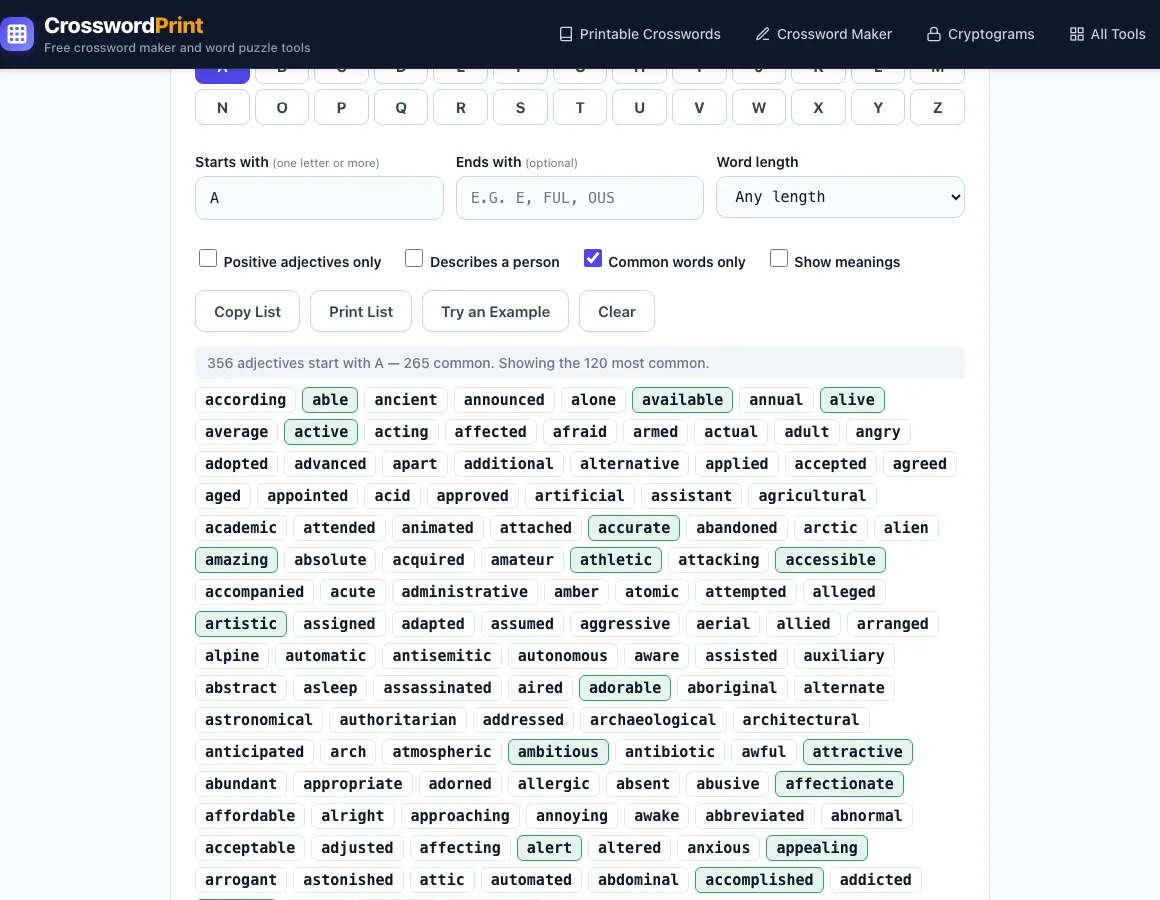
356 adjectives start with A — 265 common. Showing the 120 most common.
Made with Crossword Print · crosswordprint.com/adjectives-that-start-with/
Adjectives That Start With is a free tool that lists adjectives that start with the letter you choose, from A and E to Z, or with a longer beginning. Use it for an adjective that begins with any letter, for descriptive words that start with S, or for words that describe a person positively, such as words that start with A to describe someone you admire. It runs in your browser with no sign-up, and nothing you type is sent anywhere.
The word lists come from WordNet 3.0, Princeton’s lexical database, which labels each word’s part of speech. Words are kept only if they also appear in our 54,000-word English list, so you see words people actually use. Common words appear first. You can narrow results by length, ending, positive meaning, or whether a word describes a person.
How to use the Adjectives That Start With tool
- Click a letter chip from A to Z. The default is A, and the most common words starting with A appear as soon as the page loads.
- To search for a longer beginning, type up to 6 letters in the ‘Starts with’ box, such as ’th’ or ‘un’.
- To search by ending, type up to 6 letters in the ‘Ends with’ box, such as ‘ful’ or ‘ous’.
- Choose a ‘Word length’ option: Any length, 3 to 11 letters, or 12 or more.
- Leave ‘Common words only’ on to hide rare words, or turn it off to see every match.
- Tick ‘Positive adjectives only’ for clearly positive adjectives, or ‘Describes a person’ for words about personality, character or looks.
- Tick ‘Show meanings’ to put a short definition under each word. Tap any word to see its part of speech and up to 2 senses.
- Check the count line, then scroll the list. The first 400 words show. Press ‘Show all’ for the rest.
Copy List puts one word per line on your clipboard. Print List makes a sheet titled to match your search, such as ‘Positive Adjectives That Start With A’, in 4 columns, or 2 columns when meanings are included. Try an Example fills in a sample search, and Clear resets everything. Your search is saved in the address bar (for example, ?l=t&positive=1), so a bookmarked or shared link opens the same list. Printed lists are free for commercial use too, for example in KDP books or Etsy printables.
What is an adjective (describing word)?
An adjective is a word that describes a noun or pronoun. It tells you what kind, which one, or how many: a tall tree, a quiet room, she is kind. Many adjectives end in -ful, -ous, -ive, -able, -al or -y, as in careful, famous, creative, reliable, global and sunny.
How does the tool decide which words count as adjectives?
It uses WordNet 3.0 to check each word’s part of speech, then keeps only the words that also appear in our 54,000-word English list. Words that WordNet mainly treats as another part of speech are left out, and so are plurals and proper names. The full list holds 5,215 adjectives, and 3,817 of them are marked common.
What are positive adjectives that start with a letter, such as T?
Positive adjectives have a good or pleasant meaning. The tool uses its own hand-picked list of 461 clearly positive adjectives. Turn on ‘Positive adjectives only’ to show just those, or look at the full list, where positive words are tinted green. Starting with T, there are 20 positive adjectives, including true, tender, thoughtful, talented and tranquil.
What are adjectives that start with a letter to describe a person, such as N?
These adjectives describe personality, character or looks. Turn on ‘Describes a person’ to filter 633 adjectives. Starting with N, 20 adjectives that describe a person are listed, and they include both kind and less flattering words. Kind examples include nice, noble, neat, nimble and neighborly. Less flattering ones include naive, naughty, needy, nosy and nervous. The word alone does not tell you which it is, so check the meaning with ‘Show meanings’.
What adjectives that start with A have meanings?
Turn on ‘Show meanings’ to see a short WordNet definition under each word. Starting with A, the tool finds 356 adjectives (265 common). Tap any word to see its part of speech and up to 2 senses, which helps when two words look similar but mean different things.
Which adjectives work for an acrostic poem or name poem?
Write your name down the side of the page, one letter per line. For each letter, pick an adjective that starts with it. Type that letter in the ‘Starts with’ box, use ‘Word length’ to limit long words, and tick ‘Positive adjectives only’ for an upbeat poem or ‘Describes a person’ for a poem about character. Print List gives you a sheet to choose from, and the Acrostic Poem Generator can draft whole lines for you.
Are there adjectives that start with X or Z?
Very few. The tool lists only one common adjective starting with X, which is xenophobic. Turn off ‘Common words only’ to see the uncommon matches for any letter, including rare ones.
Frequently asked questions
Is Adjectives That Start With free, and do I need to sign up?
Yes. The tool is free, runs in your browser, and needs no sign-up.
Why does the list start with A when the page loads?
A is the default letter. The most common words starting with A show as soon as the page loads, and you can change the letter with the chips at any time.
Why are some adjectives missing from the list?
Words are left out if WordNet mainly treats them as another part of speech, or if they are plurals, proper names, or not in our 54,000-word English list.
Can I search for adjectives that start with two letters?
Yes. Type up to 6 letters in the ‘Starts with’ box, such as ’th’ or ‘un’.
How do I find adjectives ending in e?
Type e in the ‘Ends with’ box. You can also combine it with a starting letter, such as ‘b’ in ‘Starts with’ to find adjectives with letter b that end in e.
Is my search private?
Nothing you type is sent anywhere. Your search stays in your browser and in the address bar.
How can I keep or share my list?
Use Copy List to paste the words into another document, or Print List for a printed sheet. To share, send the link from the address bar. It opens the same search.
Can I use the printed adjective lists for commercial purposes, such as Amazon KDP or Etsy?
Yes. Lists you make here are free to use for any purpose, including classroom packs, KDP activity books, Etsy printables and print-on-demand products, royalty-free and with no attribution needed. The only limit is that you may not copy the tool itself to run a competing service.
Related tools
- Verbs That Start With: Use it when you need action words for a letter, such as for a word game or a writing prompt.
- Nouns That Start With: Use it when you want names for people, places or things beginning with a given letter.
- Words That Start With: Use it when you want every word type for a letter, not just adjectives.
- Acrostic Poem Generator: Use it to build a poem from a word or name, one line per letter.
- Random Word Generator: Use it when you want a surprise word to inspire a story or game.
- Word Finder: Use it to search for words that match letters or patterns you already know.
- Syllable Counter: Use it to check how many syllables a word has, for poems or rhythm.
- 5 Letter Words: Use it when you need exactly five-letter words for a puzzle.
About adjectives
An adjective (abbreviated ) is a word that describes or defines a noun or noun phrase. Its semantic role is to change information given by the noun.
The adjective is considered one of the main parts of speech of the English language, although historically they were classed together with nouns. Nowadays, certain words that usually had been classified as adjectives, including the, this, my, etc., typically are classed separately, as determiners.
That used to be an immensely funny idea. (Prepositive attributive)
Tell me something funny. (Postpositive attributive)
The good, the bad, and the funny. (Substantive)
Types of use
Depending on the language, an adjective can precede a corresponding noun on a prepositive basis or it can follow a corresponding noun on a postpositive basis. Structural, contextual, and style considerations can impinge on the pre-or post-position of an adjective in a given instance of its occurrence. In English, occurrences of adjectives generally can be classified into one of three categories:
Within a noun phrase, a prepositive adjective is antecedent to the head noun, which it modifies attributively. For example, in "I put my happy kids into the car", happy occurs on an antecedent basis within the my happy kids noun phrase (kids being its head), and is therefore a prepositive adjective.
Postpositive adjectives occur after the noun or pronoun they modify: within a noun phrase, immediately subsequent to the head noun or pronoun, which it modifies attributively, e.g. "The only room available cost twice what we expected"; in an adjacent appositive phrase, e.g. "My kid, happy as a clam, was already in the back seat"; or linked to the noun or pronoun via a copular, resultative, depictive or other linking mechanism, as a predicative adjective, e.g. "My kids are happy", "I wiped the table clean" and "We danced naked in the rain" (see Subject complement, Object complement).
Nominalized adjectives, which function as nouns. One way this happens is by eliding a noun from an adjective-noun noun phrase, whose remnant thus is a nominalization. In the sentence, "I read two books to them; he preferred the sad book, but she preferred the happy", happy is a nominalized adjective, short for "happy one" or "happy book". Another way this happens is in absolute phrases like "out with the old, in with the new", where "the old" means "that which is old" or "all that is old", and similarly with "the new". In such cases, the adjective may function as a mass noun (as in the preceding example). In English, it may also function as a plural count noun denoting a collective group, as in "The meek shall inherit the Earth", where "the meek" means "those who are meek" or "all who are meek".
Comparison (degrees)
In many languages, some adjectives are comparable and the measure of comparison is called degree. For example, a person may be "polite", but another person may be "more polite", and a third person may be the "most polite" of the three. The word "more" here modifies the adjective "polite" to indicate a comparison is being made, and "most" modifies the adjective to indicate an absolute comparison (a superlative).
Among languages that allow adjectives to be compared, different means are used to indicate comparison. Some languages do not distinguish between comparative and superlative forms. Other languages allow adjectives to be compared but do not have a special comparative form of the adjective. In such cases, as in some Australian Aboriginal languages, case-marking, such as the ablative case, may be used to indicate one entity has more of an adjectival quality than (i.e. from—hence ABL) another.
In English, many adjectives can be inflected to comparative and superlative forms by taking the suffixes "-er" and "-est" (sometimes requiring additional letters before the suffix; see forms for far below), respectively:
Some adjectives are irregular in this sense:
"many", "more", "most" (sometimes regarded as an adverb or determiner)
Text adapted from the Wikipedia article “Adjective” (revision 1355182032, 2026-05-20), authors, licensed under CC BY-SA 4.0. Shortened: some sections and paragraphs were left out, and reference markers, images and templates were removed; wording is otherwise unchanged. This text remains available under the same licence.