Acrostic Poem Generator
Type a name or word and a poem appears, one line for each letter. Shuffle or edit any line, then print it or get a blank worksheet.
Click a line to edit it, or press Shuffle on a line to swap it for another one.
Name: ______________________ Date: ______________
Poems made here are free to use for classrooms, cards, gifts and craft listings. Share this exact poem by copying the page address.
The Acrostic Poem Generator is a free acrostic generator that builds an acrostic poem from a word or name. Type a word into the Word or name box, and the tool writes one line for each letter, with every line starting with that letter, so the first letters read down the page as your word. It runs entirely in your browser, needs no sign-up, and does not send what you type to a server.
You can pick a theme, change the style, shuffle or edit any line, and print the result. It works as an acrostic name poem maker, an acrostic poem creator for classroom projects, and an acrostic maker for cards and gifts. A blank worksheet option gives you a printable acrostic poem template for writing your own lines.
How to use the Acrostic Poem Generator
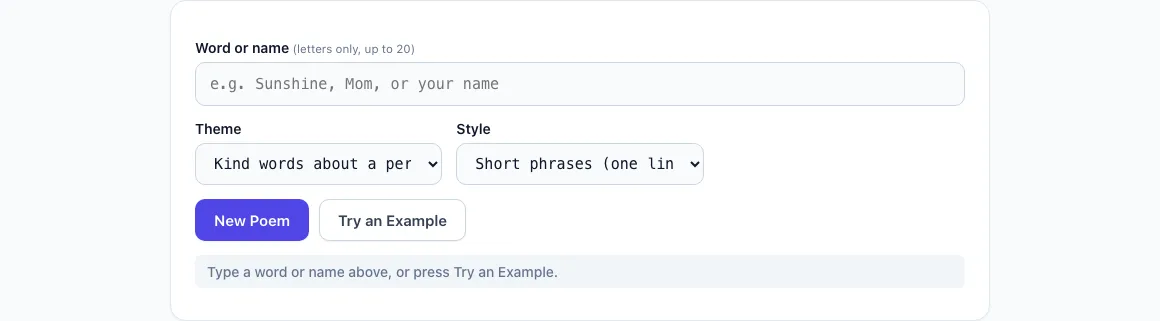
- Type a word or name in the Word or name box. Letters only, up to 20. Accents are removed, other characters are dropped, and any letters past 20 are cut, with a note.
- Read the poem that appears. It has one line per letter. A space or hyphen starts a new stanza, so Mary Ann shows a gap.
- Choose a Theme: Kind words about a person (the default), Love and friendship, Nature and seasons, or School and learning.
- Choose a Style: Short phrases (one line per letter, the default) or Single words (one adjective per letter).
- Click New Poem (or press Enter) for new lines. To try a ready-made example, click Try an Example, which loads SUNSHINE.
- Click Shuffle on any line to swap only that line for another that starts with the same letter. Repeated letters, such as the three A’s in BANANA, always get different lines.
- Click the text after a big letter to edit that line and type your own words.
- Add an optional Poem title of up to 60 characters. If you leave it empty, the word in capitals is used.
- Choose Print the poem or Blank worksheet (write your own lines), tick Page border if you want one, and press Print. Copy Text copies the title and lines.
Opening the address bar link (it looks like ?w=SUNSHINE&seed=…) shows the same poem for anyone you share it with. Hand edits and shuffles are not saved in the link.
What is an acrostic poem
An acrostic poem is a poem in which the first letter of each line spells out a word, name or message when you read down the page. It does not need to rhyme, and each line can be a single word, a phrase or a full sentence.
Acrostics are very old. They appear in Hebrew psalms, such as the alphabetic acrostics of Psalm 119, and in Latin and Greek verse. Lewis Carroll ended Through the Looking-Glass with an acrostic poem that spells out Alice Pleasance Liddell. The form is popular today because the letter pattern gives a writer a clear starting point. Variations hide the word elsewhere: in the last letter of each line (a telestich) or down the middle of the lines (a mesostich).
How to write an acrostic poem (steps)
To write an acrostic poem by hand:
- Write the word down the left side of the page in capitals.
- Brainstorm words about your subject for each letter.
- Write one line for each letter, starting that line with the letter.
- Read the poem aloud, then revise any line that sounds awkward.
Here is how the tool’s output for MOM, with the Nature theme and short phrases, reads:
Morning mist hangs over the lake Owls call softly in the night Moonlight silvers the meadow
For ZOE, with the Kind words theme and single words, the lines are Zippy, Outgoing and Energetic. Letters such as X, Q, Y and Z are the hardest to brainstorm by hand, so the tool covers all of them. Some X lines use playful “X-tra” spellings.
A few tips make any acrostic read better. Keep the lines roughly the same length, so the poem looks tidy on the page. Choose details that fit the person or subject rather than general praise. Read the poem aloud once, and change any line that breaks the rhythm.
Frequently asked questions
Is the acrostic poem generator free, and can I print the poem?
Yes. The tool is free, requires no sign-up, and has a Print button. A Blank worksheet option prints the big letters with ruled writing lines and a Name and Date line.
Can I use the poems for cards, classrooms or to sell on Etsy or KDP?
Yes. The phrase bank is our own writing, so the poems you make are free to use in classrooms, on cards and gifts, and in products you sell, such as Etsy printables or KDP books. No credit is required, and the only limit is copying the generator itself to run a competing service.
Does an acrostic poem have to rhyme?
No. The only rule is that the first letter of each line spells the word or name. Rhyme is optional, and the tool’s lines do not rhyme.
Can I make an acrostic name poem?
Yes. Type a first name, a full name or a nickname in the Word or name box, using up to 20 letters. A space or hyphen starts a new stanza, so each part of the name is shown separately.
Is what I type sent to a server?
No. The tool runs entirely in your browser, and nothing you type is sent to a server. A shared link only carries the word, theme, style and a random seed.
Is there a printable acrostic poem template for a class?
Yes. Choose Blank worksheet (write your own lines) to print the big letters with writing lines, which works well as a classroom acrostic poem template.
Related tools
- Rhyming Dictionary: Use it to find rhymes when you write the poem.
- Syllable Counter: use it to check how many syllables are in each line of your poem.
- Name Anagram Generator: use it to rearrange the letters of a name before you choose a word for a poem.
- Random Word Generator: use it when you need a fresh word to start an acrostic.
- Word Finder: use it to look up words that begin with a particular letter.
- Crossword Maker: use it to build a word puzzle from your own vocabulary list.
- Cryptogram Maker: use it to hide a short message in a substitution code for students to solve.
- Adjectives That Start With: use it to find a describing word for each letter of your poem.
- Verbs That Start With: use it to find an action word for a letter.
About acrostics
An acrostic is a poem or other word composition in which the first letter (or syllable, or word) of each new line (or paragraph, or other recurring feature in the text) spells out a word, message or the alphabet. The term comes from the French acrostiche from post-classical Latin acrostichis, from Koine Greek ἀκροστιχίς, from Ancient Greek ἄκρος "highest, topmost" and στίχος "verse". As a form of constrained writing, an acrostic can be used as a mnemonic device to aid memory retrieval. When the last letter of each new line (or other recurring feature) forms a word it is called a telestich (or telestic); the combination of an acrostic and a telestich in the same composition is called a double acrostic (e.g. the first-century Latin Sator Square).
Acrostics are common in medieval literature, where they usually serve to highlight the name of the poet or his patron, or to make a prayer to a saint. They are most frequent in verse works but can also appear in prose. The Middle High German poet Rudolf von Ems for example opens all his great works with an acrostic of his name, and his world chronicle marks the beginning of each age with an acrostic of the key figure (Moses, David, etc.). In chronicles, acrostics are common in German and English but rare in other languages.
Form
Relatively simple acrostics may merely spell out the letters of the alphabet in order; such an acrostic may be called an 'alphabetical acrostic' or abecedarius. These acrostics occur in the Hebrew Bible in the first four of the five chapters of the Book of Lamentations, in the praise of the good wife in Proverbs 31:10-31, and in Psalms 9-10, 25, 34, 37, 111, 112, 119 and 145.
Notable among the acrostic Psalms is the long Psalm 119, which typically is printed in subsections named after the 22 letters of the Hebrew alphabet, each section consisting of 8 verses, each of which begins with the same letter of the alphabet and the entire psalm consisting of 22 x 8 = 176 verses; and Psalm 145, which is recited three times a day in the Jewish services. Some acrostic psalms are technically imperfect. For example, Psalm 9 and Psalm 10 appear to constitute a single acrostic psalm together, but the length assigned to each letter is unequal and five of the 22 letters of the Hebrew alphabet are not represented and the sequence of two letters is reversed. In Psalm 25 one Hebrew letter is not represented, the following letter (Resh) repeated. In Psalm 34 the current final verse, 23, does fit verse 22 in content, but adds an additional line to the poem. In Psalms 37 and 111 the numbering of verses and the division into lines are interfering with each other; as a result in Psalm 37, for the letters Daleth and Kaph there is only one verse, and the letter Ayin is not represented. Psalm 111 and 112 have 22 lines, but 10 verses. Psalm 145 does not represent the letter Nun, having 21 one verses, but one Qumran manuscript of this Psalm does have that missing line, which agrees with the Septuagint. Some, like O Palmer Robertson, see the acrostic Psalms of book 1 and book 5 of Psalms as teaching and memory devices as well as transitions between subjects in the structure of the Psalms.
Often the ease of detectability of an acrostic can depend on the intention of its creator. In some cases an author may desire an acrostic to have a better chance of being perceived by an observant reader, such as the acrostic contained in the Hypnerotomachia Poliphili (where the key capital letters are decorated with ornate embellishments). However, acrostics may also be used as a form of steganography, where the author seeks to conceal the message rather than proclaim it. This might be achieved by making the key letters uniform in appearance with the surrounding text, or by aligning the words in such a way that the relationship between the key letters is less obvious. These are referred to as null ciphers in steganography, using the first letter of each word to form a hidden message in an otherwise innocuous text. Using letters to hide a message, as in acrostic ciphers, was popular during the Renaissance, and could employ various methods of enciphering, such as selecting other letters than initials based on a repeating pattern (equidistant letter sequences), or even concealing the message by starting at the end of the text and working backwards.
Text adapted from the Wikipedia article “Acrostic” (revision 1360972741, 2026-06-24), authors, licensed under CC BY-SA 4.0. Shortened: some sections and paragraphs were left out, and reference markers, images and templates were removed; wording is otherwise unchanged. This text remains available under the same licence.